Area Converter
Convert Between Metric & Imperial Units
Area Conversion Formula:
Show the calculatorTo convert between area units, multiply the original value by the conversion factor:
Conversion Factor = (Target Unit in Square Meters) / (Source Unit in Square Meters)
Common conversion factors:
- 1 square meter = 1 square meter
- 1 square kilometer = 1,000,000 square meters
- 1 hectare = 10,000 square meters
- 1 acre = 4,046.86 square meters
- 1 square mile = 2,589,988.11 square meters
- 1 square foot = 0.092903 square meters
- 1 square inch = 0.00064516 square meters
Example: To convert 5 acres to hectares: 5 × 0.404686 = 2.023 hectares
To convert from square meters to other units, divide by the conversion factor.
This ensures accurate conversions between all area units.
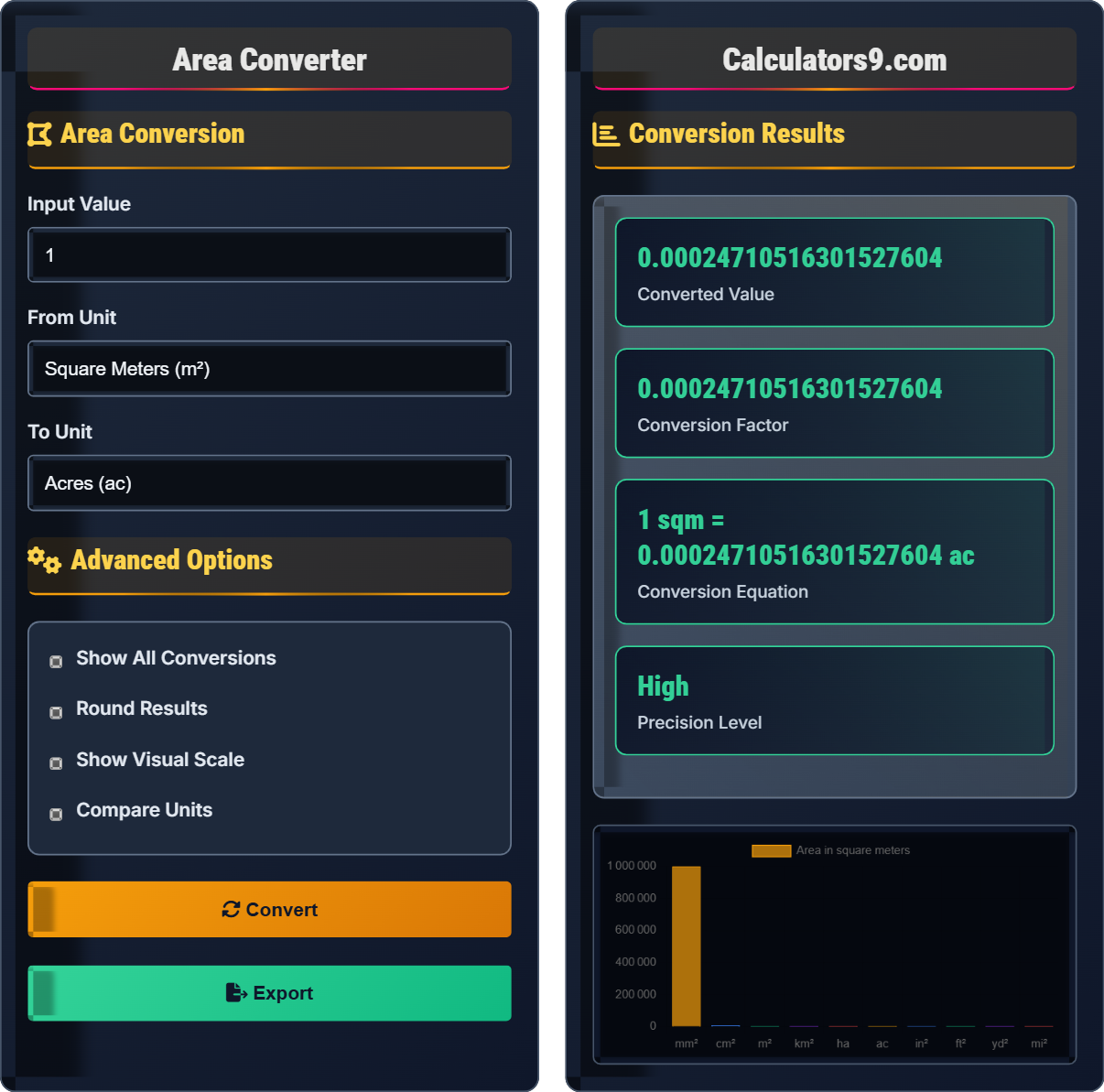
Area Conversion
Advanced Options
Conversion Results
| Unit | Value |
|---|---|
| Square Meters | 1 |
| Square Feet | 10.764 |
| Square Yards | 1.196 |
| Acres | 0.247 |
| Hectares | 0.01 |
Area Conversion Guide
Area is the measure of the amount of space inside a two-dimensional shape. The International System of Units (SI) defines the square meter as the base unit of area. Other units are derived from the square meter through powers of ten (metric system) or historical definitions (imperial system).
The metric system is based on powers of ten, making conversions simple. The imperial system uses historical definitions that require specific conversion factors. Most countries use the metric system, while the US primarily uses imperial units for land measurement.
When converting between units, always verify your results. For critical applications like real estate transactions, use precise conversion factors. Remember that rounding can introduce significant errors in calculations involving multiple conversions.
Area Conversion Basics
Measure of the amount of space inside a 2D shape, measured in square units.
Target Value = Original Value × (Target Unit Factor / Original Unit Factor)
Where factors are in base units (square meters).
- Always use consistent units in calculations
- Verify conversion factors for accuracy
- Round appropriately for context
- Consider significant figures
Measurement Strategies
Choose appropriate units for the scale of measurement.
- Use metric for scientific work
- Check conversion accuracy
- Document conversion factors used
- Double-check critical conversions
- Context determines precision needs
- Some applications require exact conversions
- International standards vary
- Historical context matters
Area Conversion Learning Quiz
How many square feet are in 1 square meter?
The answer is A) 10.764 sq ft. Using the conversion factor: 1 square meter = 10.764 square feet.
When converting from metric to imperial units for area, it's important to know the exact conversion factor. For square meters to square feet, the factor is 10.764. This conversion is particularly useful in real estate and construction where both metric and imperial measurements are used.
Conversion Factor: Ratio used to convert between units
Base Unit: Fundamental unit in a measurement system
Derived Unit: Unit formed from base units
• 1 m² = 10.764 ft²
• 1 m² = 10,000 cm²
• Always check your work
• Memorize common conversion factors
• Estimate to check reasonableness
• Use online tools for verification
• Using incorrect conversion factors
• Confusing linear and area conversions
• Misplacing decimal points
A rectangular plot measures 50 meters by 30 meters. What is the area in acres? Show your work and explain the conversion process step by step.
First, calculate the area in square meters: 50 m × 30 m = 1,500 m²
Then, convert to acres: 1,500 m² × (1 acre / 4046.86 m²) = 0.371 acres
So the rectangular plot has an area of approximately 0.371 acres.
When calculating area from dimensions, first compute the area in the same units as the dimensions (meters in this case). Then convert to the target unit using the appropriate conversion factor. For acres, the conversion factor is 1 acre = 4046.86 square meters. This two-step process ensures accuracy in the calculation.
Area: Measure of space inside a 2D shape
Conversion Factor: Exact ratio between units
Rectangular Area: Length × Width
• Calculate area first, then convert
• 1 acre = 4046.86 m²
• Area = length × width
• Always calculate area before unit conversion
• Keep track of units throughout calculations
• Verify results with rough estimates
• Converting dimensions before calculating area
• Using incorrect area conversion factors
• Forgetting to multiply length by width
FAQ
Q: What's the difference between hectares and acres?
A: Hectares and acres are both units of land measurement but differ in size:
• 1 hectare = 10,000 square meters = 2.471 acres
• 1 acre = 4,046.86 square meters = 0.4047 hectares
Hectares are the preferred unit in most countries outside the US, while acres are commonly used in the US and UK. A hectare is roughly equivalent to 2.5 football fields, while an acre is about 1.5 football fields.
For conversion: hectares × 2.471 = acres, and acres × 0.4047 = hectares.
Q: Why do construction measurements sometimes differ between metric and imperial systems?
A: Construction area measurements can differ between systems due to several factors:
1. Material sizing: Standard lumber and material dimensions may not convert evenly.
2. Rounding practices: Measurements are often rounded to convenient fractions.
3. Manufacturing tolerances: Materials have acceptable variation ranges.
4. Historical standards: Some measurements originated from practical rather than scientific considerations.
When converting, it's important to understand whether you're working with finished or rough dimensions.