Energy Converter
Convert Between Metric & Imperial Units
Energy Conversion Formula:
Show the calculatorTo convert between energy units, multiply the original value by the conversion factor:
Conversion Factor = (Target Unit in Joules) / (Source Unit in Joules)
Common conversion factors:
- 1 Joule (J) = 1 J
- 1 Kilojoule (kJ) = 1000 J
- 1 Calorie (cal) = 4.184 J
- 1 Kilocalorie (kcal) = 4184 J
- 1 Watt-hour (Wh) = 3600 J
- 1 Kilowatt-hour (kWh) = 3,600,000 J
- 1 British Thermal Unit (BTU) = 1055.06 J
- 1 Electronvolt (eV) = 1.60218e-19 J
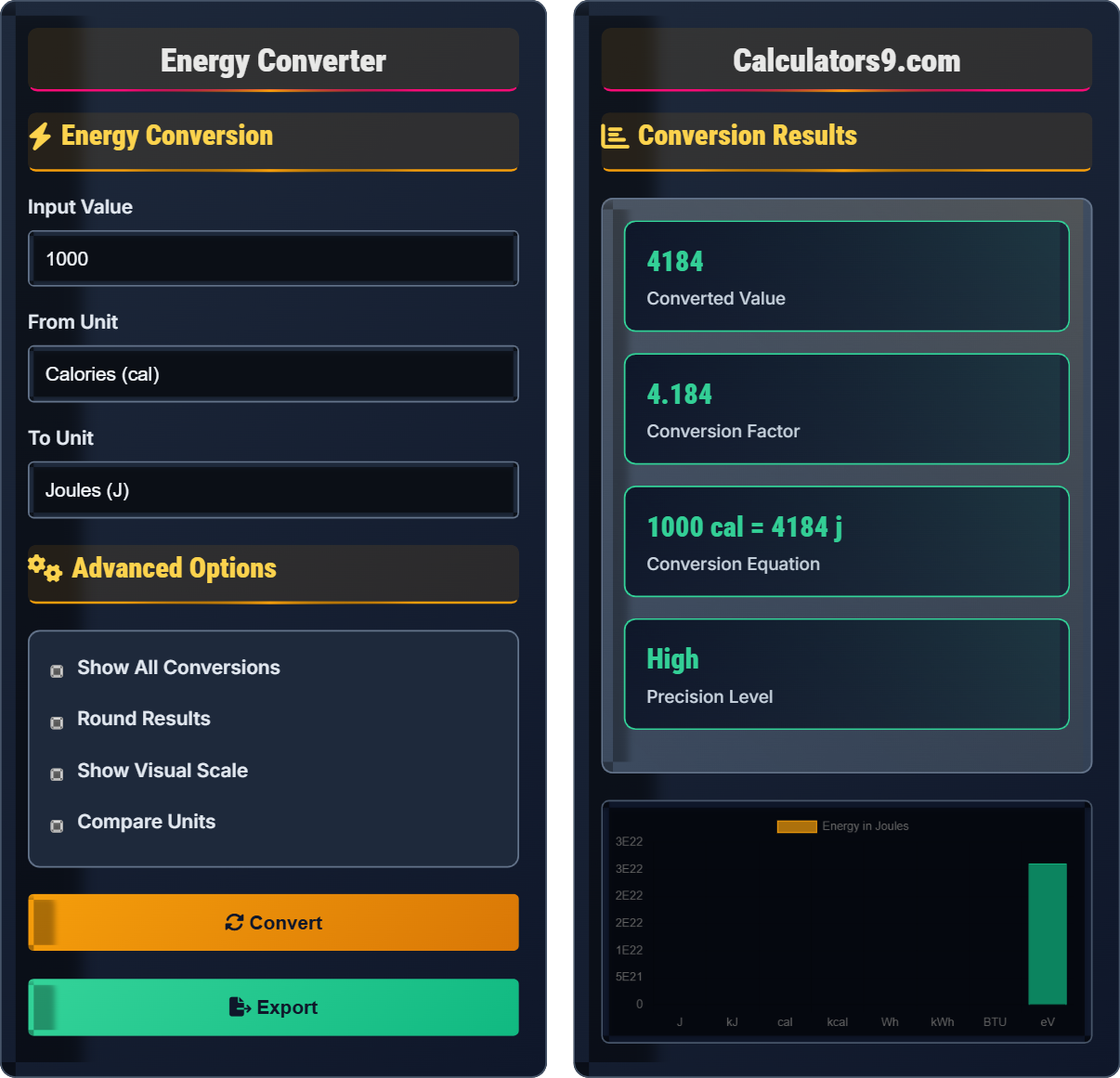
Example: To convert 1000 calories to joules: 1000 × 4.184 = 4184 J
To convert from joules to other units, divide by the conversion factor.
This ensures accurate conversions between all energy units.
Energy Conversion
Advanced Options
Conversion Results
| Unit | Value |
|---|---|
| Calories | 1000 |
| Joules | 4184.00 |
| Kilojoules | 4.18 |
| Watt-hours | 1.16 |
| BTU | 3.97 |
Energy Conversion Guide
Energy is the capacity to do work. The International System of Units (SI) defines the Joule (J) as the base unit of energy. One Joule equals the work done when a force of one Newton moves an object one meter.
Different fields use various energy units based on convenience and tradition. Scientific applications typically use Joules or kilojoules, nutrition uses calories or kilocalories, electricity uses watt-hours or kilowatt-hours, and heating/cooling uses BTUs.
When converting between energy units, always verify your results. For critical applications like engineering or scientific research, use precise conversion factors. Remember that rounding can introduce significant errors in calculations involving multiple conversions.
Energy Conversion Basics
Capacity to do work, measured in Joules (kg⋅m²/s²).
Target Value = Original Value × (Target Unit Factor / Original Unit Factor)
Where factors are in base units (Joules).
- Always use consistent units in calculations
- Verify conversion factors for accuracy
- Round appropriately for context
- Consider significant figures
Measurement Strategies
Choose appropriate units for the scale of measurement.
- Use metric for scientific work
- Check conversion accuracy
- Document conversion factors used
- Double-check critical conversions
- Context determines precision needs
- Some applications require exact conversions
- International standards vary
- Historical context matters
Energy Conversion Learning Quiz
How many joules are in 1 kilocalorie?
The answer is A) 4184 J. By definition, 1 kilocalorie (kcal) equals 1000 calories, and 1 calorie equals 4.184 Joules. Therefore, 1 kcal = 1000 × 4.184 = 4184 J.
The food Calorie (with capital C) used in nutrition is actually equivalent to 1 kilocalorie. This conversion is fundamental in nutrition science, helping to quantify the energy content of foods. Understanding this relationship is essential for dietetics, exercise physiology, and metabolic studies.
Calorie: Energy needed to raise 1g of water by 1°C
Kilocalorie: 1000 calories (food Calorie)
Joule: SI unit of energy
• 1 kcal = 4184 J
• 1 cal = 4.184 J
• Food Calorie = 1 kcal
• Remember: Food Calories are actually kilocalories
• Use 4.184 as the conversion factor
• Double-check when working with nutrition data
• Confusing food Calories with calories
• Using incorrect conversion factors
• Forgetting to multiply by 1000 for kcal
A typical household uses 30 kWh of electricity per day. Calculate the energy in joules, calories, and BTU. Show your work and explain the conversion process step by step.
First, convert kWh to Joules: 30 kWh × 3,600,000 J/kWh = 108,000,000 J
Next, convert Joules to calories: 108,000,000 J ÷ 4.184 J/cal = 25,813,000 cal
Finally, convert Joules to BTU: 108,000,000 J ÷ 1055.06 J/BTU = 102,364 BTU
So 30 kWh equals approximately 108 million joules, 25.8 million calories, or 102,364 BTU.
When converting between energy units, it's often easiest to convert to the base unit (Joules) first, then to the target unit. This approach minimizes errors and ensures consistency. For electricity bills, kWh is used for convenience, but for scientific calculations, Joules are preferred.
kWh: Kilowatt-hour, 1000 watts for 1 hour
BTU: British Thermal Unit, energy to heat 1 lb of water by 1°F
Conversion Factor: Exact ratio between units
• 1 kWh = 3,600,000 J
• 1 cal = 4.184 J
• 1 BTU = 1055.06 J
• Use Joules as an intermediate unit for accuracy
• Remember: 1 kWh = 3.6 MJ
• Check with known benchmarks
• Forgetting to convert kWh to Wh first
• Using incorrect conversion factors
• Misplacing decimal points in large numbers
FAQ
Q: What's the difference between energy and power?
A: Energy and power are related but distinct concepts:
Energy: The capacity to do work (measured in Joules)
Power: The rate of doing work or transferring energy (measured in Watts = Joules per second)
Relationship: Power = Energy / Time
Examples:
• A light bulb uses 60 J of energy per second = 60 W of power
• Running for 1 hour expends about 3600 kJ of energy
• If you run that 3600 kJ in 1 hour, your average power output is 1 kW
Electricity bills measure energy (kWh), not power (kW).
Q: Why do nutrition labels use Calories instead of Joules?
A: Nutrition labels use Calories (actually kilocalories) for historical and practical reasons:
1. Historical precedent: The calorie was established in nutrition science long before the Joule
2. Practical values: Food contains thousands to millions of Joules, but 1-3000 Calories
3. Metabolic calculations: Metabolic rates were historically calculated in calories
4. Consumer familiarity: People understand Calories for dietary planning
5. Regulatory standards: Food labeling regulations are established in Calories
However, some countries now include both Calories and kilojoules (kJ) on labels. The conversion is: 1 Calorie = 4.184 kJ.