Power Converter
Convert Between Metric & Imperial Units
Power Conversion Formula:
Show the calculatorTo convert between power units, multiply the original value by the conversion factor:
Conversion Factor = (Target Unit in Watts) / (Source Unit in Watts)
Common conversion factors:
- 1 Watt (W) = 1 W
- 1 Kilowatt (kW) = 1000 W
- 1 Megawatt (MW) = 1,000,000 W
- 1 Horsepower (hp) = 745.7 W
- 1 Metric Horsepower (PS) = 735.5 W
- 1 BTU per hour (BTU/hr) = 0.293071 W
- 1 Ton of Refrigeration = 3517 W
Example: To convert 5 hp to kilowatts: 5 × 745.7 W ÷ 1000 = 3.73 kW
To convert from watts to other units, divide by the conversion factor.
This ensures accurate conversions between all power units.
Power Conversion
Advanced Options
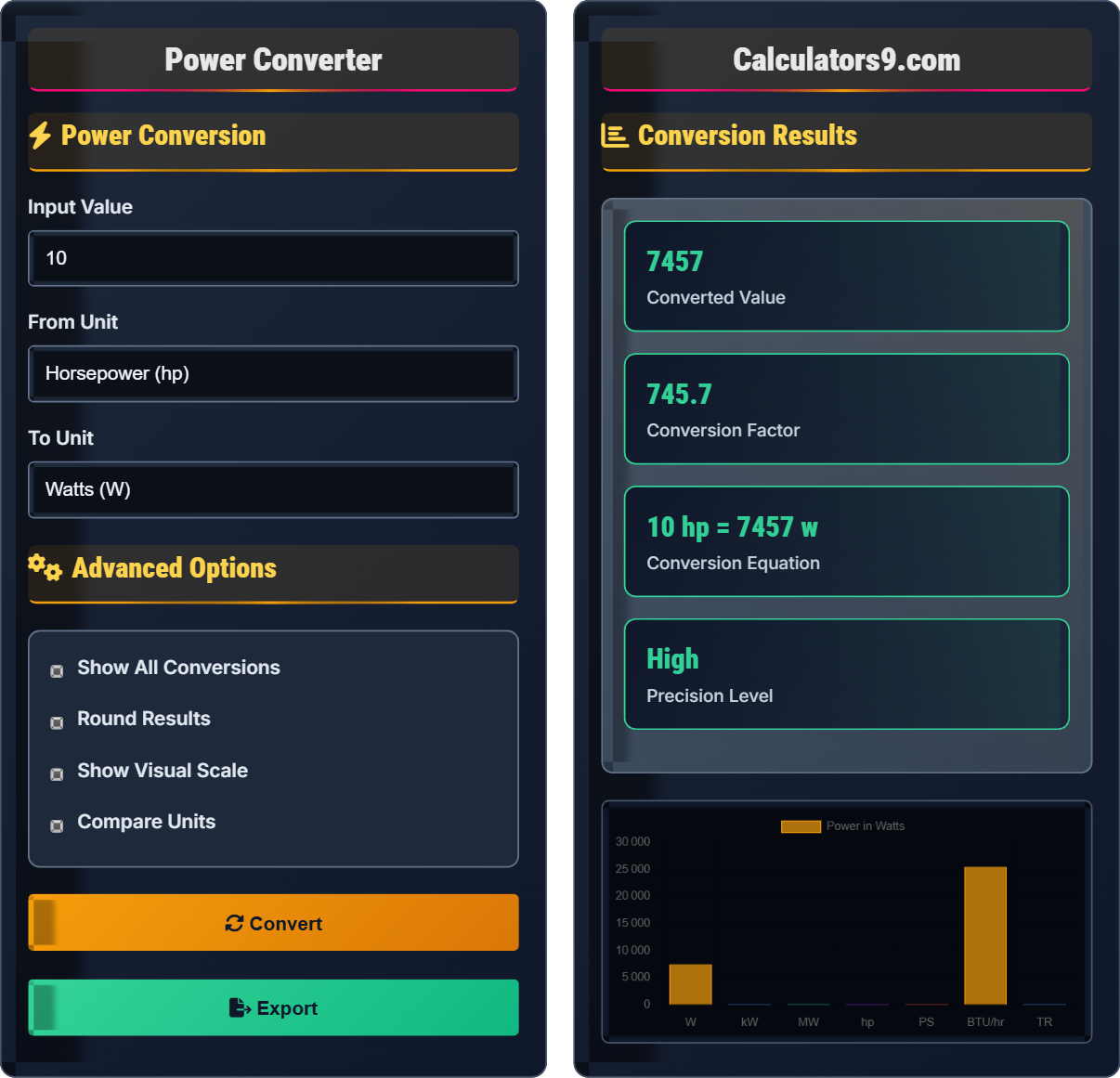
Conversion Results
| Unit | Value |
|---|---|
| Horsepower | 10 |
| Watts | 7457.00 |
| Kilowatts | 7.46 |
| BTU per Hour | 25444.39 |
| Ton of Refrigeration | 2.12 |
Power Conversion Guide
Power is the rate at which work is done or energy is transferred. The International System of Units (SI) defines the Watt (W) as the base unit of power. One Watt equals one Joule per second (J/s). Mechanical power is often measured in horsepower, while electrical power commonly uses watts or kilowatts.
Different fields use various power units based on convention and convenience. Electrical applications typically use Watts, kilowatts, or megawatts. Mechanical applications often use horsepower. Heating and cooling systems may use BTU/hr or tons of refrigeration.
When converting between power units, always verify your results. For critical applications like engineering or industrial calculations, use precise conversion factors. Remember that rounding can introduce significant errors in calculations involving multiple conversions.
Power Conversion Basics
Rate of doing work or transferring energy, measured in Watts (Joules per second).
Target Value = Original Value × (Target Unit Factor / Original Unit Factor)
Where factors are in base units (Watts).
- Always use consistent units in calculations
- Verify conversion factors for accuracy
- Round appropriately for context
- Consider significant figures
Measurement Strategies
Choose appropriate units for the scale of measurement.
- Use metric for scientific work
- Check conversion accuracy
- Document conversion factors used
- Double-check critical conversions
- Context determines precision needs
- Some applications require exact conversions
- International standards vary
- Historical context matters
Power Conversion Learning Quiz
How many watts are in 1 horsepower?
The answer is A) 745.7 W. By definition, 1 mechanical horsepower equals 550 foot-pounds per second, which converts to 745.7 watts. This is the standard conversion used in most engineering applications.
Horsepower was defined by James Watt as 33,000 foot-pounds per minute (550 foot-pounds per second), based on the power of draft horses. This conversion is fundamental in mechanical engineering, automotive applications, and industrial machinery specifications.
Horsepower: Unit of power defined as 550 ft-lbs/sec
Watt: SI unit of power (Joules per second)
Metric HP: 735.5 W (different from mechanical HP)
• 1 hp = 745.7 W (mechanical)
• 1 PS = 735.5 W (metric)
• Always specify which HP system you're using
• Remember: Mechanical HP > Metric HP
• Use 745.7 as the standard conversion factor
• Check specifications to see which HP system is used
• Confusing mechanical and metric horsepower
• Using 550 as the conversion factor
• Forgetting to convert units in calculations
A car engine produces 200 horsepower. Calculate its power in kilowatts, BTU per hour, and tons of refrigeration. Show your work and explain the conversion process step by step.
First, convert horsepower to watts: 200 hp × 745.7 W/hp = 149,140 W
Then, convert to kilowatts: 149,140 W ÷ 1000 = 149.14 kW
Next, convert to BTU/hr: 149,140 W ÷ 0.293071 W/BTU/hr = 508,900 BTU/hr
Finally, convert to tons of refrigeration: 149,140 W ÷ 3517 W/TR = 42.4 TR
So 200 hp equals 149.14 kW, 508,900 BTU/hr, or 42.4 tons of refrigeration.
When converting between multiple units, it's often easiest to convert to the base unit (watts) first, then to the target units. This approach ensures consistency and minimizes errors. The relationship between mechanical power (horsepower) and thermal power (BTU/hr) is useful in HVAC applications where engine-powered equipment drives cooling systems.
BTU/hr: British Thermal Unit per hour
Ton of Refrigeration: Heat absorption rate of melting 1 ton of ice in 24 hours
Conversion Factor: Exact ratio between units
• 1 hp = 745.7 W
• 1 kW = 1000 W
• 1 BTU/hr = 0.293 W
• 1 TR = 3517 W
• Use watts as an intermediate unit for accuracy
• Remember: 1 TR ≈ 12,000 BTU/hr
• Check with known benchmarks
• Forgetting to convert from watts to kilowatts
• Using incorrect conversion factors
• Misplacing decimal points in large numbers
FAQ
Q: What's the difference between mechanical horsepower and metric horsepower?
A: There are two main horsepower definitions:
Mechanical Horsepower (hp): 550 ft-lbf/s = 745.7 W
Metric Horsepower (PS or cv): 75 kgf⋅m/s = 735.5 W
The mechanical horsepower is used primarily in the US and UK, while metric horsepower is used in Europe. The difference is about 1.4%. When specifying engine power, it's important to clarify which system is used.
Other systems include electrical horsepower (exactly 746 W) and boiler horsepower (9,809.5 W), though these are less common.
Q: Why do HVAC systems use tons of refrigeration instead of BTU/hr?
A: Tons of refrigeration originated from the amount of heat needed to melt one ton (2000 lbs) of ice in 24 hours:
1 ton of refrigeration = 12,000 BTU/hr = 3.517 kW
It's used because:
1. Historical: Before mechanical refrigeration, ice was used for cooling
2. Practical: HVAC systems are large enough that kW values would be unwieldy
3. Industry standard: Equipment manufacturers and engineers use tons as the standard unit
For example, a residential AC unit might be 3-5 tons, while commercial systems can be 100+ tons.