Pressure Converter
Convert Between Metric & Imperial Units
Pressure Conversion Formula:
Show the calculatorTo convert between pressure units, multiply the original value by the conversion factor:
Conversion Factor = (Target Unit in Pascals) / (Source Unit in Pascals)
Common conversion factors:
- 1 Pascal (Pa) = 1 Pa
- 1 Kilopascal (kPa) = 1000 Pa
- 1 Megapascal (MPa) = 1,000,000 Pa
- 1 Bar = 100,000 Pa
- 1 Atmosphere (atm) = 101,325 Pa
- 1 PSI (pound per sq. inch) = 6,894.76 Pa
- 1 Torr = 133.322 Pa
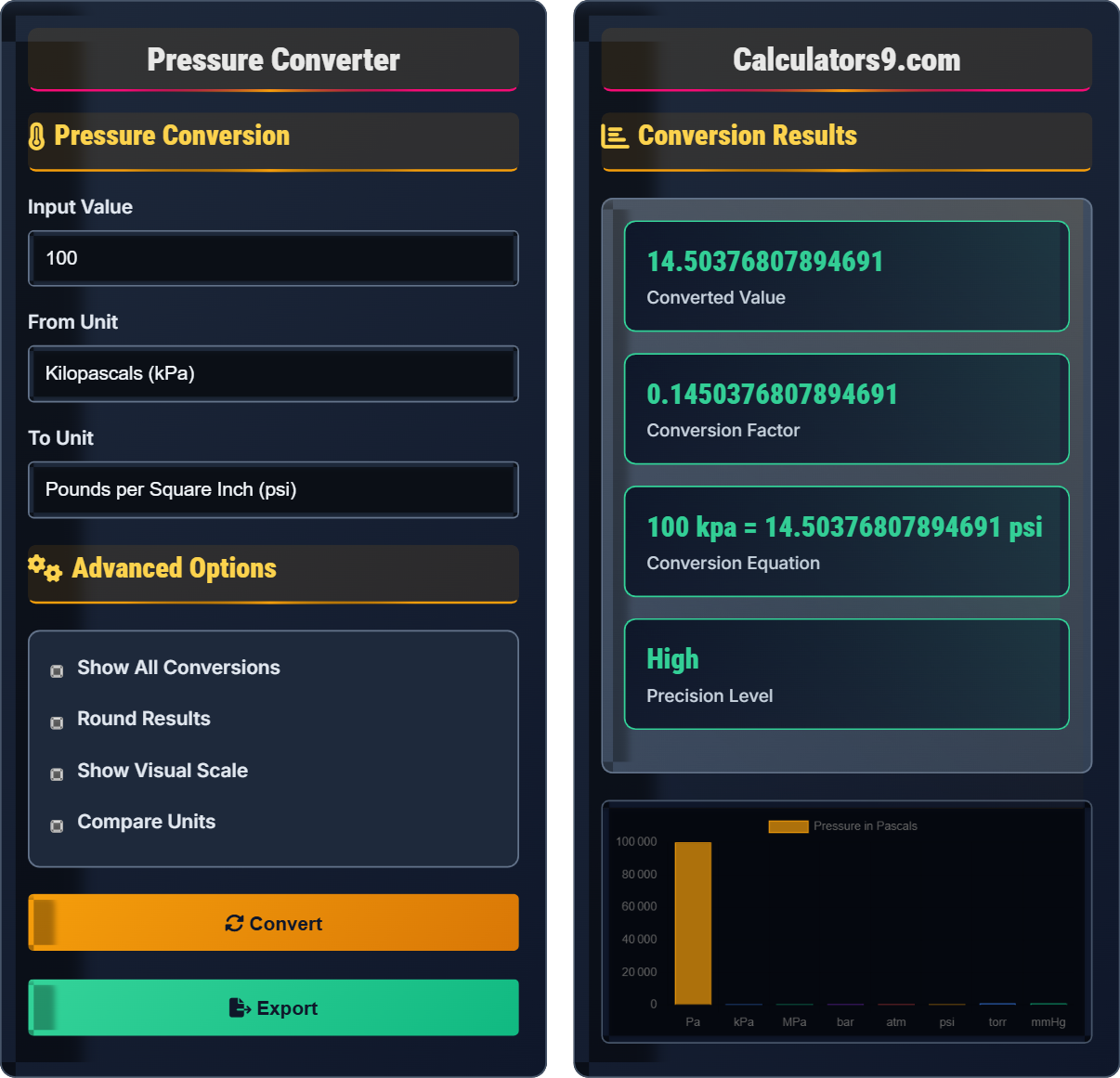
Example: To convert 100 kPa to PSI: 100 × 1000 Pa/kPa ÷ 6,894.76 Pa/PSI = 14.5 PSI
To convert from Pascals to other units, divide by the conversion factor.
This ensures accurate conversions between all pressure units.
Pressure Conversion
Advanced Options
Conversion Results
| Unit | Value |
|---|---|
| Kilopascals | 100 |
| Pounds per Square Inch | 14.50 |
| Bars | 1.00 |
| Atmospheres | 0.99 |
| Torr | 750.06 |
Pressure Conversion Guide
Pressure is the force applied perpendicular to the surface of an object per unit area. The International System of Units (SI) defines the Pascal (Pa) as the base unit of pressure. One Pascal equals one Newton per square meter (N/m²).
Different industries use various pressure units based on tradition and practicality. Scientific applications typically use Pascals or kilopascals, automotive uses PSI for tire pressure, meteorology uses hectopascals (hPa) or millibars (mb), and medical fields often use mmHg for blood pressure readings.
When converting between pressure units, always verify your results. For critical applications like medical devices or aerospace engineering, use precise conversion factors. Remember that rounding can introduce significant errors in calculations involving multiple conversions.
Pressure Conversion Basics
Force per unit area, measured in Newtons per square meter (Pascals).
Target Value = Original Value × (Target Unit Factor / Original Unit Factor)
Where factors are in base units (Pascals).
- Always use consistent units in calculations
- Verify conversion factors for accuracy
- Round appropriately for context
- Consider significant figures
Measurement Strategies
Choose appropriate units for the scale of measurement.
- Use metric for scientific work
- Check conversion accuracy
- Document conversion factors used
- Double-check critical conversions
- Context determines precision needs
- Some applications require exact conversions
- International standards vary
- Historical context matters
Pressure Conversion Learning Quiz
How many pounds per square inch (psi) are in 1 atmosphere (atm)?
The answer is A) 14.7 psi. Using the conversion factor: 1 atm = 101,325 Pa, and 1 psi = 6,894.76 Pa, so 101,325 ÷ 6,894.76 = 14.7 psi.
Standard atmospheric pressure is defined as 101,325 Pascals or 1 atmosphere. This is equivalent to 14.7 pounds per square inch. This conversion is fundamental in many engineering and scientific applications, especially in fluid mechanics and thermodynamics.
Standard Atmospheric Pressure: 101,325 Pa or 1 atm
PSI: Pounds per square inch
Conversion Factor: Ratio between units
• 1 atm = 101,325 Pa
• 1 psi = 6,894.76 Pa
• 1 atm = 14.7 psi
• Memorize standard atmospheric pressure
• Use Pascals as intermediate unit for accuracy
• Check with known benchmarks
• Using approximate conversion factors
• Confusing gauge vs absolute pressure
• Misplacing decimal points
A scuba diver is at a depth of 30 meters underwater. Calculate the total pressure in atmospheres (atm) and PSI. Show your work and explain the conversion process step by step.
First, calculate the water pressure: Depth × Water Density × Gravity
Water pressure = 30 m × 1000 kg/m³ × 9.81 m/s² = 294,300 Pa
Add atmospheric pressure: 294,300 + 101,325 = 395,625 Pa
In atmospheres: 395,625 Pa ÷ 101,325 Pa/atm = 3.90 atm
In PSI: 395,625 Pa ÷ 6,894.76 Pa/psi = 57.4 psi
At 30 meters depth, the total pressure is approximately 3.90 atmospheres or 57.4 PSI.
Underwater pressure increases by approximately 1 atmosphere for every 10 meters of depth. At 30 meters, the water pressure is about 3 atmospheres, plus 1 atmosphere of surface pressure, totaling 4 atmospheres. This is why divers must account for increasing pressure with depth, affecting air consumption and decompression requirements.
Hydrostatic Pressure: Pressure due to fluid depth
Water Density: 1000 kg/m³
Gravity: 9.81 m/s²• Pressure = Depth × Density × Gravity
• Add atmospheric pressure for total pressure
• 10m depth ≈ 1 additional atm
• Always add atmospheric pressure
• Use Pascals for intermediate calculations
• Remember: 10m ≈ 1 atm increase
• Forgetting to add atmospheric pressure
• Using incorrect water density
• Confusing gauge vs absolute pressure
FAQ
Q: What's the difference between gauge and absolute pressure?
A: The key difference is the reference point:
Absolute Pressure: Measured relative to a perfect vacuum (0 Pa)
Gauge Pressure: Measured relative to atmospheric pressure
Formula: Absolute Pressure = Gauge Pressure + Atmospheric Pressure
Examples:
• Tire pressure gauge shows 32 psi (gauge)
• Actual absolute pressure = 32 + 14.7 = 46.7 psi
Most pressure gauges read gauge pressure, but scientific calculations often require absolute pressure.
Q: Why are there so many different pressure units?
A: Different pressure units evolved for specific applications:
1. Scientific: Pascals (Pa) - SI unit, convenient for calculations
2. Engineering: PSI - convenient for structural calculations
3. Meteorology: Millibars/hPa - convenient for weather measurements
4. Medical: mmHg - historically used for blood pressure
5. Aviation: inHg - for altimeter settings
Each unit provides convenient numbers for its specific field. For example, atmospheric pressure is about 101,325 Pa, but more conveniently expressed as 14.7 psi or 1.013 bar.