Speed Converter
Convert Between Metric & Imperial Units
Speed Conversion Formula:
Show the calculatorTo convert between speed units, multiply the original value by the conversion factor:
Conversion Factor = (Target Unit in m/s) / (Source Unit in m/s)
Common conversion factors:
- 1 meter per second (m/s) = 3.6 kilometers per hour (km/h)
- 1 mile per hour (mph) = 0.44704 meters per second (m/s)
- 1 knot = 0.514444 meters per second (m/s)
- 1 foot per second (ft/s) = 0.3048 meters per second (m/s)
Example: To convert 60 mph to km/h: 60 × 1.60934 = 96.56 km/h
To convert from m/s to other units, divide by the conversion factor.
This ensures accurate conversions between all speed units.
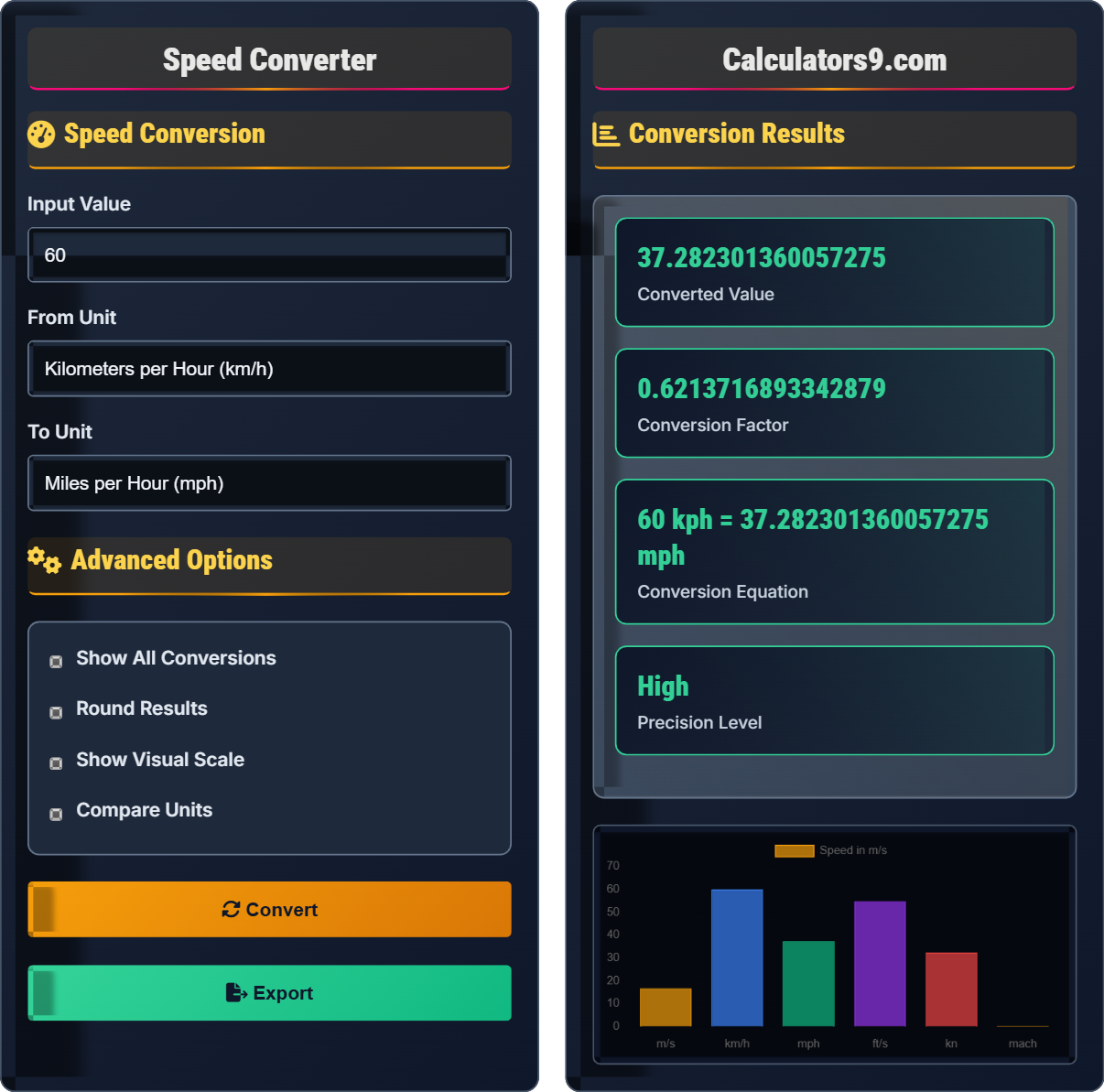
Speed Conversion
Advanced Options
Conversion Results
| Unit | Value |
|---|---|
| Kilometers per Hour | 60 |
| Miles per Hour | 37.28 |
| Meters per Second | 16.67 |
| Feet per Second | 54.68 |
| Knots | 32.40 |
Speed Conversion Guide
Speed is the rate at which an object covers distance. The International System of Units (SI) defines meters per second (m/s) as the base unit of speed. Other units are derived from this base unit through different distance and time combinations.
The metric system uses kilometers per hour (km/h) in most countries, while the imperial system uses miles per hour (mph) primarily in the US and UK. Aviation uses knots (nautical miles per hour), and scientific applications often use meters per second.
When converting between units, always verify your results. For critical applications like aviation or automotive engineering, use precise conversion factors. Remember that rounding can introduce significant errors in calculations involving multiple conversions.
Speed Conversion Basics
Rate of change of distance with respect to time, measured in distance per unit time.
Target Value = Original Value × (Target Unit Factor / Original Unit Factor)
Where factors are in base units (meters per second).
- Always use consistent units in calculations
- Verify conversion factors for accuracy
- Round appropriately for context
- Consider significant figures
Measurement Strategies
Choose appropriate units for the scale of measurement.
- Use metric for scientific work
- Check conversion accuracy
- Document conversion factors used
- Double-check critical conversions
- Context determines precision needs
- Some applications require exact conversions
- International standards vary
- Historical context matters
Speed Conversion Learning Quiz
How many kilometers per hour are in 60 miles per hour?
The answer is A) 96.56 km/h. Using the conversion factor: 1 mph = 1.60934 km/h, so 60 mph × 1.60934 km/h = 96.56 km/h.
When converting from miles per hour to kilometers per hour, use the conversion factor 1.60934. This is because 1 mile equals 1.60934 kilometers. This conversion is particularly useful when traveling internationally or understanding speed limits in different countries.
Conversion Factor: Ratio used to convert between units
Base Unit: Fundamental unit in a measurement system
Derived Unit: Unit formed from base units
• 1 mph = 1.60934 km/h
• 1 km/h = 0.621371 mph
• Always check your work
• Memorize common conversion factors
• Estimate to check reasonableness
• Use online tools for verification
• Using incorrect conversion factors
• Confusing mph and km/h
• Misplacing decimal points
A commercial aircraft flies at 500 knots. What is this speed in meters per second? Show your work and explain the conversion process step by step.
First, convert knots to kilometers per hour: 500 knots × 1.852 km/h per knot = 926 km/h
Then, convert kilometers per hour to meters per second: 926 km/h × (1000 m/km) ÷ (3600 s/h) = 257.22 m/s
Alternatively, using direct conversion: 500 knots × 0.514444 m/s per knot = 257.22 m/s
The aircraft travels at approximately 257.22 meters per second.
When converting from knots to meters per second, you can either convert through an intermediate unit (knots to km/h to m/s) or use the direct conversion factor. The direct conversion is more efficient: 1 knot = 0.514444 m/s. This conversion is important in aviation where speeds are commonly expressed in knots.
Knot: Unit of speed equal to one nautical mile per hour
Nautical Mile: 1.852 kilometers
Conversion Factor: Exact ratio between units
• 1 knot = 1.852 km/h
• 1 knot = 0.514444 m/s
• 1 km/h = 0.277778 m/s
• Use direct conversion when possible
• Memorize aviation-specific conversions
• Verify results with alternative methods
• Confusing knots with mph
• Forgetting to convert time units
• Using incorrect conversion factors
FAQ
Q: Why do aircraft use knots instead of miles per hour?
A: Aircraft use knots for several important reasons:
1. Navigation: Knots correspond to nautical miles, which relate directly to Earth's latitude and longitude coordinates
2. International standard: Knots are the universal unit for aviation and maritime navigation
3. Historical: Nautical miles were originally defined as 1 minute of arc along Earth's surface
4. Accuracy: Nautical miles account for Earth's curvature, making navigation more precise
One knot equals one nautical mile per hour, which is 1.151 statute miles per hour.
Q: What's the difference between speed and velocity?
A: Speed and velocity are related but distinct concepts:
Speed: Scalar quantity that measures how fast an object moves (magnitude only)
Velocity: Vector quantity that measures both speed and direction of motion
For example, a car traveling at 60 mph north has a velocity of 60 mph north, but its speed is simply 60 mph. In physics, velocity is more informative because it includes directional information.
Both are measured in the same units (m/s, km/h, mph, etc.), but velocity includes direction.