Volume Converter
Convert Between Metric & Imperial Units
Volume Conversion Formula:
Show the calculatorTo convert between volume units, multiply the original value by the conversion factor:
Conversion Factor = (Target Unit in Cubic Meters) / (Source Unit in Cubic Meters)
Common conversion factors:
- 1 liter = 0.001 cubic meters
- 1 gallon (US) = 0.00378541 cubic meters
- 1 quart (US) = 0.000946353 cubic meters
- 1 pint (US) = 0.000473176 cubic meters
- 1 cup (US) = 0.000236588 cubic meters
- 1 fluid ounce (US) = 0.0000295735 cubic meters
Example: To convert 5 gallons to liters: 5 × 3.78541 = 18.927 liters
To convert from cubic meters to other units, divide by the conversion factor.
This ensures accurate conversions between all volume units.
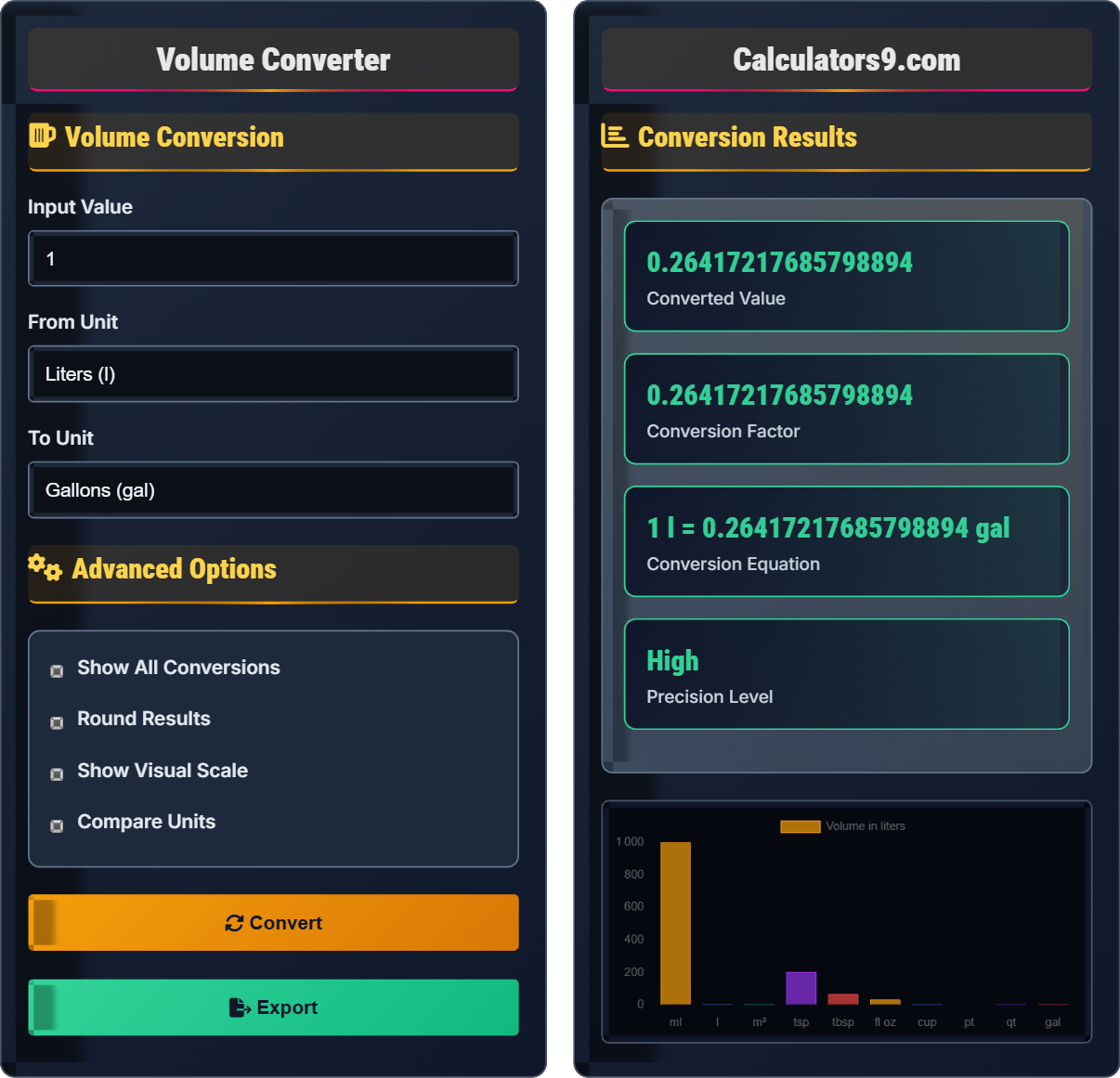
Volume Conversion
Advanced Options
Conversion Results
| Unit | Value |
|---|---|
| Liters | 1 |
| Milliliters | 1000 |
| Gallons | 0.264 |
| Quarts | 1.057 |
| Cups | 4.227 |
Volume Conversion Guide
Volume is the measure of the amount of space occupied by a substance or object. The International System of Units (SI) defines the cubic meter as the base unit of volume. Other units are derived from the cubic meter through powers of ten (metric system) or historical definitions (imperial system).
The metric system is based on powers of ten, making conversions simple. The imperial system uses historical definitions that require specific conversion factors. Most countries use the metric system, while the US primarily uses imperial units for volume measurements.
When converting between units, always verify your results. For critical applications like chemistry or medicine, use precise conversion factors. Remember that rounding can introduce significant errors in calculations involving multiple conversions.
Volume Conversion Basics
Amount of space occupied by a substance, measured in standard units.
Target Value = Original Value × (Target Unit Factor / Original Unit Factor)
Where factors are in base units (usually cubic meters).
- Always use consistent units in calculations
- Verify conversion factors for accuracy
- Round appropriately for context
- Consider significant figures
Measurement Strategies
Choose appropriate units for the scale of measurement.
- Use metric for scientific work
- Check conversion accuracy
- Document conversion factors used
- Double-check critical conversions
- Context determines precision needs
- Some applications require exact conversions
- International standards vary
- Historical context matters
Volume Conversion Learning Quiz
How many fluid ounces are in 1 liter?
The answer is A) 33.8 fl oz. Using the conversion factor: 1 liter = 33.814 fluid ounces, so 1 liter ≈ 33.8 fl oz.
When converting from metric to imperial units, it's important to know the exact conversion factor. For liters to fluid ounces, the factor is 33.814. This conversion is particularly useful in cooking and nutrition where recipes may specify volumes in different units.
Conversion Factor: Ratio used to convert between units
Base Unit: Fundamental unit in a measurement system
Derived Unit: Unit formed from base units
• 1 liter = 33.814 fl oz
• 1 liter = 1000 ml
• Always check your work
• Memorize common conversion factors
• Estimate to check reasonableness
• Use online tools for verification
• Using incorrect conversion factors
• Confusing US and UK fluid ounces
• Misplacing decimal points
A recipe calls for 2.5 cups of milk. How many milliliters is this? Show your work and explain the conversion process step by step.
First, convert cups to liters: 2.5 cups × 0.236588 liters/cup = 0.59147 liters
Then, convert liters to milliliters: 0.59147 liters × 1000 ml/liter = 591.47 ml
So 2.5 cups equals approximately 591.5 milliliters.
When converting between units that aren't directly related (like cups to milliliters), it's often easiest to convert to a common base unit first. In this case, we converted cups to liters (the SI base unit) and then to milliliters. This two-step process reduces the chance of errors compared to memorizing a direct conversion factor.
Mixed Units: Measurements using multiple unit types
Base Unit: Fundamental unit in a measurement system
Conversion Factor: Exact ratio between units
• 1 cup = 0.236588 liters
• 1 liter = 1000 ml
• Convert to base unit first
• Use liters as an intermediate unit when converting
• Memorize common conversion factors
• Estimate to check reasonableness
• Using incorrect conversion factors
• Forgetting to convert intermediate units
• Misplacing decimal points
FAQ
Q: What's the difference between US and Imperial volume measurements?
A: US and Imperial (British) volume measurements differ in their definitions:
• US gallon = 3.785 liters, Imperial gallon = 4.546 liters (20% larger)
• US quart = 0.946 liters, Imperial quart = 1.136 liters
• US pint = 0.473 liters, Imperial pint = 0.568 liters
• US fluid ounce = 29.57 ml, Imperial fluid ounce = 28.41 ml
These differences are important when following recipes from different countries, especially in baking where precise measurements are critical.
Q: Why do laboratories use volumetric glassware instead of kitchen measurements?
A: Laboratory volumetric glassware provides precise measurements essential for accurate chemical reactions:
1. Calibration: Glassware is precisely calibrated to specific volumes at certain temperatures
2. Accuracy: Graduated cylinders, pipettes, and volumetric flasks have tolerances of ±0.1% or better
3. Temperature: Volume varies with temperature, lab glassware is calibrated for specific temperatures
4. Meniscus: Lab glassware has precise markings for reading the meniscus of liquids
5. Reproducibility: Ensures consistent results across different experiments and researchers
Kitchen measurements are adequate for cooking but insufficient for scientific accuracy.