Weight Converter
Convert Between Metric & Imperial Units
Weight Conversion Formula:
Show the calculatorTo convert between weight units, multiply the original value by the conversion factor:
Conversion Factor = (Target Unit in Kilograms) / (Source Unit in Kilograms)
Common conversion factors:
- 1 gram = 0.001 kilograms
- 1 pound = 0.45359237 kilograms
- 1 ounce = 0.028349523125 kilograms
- 1 stone = 6.35029318 kilograms
- 1 ton (US) = 907.18474 kilograms
- 1 tonne (metric) = 1000 kilograms
Example: To convert 10 pounds to kilograms: 10 × 0.45359237 = 4.536 kilograms
To convert from kilograms to other units, divide by the conversion factor.
This ensures accurate conversions between all weight units.
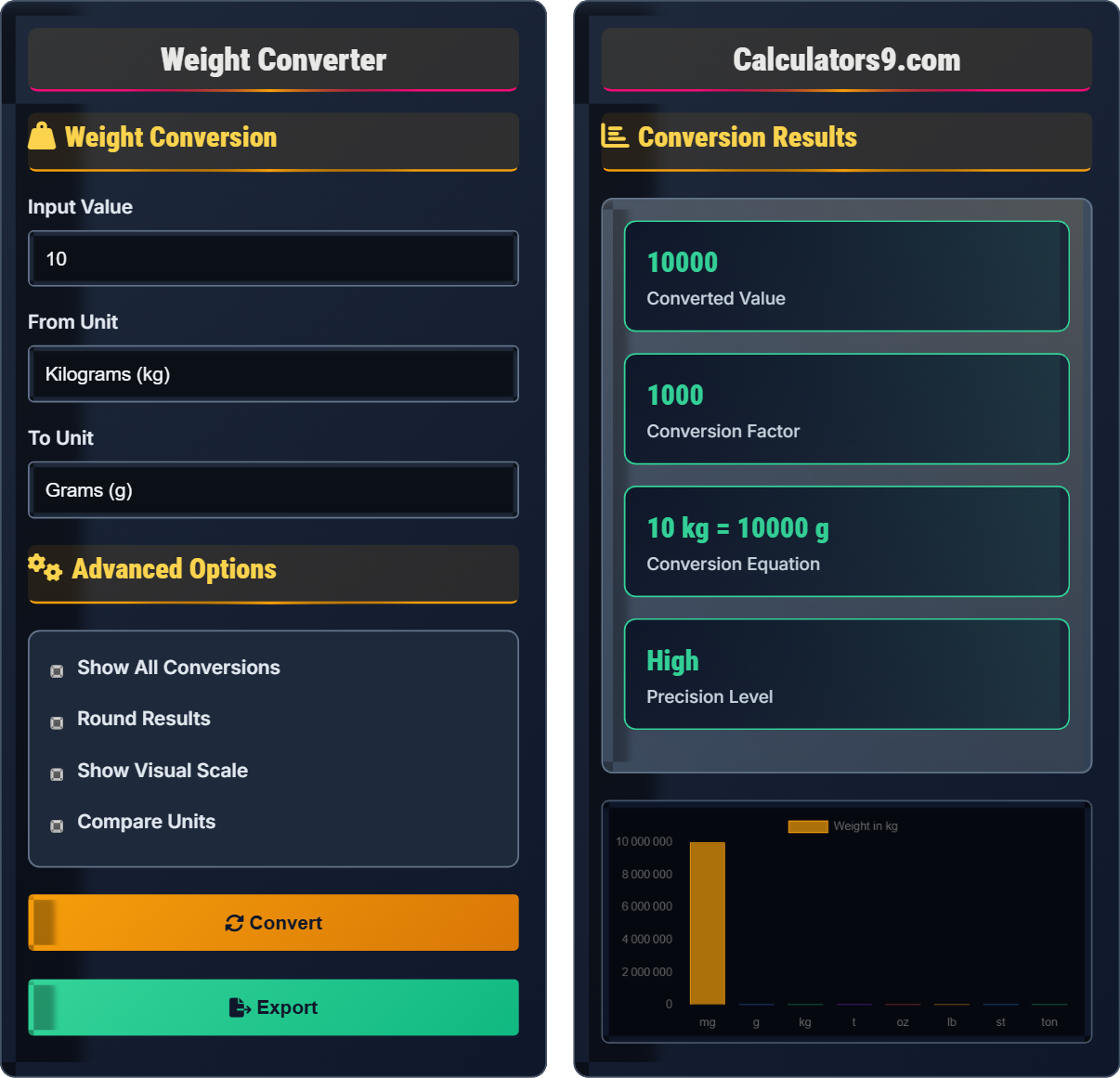
Weight Conversion
Advanced Options
Conversion Results
| Unit | Value |
|---|---|
| Kilograms | 10 |
| Grams | 10000 |
| Pounds | 22.046 |
| Ounces | 352.74 |
| Stone | 1.575 |
Weight Conversion Guide
Weight is the force exerted by gravity on an object, commonly measured in units like grams, kilograms, pounds, and ounces. The International System of Units (SI) defines the kilogram as the base unit of mass (which is often used interchangeably with weight in everyday contexts).
The metric system is based on powers of ten, making conversions simple. The imperial system uses historical definitions that require specific conversion factors. Most countries use the metric system, while the US primarily uses imperial units for weight measurements.
When converting between units, always verify your results. For critical applications like pharmaceuticals or scientific experiments, use precise conversion factors. Remember that rounding can introduce significant errors in calculations involving multiple conversions.
Weight Conversion Basics
Force exerted by gravity on an object, measured in standard units.
Target Value = Original Value × (Target Unit Factor / Original Unit Factor)
Where factors are in base units (usually kilograms).
- Always use consistent units in calculations
- Verify conversion factors for accuracy
- Round appropriately for context
- Consider significant figures
Measurement Strategies
Choose appropriate units for the scale of measurement.
- Use metric for scientific work
- Check conversion accuracy
- Document conversion factors used
- Double-check critical conversions
- Context determines precision needs
- Some applications require exact conversions
- International standards vary
- Historical context matters
Weight Conversion Learning Quiz
How many pounds are in 5 kilograms?
The answer is A) 11.025 lbs. Using the conversion factor: 1 kg = 2.205 lbs, so 5 kg × 2.205 lbs/kg = 11.025 lbs.
When converting from metric to imperial units, it's important to know the exact conversion factor. For kilograms to pounds, the factor is 2.20462262, but 2.205 is sufficient for most applications. Always double-check the conversion factor to avoid errors in calculations.
Conversion Factor: Ratio used to convert between units
Base Unit: Fundamental unit in a measurement system
Derived Unit: Unit formed from base units
• 1 kg = 2.205 lbs (approximate)
• 1 kg = 1000 g
• Always check your work
• Memorize common conversion factors
• Estimate to check reasonableness
• Use online tools for verification
• Using incorrect conversion factors
• Confusing weight and mass
• Misplacing decimal points
A shipment weighs 2 tons 500 pounds. What is the total weight in kilograms? Show your work and explain the conversion process step by step.
First, convert tons to pounds: 2 tons × 2000 lbs/ton = 4000 lbs
Add the additional weight: 4000 lbs + 500 lbs = 4500 lbs
Convert total pounds to kilograms: 4500 lbs × 0.45359237 kg/lb = 2041.165665 kg
The total weight is approximately 2041.17 kilograms.
When dealing with mixed units (tons and pounds), first convert everything to the same unit (pounds in this case) before converting to the target unit. This step-by-step approach minimizes errors. For the final conversion, use the precise conversion factor: 1 lb = 0.45359237 kg.
Mixed Units: Measurements using multiple unit types
US Ton: 2000 pounds (not to be confused with metric ton)
Conversion Factor: Exact ratio between units
• 1 US ton = 2000 lbs
• 1 lb = 0.45359237 kg
• Convert to same unit first
• Always convert mixed units to a single unit first
• Keep track of units throughout calculations
• Verify results with rough estimates
• Confusing US ton with metric ton (1000 kg)
• Using incorrect conversion factors
FAQ
Q: What's the difference between mass and weight in cooking measurements?
A: Technically, mass is the amount of matter in an object (measured in grams/kilograms), while weight is the force of gravity acting on that mass (measured in Newtons). However, in cooking, we typically refer to mass when talking about weight.
For practical purposes in cooking: 1 gram of water = 1 milliliter of water (at 4°C). This relationship simplifies many recipes. When measuring dry ingredients, we use mass (grams) for accuracy, while liquid measurements often use volume (milliliters).
Professional kitchens always use scales for precise measurements rather than volume measures.
Q: Why do shipping weights sometimes differ between metric and imperial systems?
A: Shipping weight discrepancies occur due to several factors:
1. Measurement precision: Different systems may round differently.
2. Package variations: Actual packaging may differ from stated dimensions.
3. Conversion accuracy: Some systems use approximate conversion factors.
4. Regulatory differences: Different countries have varying standards.
5. Equipment calibration: Scales may be calibrated differently.
Always verify weights using calibrated equipment and use precise conversion factors for international shipments.