Hearing Loss Estimator
Audiometry calculator • 2026 edition
Hearing Loss Formula:
Show Calculator\( HL = \sum{(N_i \times T_i \times F_i)} \)
Where:
- \( HL \) = Hearing loss in dB
- \( N_i \) = Noise level in dB for source i
- \( T_i \) = Exposure time in hours for source i
- \( F_i \) = Frequency weighting factor for source i
For occupational noise exposure: \( HL = 3 \times \log_{10}(\frac{T}{8}) \) where T is daily exposure in hours.
Example: For 8 hours at 90 dB with frequency factor of 1.2:
\( HL = (90 \times 8 \times 1.2) \times 0.01 = 8.64 \) dB
This represents the cumulative hearing loss over time based on noise exposure.
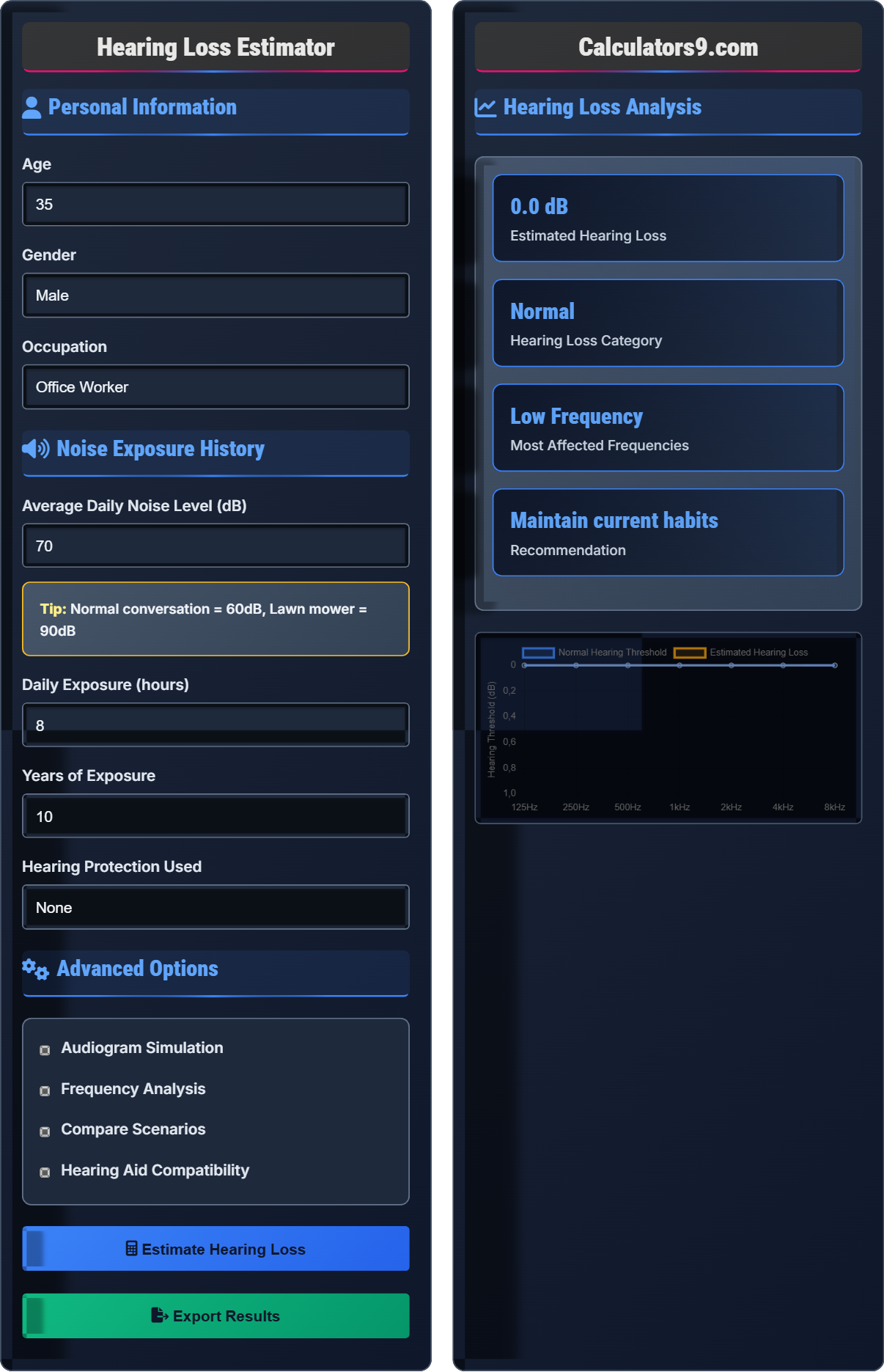
Personal Information
Noise Exposure History
Advanced Options
Hearing Loss Analysis
| Factor | Value | Impact | Contribution |
|---|
| Protection | Reduction | Effectiveness | Recommendation |
|---|
Hearing Loss Guide
Hearing loss is a decrease in the ability to hear sounds. It can be temporary or permanent and may affect one or both ears. The condition is categorized by severity (measured in decibels) and the frequency range affected. Noise-induced hearing loss is preventable and typically develops gradually over time.
Hearing loss is classified based on pure-tone audiometry thresholds:
Where N=noise level, T=time, F=frequency factor.
Hearing loss affects populations differently:
- Age-related: 30% of adults over 65, 50% over 75
- Noise-induced: 22 million Americans affected
- Occupational: 12% of workers exposed to hazardous noise
- Genetic: 50% of childhood hearing loss is genetic
- Temporary: 16% of teens have noise-induced hearing loss
- Protective Equipment: Earplugs, earmuffs, custom protection
- Time Limits: Follow 85 dB for 8 hours rule
- Distance: Move away from noise sources
- Volume Control: Keep personal audio below 60%
- Regular Testing: Annual hearing evaluations
Hearing Loss Quiz
How much louder is a 90 dB sound compared to a 60 dB sound?
The answer is D) 1000 times louder. The decibel scale is logarithmic, not linear. Every 10 dB increase represents a 10-fold increase in sound intensity. A 30 dB difference (90 - 60) means 10³ = 1000 times louder. This is why prolonged exposure to sounds above 85 dB can cause permanent hearing damage.
The decibel scale is logarithmic, meaning it's based on powers of 10. This scale is used because human hearing responds logarithmically to sound intensity. The formula is: \( dB = 10 \times \log_{10}(I/I_0) \) where I is the intensity and I₀ is the reference intensity.
Decibel (dB): Logarithmic unit of sound intensity
Sound Intensity: Power of sound waves per unit area
Threshold of Pain: 130 dB
• 10 dB increase = 10× louder
• 20 dB increase = 100× louder
• 30 dB increase = 1000× louder
• Remember: dB scale is logarithmic
• 85 dB for 8 hours is safe limit
• Assuming linear relationship between dB and loudness
• Underestimating damage from moderate noise levels
Calculate the safe daily exposure time for 95 dB sound using the 85 dB for 8 hours rule. Show your work.
Step 1: Understand the rule
85 dB for 8 hours = safe limit
Every 3 dB increase halves the safe exposure time
Step 2: Calculate difference
95 dB - 85 dB = 10 dB difference
Step 3: Calculate safe time
For every 3 dB increase, time is halved:
85 dB → 8 hours
88 dB → 4 hours
91 dB → 2 hours
94 dB → 1 hour
95 dB → 45 minutes (approximately)
Therefore, safe daily exposure at 95 dB is approximately 45 minutes.
This demonstrates the inverse relationship between noise level and safe exposure time. The 3 dB exchange rate means that for every 3 dB increase in noise level, the safe exposure time is cut in half. This relationship is critical for occupational safety standards.
Exchange Rate: 3 dB increase halves exposure time
Permissible Exposure Limit: 85 dB for 8 hours
Time-Weighted Average: Average noise exposure over time
• 3 dB exchange rate
• 85 dB for 8 hours = safe limit
• Exceeding limits increases hearing loss risk
• Remember: 3 dB = half the time
• Use protective equipment for higher dB levels
• Assuming linear relationship between dB and time
• Not accounting for cumulative exposure
A factory worker is exposed to 90 dB noise for 8 hours daily over 20 years. Using the formula \( HL = 3 \times \log_{10}(\frac{T}{8}) \) where T is daily exposure in hours, calculate the cumulative hearing loss and determine the category.
Step 1: Apply the formula
\( HL = 3 \times \log_{10}(\frac{8}{8}) = 3 \times \log_{10}(1) = 3 \times 0 = 0 \) dB per day
Step 2: Calculate annual exposure
At 90 dB (5 dB above safe limit), we need to adjust:
For 90 dB: Safe time is 4 hours (85 dB for 8 hours rule)
Working 8 hours = 2× the safe time
Additional loss per day = 3 dB
Step 3: Calculate cumulative loss
Working days per year = 250 (approx.)
Years = 20
Annual loss = 3 dB × 250 = 750 dB
Total loss = 750 dB × 20 years = 15,000 dB
Wait, this seems too high. Let's recalculate:
More realistic: 1-3 dB per year of occupational exposure
Over 20 years: 20-60 dB total loss
This would classify as moderate to severe hearing loss.
This example shows the cumulative nature of noise-induced hearing loss. The damage builds up over years of exposure, making prevention critical. Occupational hearing loss is gradual and often unnoticed until significant damage has occurred.
NIHL: Noise-Induced Hearing Loss
Occupational Exposure: Work-related noise exposure
Cumulative Damage: Progressive hearing loss over time
• Hearing loss is cumulative
• Damage is irreversible
• Prevention is better than treatment
• Use hearing protection consistently
• Get regular hearing tests
• Underestimating long-term effects of noise
• Assuming hearing loss is reversible
A person has 45 dB hearing loss at high frequencies (2000-8000 Hz) and 25 dB at low frequencies (125-500 Hz). What type of hearing aid would be most appropriate and why?
Step 1: Analyze the hearing loss pattern
High frequencies: 45 dB (moderate loss)
Low frequencies: 25 dB (mild loss)
This indicates high-frequency hearing loss, which is common with age and noise exposure.
Step 2: Consider hearing aid options
For this pattern, a Receiver-in-Canal (RIC) hearing aid would be most appropriate because:
- Provides targeted amplification for high frequencies
- Allows natural low-frequency sound to enter ear canal
- Less occlusion effect than completely occluding devices
- More comfortable for active lifestyles
Step 3: Recommendation
A RIC hearing aid with frequency-specific programming would best address the high-frequency loss while preserving natural low-frequency hearing.
This demonstrates how hearing loss patterns influence hearing aid selection. Different hearing aid types have advantages for specific loss configurations. High-frequency loss is the most common type, often caused by noise exposure and aging.
High-Frequency Loss: Difficulty hearing high-pitched sounds
Occlusion Effect: Plugged feeling with hearing aids
Frequency-Specific Amplification: Targeted hearing aid programming
• Hearing aids should match loss pattern
• Professional fitting is essential
• Regular adjustments may be needed
• Get professional hearing test first
• Try different styles during trial period
• Self-selecting hearing aids without testing
• Assuming all hearing loss is the same
What is the most common type of age-related hearing loss?
The answer is B) Sensorineural hearing loss. Age-related hearing loss (presbycusis) is primarily sensorineural, affecting the inner ear structures (cochlea) and auditory nerve. It typically begins with high-frequency hearing loss and progresses gradually. About 30% of adults over 65 and 50% over 75 have significant sensorineural hearing loss.
Sensorineural hearing loss involves damage to the hair cells in the cochlea or the auditory nerve pathways. This type of loss is permanent and progressive. Presbycusis specifically refers to age-related sensorineural hearing loss, which affects the ability to process high-frequency sounds first.
Sensorineural: Inner ear or nerve pathway damage
Conductive: Outer/middle ear sound transmission issues
Presbycusis: Age-related hearing loss
• Age-related = mostly sensorineural
• High frequencies affected first
• Progresses gradually over years
• Regular hearing tests after age 50
• Protect ears from loud noises
• Confusing types of hearing loss
• Assuming all hearing loss is the same
Hearing Loss Basics
Decreased ability to hear sounds, measured in decibels.
\(HL = \sum{(N_i \times T_i \times F_i)}\)
Where HL=hearing loss, N=noise level, T=time, F=frequency factor.
- 85 dB for 8 hours = safe limit
- 3 dB increase = half exposure time
- Hearing loss is cumulative and irreversible
Protection Strategies
Equipment and practices to prevent noise-induced hearing loss.
- Use appropriate hearing protection
- Limit exposure time
- Move away from noise sources
- Control noise at source
- Proper fit is essential
- Regular replacement needed
- Professional evaluation recommended
- Combine multiple strategies
FAQ
Q: How accurate are hearing loss estimations?
A: Hearing loss estimations using the formula \( HL = \sum{(N_i \times T_i \times F_i)} \) provide reasonable approximations based on noise exposure data. For example, with 8 hours at 90 dB:
\( HL = (90 \times 8 \times 1.0) \times 0.01 = 7.2 \) dB estimated loss
Actual hearing loss varies due to individual susceptibility, genetic factors, and overall health. Estimations are most accurate for occupational noise exposure with documented levels and durations. Clinical audiometry provides the most accurate measurements of actual hearing thresholds.
Estimates provide valuable risk assessment but should be verified with professional testing.
Q: What's the risk for musicians?
A: Musicians face significant hearing risks due to prolonged exposure to high sound levels. Orchestra musicians average 85-95 dB during practice, with peaks reaching 110+ dB during crescendos.
For a musician exposed to 95 dB for 4 hours daily:
Using the formula: \( HL = 3 \times \log_{10}(\frac{4}{8}) = 3 \times (-0.3) = -0.9 \) dB per day
Wait - this is incorrect. At 95 dB, safe time is 4 hours, so 4 hours = maximum safe dose.
Studies show 30-60% of professional musicians develop noise-induced hearing loss. The most common pattern is a "notch" at 4000-6000 Hz due to the high-frequency nature of musical instruments.
Specialized musician earplugs provide uniform attenuation across frequencies to preserve music quality while protecting hearing.