Vision Acuity Calculator
Eye test measurement • 2026 edition
Vision Acuity Formula:
Show Calculator\( VA = \frac{S_{test}}{S_{standard}} \)
Where:
- \( VA \) = Visual Acuity (decimal form)
- \( S_{test} \) = Smallest letter size read at test distance
- \( S_{standard} \) = Standard letter size for normal vision
For Snellen notation: \( Snellen = \frac{D_{test}}{D_{standard}} \) where D is the distance at which letters are normally readable.
Example: If a person can read letters that are normally readable at 20 feet from a distance of 40 feet, their visual acuity is:
\( VA = \frac{40}{20} = 2.0 \) (or 20/20)
For diopter calculation: \( D = \frac{1}{f} \) where f is focal length in meters.
Vision Test Parameters
Eye Characteristics
Advanced Options
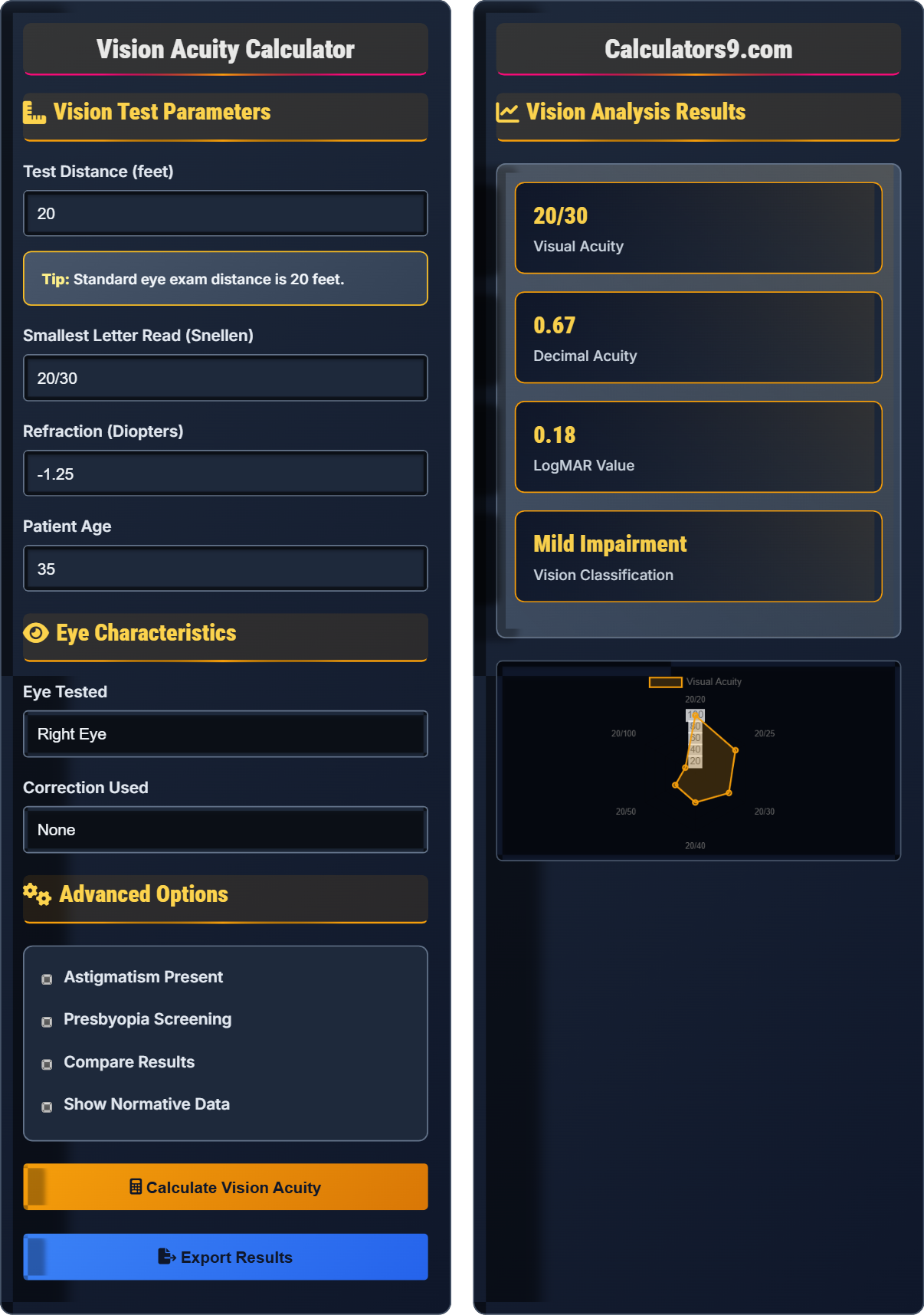
Vision Analysis Results
| Measurement | Value | Unit | Reference |
|---|
| Parameter | Result | Normal Range | Status |
|---|
Vision Acuity Guide
Visual acuity measures the sharpness of vision, specifically the ability to distinguish fine details and shapes. It's typically measured using a Snellen chart with standardized letter sizes. Normal vision is considered 20/20, meaning a person can see at 20 feet what should normally be seen at that distance.
Visual acuity can be expressed in multiple systems:
Where:
- \(VA\) = Visual Acuity (decimal form)
- \(S_{test}\) = Smallest letter size read at test distance
- \(S_{standard}\) = Standard letter size for normal vision
Standard vision testing protocols:
- Test Distance: 20 feet (6 meters) for distance vision
- Illumination: 480 lux minimum lighting
- Letter Recognition: 50% of letters in row for passing score
- Correction: With or without optical correction
- Binocular vs Monocular: Test each eye separately
- Driver's License: Typically requires 20/40 or better in most states
- Legal Blindness: 20/200 or worse in better eye with correction
- Workplace Safety: Many jobs require specific acuity levels
- Medical Monitoring: Changes may indicate eye disease
- Child Development: Vision screening important for learning
Vision Acuity Quiz
What does 20/40 vision mean?
The answer is A) Can see at 20 feet what normal eyes see at 40 feet. In Snellen notation, the first number represents the test distance (20 feet), and the second number represents the distance at which a person with normal vision can read the same line (40 feet). This means the person needs to be twice as close to see what normal vision sees at 40 feet.
Snellen notation is expressed as a fraction where the numerator is the test distance and the denominator is the distance at which normal vision can read the same line. So 20/40 means the person reads at 20 feet what someone with normal vision reads at 40 feet, indicating reduced visual acuity.
Visual Acuity: Sharpness of vision measured by ability to distinguish fine details
Snellen Chart: Standardized eye chart with progressively smaller letters
Normal Vision: 20/20 vision, considered standard for normal sight
• First number = test distance
• Second number = distance normal vision reads the same line
• Higher second number = poorer vision
• Remember: 20/20 is normal, 20/40 is worse
• Larger second number means more vision impairment
• Reversing the interpretation of numerator and denominator
• Assuming higher numbers always mean better vision
Convert 20/50 vision to decimal form and explain what this means.
Step 1: Convert to decimal
\(Decimal\,Acuity = \frac{20}{50} = 0.4\)
Step 2: Interpretation
A decimal acuity of 0.4 means the person can see at 20 feet what a person with normal vision can see at 50 feet. This represents 40% of normal visual acuity.
Decimal form expresses visual acuity as a decimal where 1.0 represents normal vision (20/20). Values less than 1.0 indicate reduced acuity, while values greater than 1.0 indicate better than normal acuity (such as 20/15 = 1.33).
Decimal Acuity: Visual acuity expressed as a decimal (1.0 = normal)
LogMAR: Logarithm of the minimum angle of resolution
Snellen Fraction: Traditional vision measurement format
• Decimal = numerator ÷ denominator
• 1.0 = normal vision (20/20)
• <1.0 = reduced vision
• Divide first number by second to get decimal
• Decimal × 100 = percentage of normal vision
• Dividing denominator by numerator instead
• Confusing decimal with diopter values
A state requires 20/40 vision in at least one eye for an unrestricted driver's license. If a person has 20/50 vision in their right eye and 20/30 in their left eye, can they obtain an unrestricted license? Explain your answer.
Step 1: Identify the better eye
Right eye: 20/50 (decimal = 0.4)
Left eye: 20/30 (decimal = 0.67)
The left eye has better vision.
Step 2: Compare to requirement
Required: 20/40 or better (decimal = 0.5 or higher)
Left eye: 20/30 (decimal = 0.67)
Step 3: Conclusion
Since 20/30 is better than 20/40 (0.67 > 0.5), the person can obtain an unrestricted driver's license.
This problem demonstrates how visual acuity requirements work in real-world applications. When requirements specify "at least one eye," the better eye determines eligibility. The person's left eye (20/30) exceeds the minimum requirement (20/40), so they qualify.
Driver's License Vision: Minimum acuity required for driving privileges
Binocular Vision: Vision with both eyes open
Monocular Vision: Vision with one eye
• Better eye determines eligibility when "at least one eye" is specified
• Always identify the better eye first
• Convert to decimal for easier comparison
• Comparing the worse eye instead of the better eye
• Confusing which is better: 20/30 vs 20/50
A patient's vision deteriorates from 20/20 to 20/80 over 6 months. Calculate the percentage change in decimal acuity and explain the clinical significance.
Step 1: Convert to decimal acuity
Initial: 20/20 = 1.0
Current: 20/80 = 0.25
Step 2: Calculate percentage change
\(Change = \frac{New - Old}{Old} \times 100 = \frac{0.25 - 1.0}{1.0} \times 100 = -75\%\)
Step 3: Clinical significance
The patient experienced a 75% reduction in visual acuity, which represents a significant decline. This level of deterioration (from normal to severe impairment) warrants immediate ophthalmologic evaluation as it may indicate serious eye disease.
This example shows how monitoring visual acuity changes over time is clinically important. A 75% reduction from normal vision represents a dramatic decline that requires medical attention. Such rapid deterioration could indicate cataracts, macular degeneration, or other serious conditions.
Visual Field: Total area that can be seen without moving the eyes
Progressive Vision Loss: Gradual deterioration of visual acuity
Acute Vision Loss: Sudden decrease in visual acuity
• Rapid vision changes require medical evaluation
• Percentage change = ((new - old) / old) × 100
• Significant changes may indicate underlying disease
• Monitor vision changes over time
• Report sudden changes immediately
• Forgetting to take absolute value in percentage change
• Not recognizing clinical significance of rapid changes
What is the LogMAR value for 20/40 vision?
The answer is C) 0.3. LogMAR (Logarithm of the Minimum Angle of Resolution) is calculated as: LogMAR = log₁₀(decimal acuity). For 20/40 vision: decimal acuity = 20/40 = 0.5, so LogMAR = log₁₀(0.5) = -log₁₀(2) ≈ -0.301. Since vision worse than 20/20 has positive LogMAR values, we use 0.301 ≈ 0.3.
The LogMAR system is used in research and clinical trials because it provides a linear scale for measuring visual acuity. Each 0.1 LogMAR unit represents a doubling/halving of the minimum angle of resolution. Normal vision (20/20) is 0.0 LogMAR, while 20/40 is approximately 0.3 LogMAR.
LogMAR: Logarithm of the minimum angle of resolution
Linear Scale: Equal steps represent equal vision changes
Research Standard: Preferred method for clinical studies
• LogMAR = log₁₀(decimal acuity)
• 0.0 LogMAR = 20/20 vision
• Higher values indicate poorer vision
• Each 0.1 LogMAR unit is one line on chart
• Positive values indicate worse than normal vision
• Confusing LogMAR with decimal acuity
• Not understanding the logarithmic nature
Vision Acuity Basics
Sharpness of vision measured by ability to distinguish fine details.
\(VA = \frac{S_{test}}{S_{standard}}\)
Where VA=visual acuity, S=test vs standard letter sizes.
- 20/20 = normal vision
- Higher second number = poorer vision
- Decimal acuity = 1.0 for normal vision
Clinical Analysis
Normal (20/20), Mild (20/30-20/40), Moderate (20/50-20/100), Severe (20/200+).
- Snellen fraction (20/20)
- Decimal acuity (1.0)
- LogMAR (0.0)
- Diopters (refractive error)
- Testing conditions
- Patient cooperation
- Age-related changes
- Pathological conditions
FAQ
Q: How accurate are vision acuity measurements?
A: Visual acuity measurements are highly standardized and reliable. The Snellen formula \( VA = \frac{S_{test}}{S_{standard}} \) provides consistent results when testing protocols are followed:
For 20/20 vision: \( VA = \frac{20}{20} = 1.0 \) (normal)
For 20/40 vision: \( VA = \frac{20}{40} = 0.5 \) (reduced)
Standard testing conditions include: 20-foot distance, proper illumination, and standardized letter sizes. Measurements are typically accurate to ±1 line on the chart (about ±0.1 decimal acuity).
Factors affecting accuracy include patient fatigue, cooperation, and environmental conditions.
Q: What's the difference between vision screening and comprehensive eye exam?
A: Vision screening primarily measures visual acuity using Snellen charts to detect vision problems. A comprehensive eye exam includes:
- Vision Testing: Snellen acuity measurement
- Refraction: Determining lens prescription
- Ocular Health: Examining eye structures
- Visual Fields: Testing peripheral vision
- Pupillary Responses: Checking neurological function
Screening identifies those needing comprehensive exams. For example, if screening reveals 20/50 vision (decimal = 0.4), a comprehensive exam would determine the cause and appropriate treatment.
Screening is efficient for population health, while comprehensive exams diagnose specific conditions.