Carbon Sequestration Calculator
CO2 removal • Environmental science
Carbon Sequestration Formula:
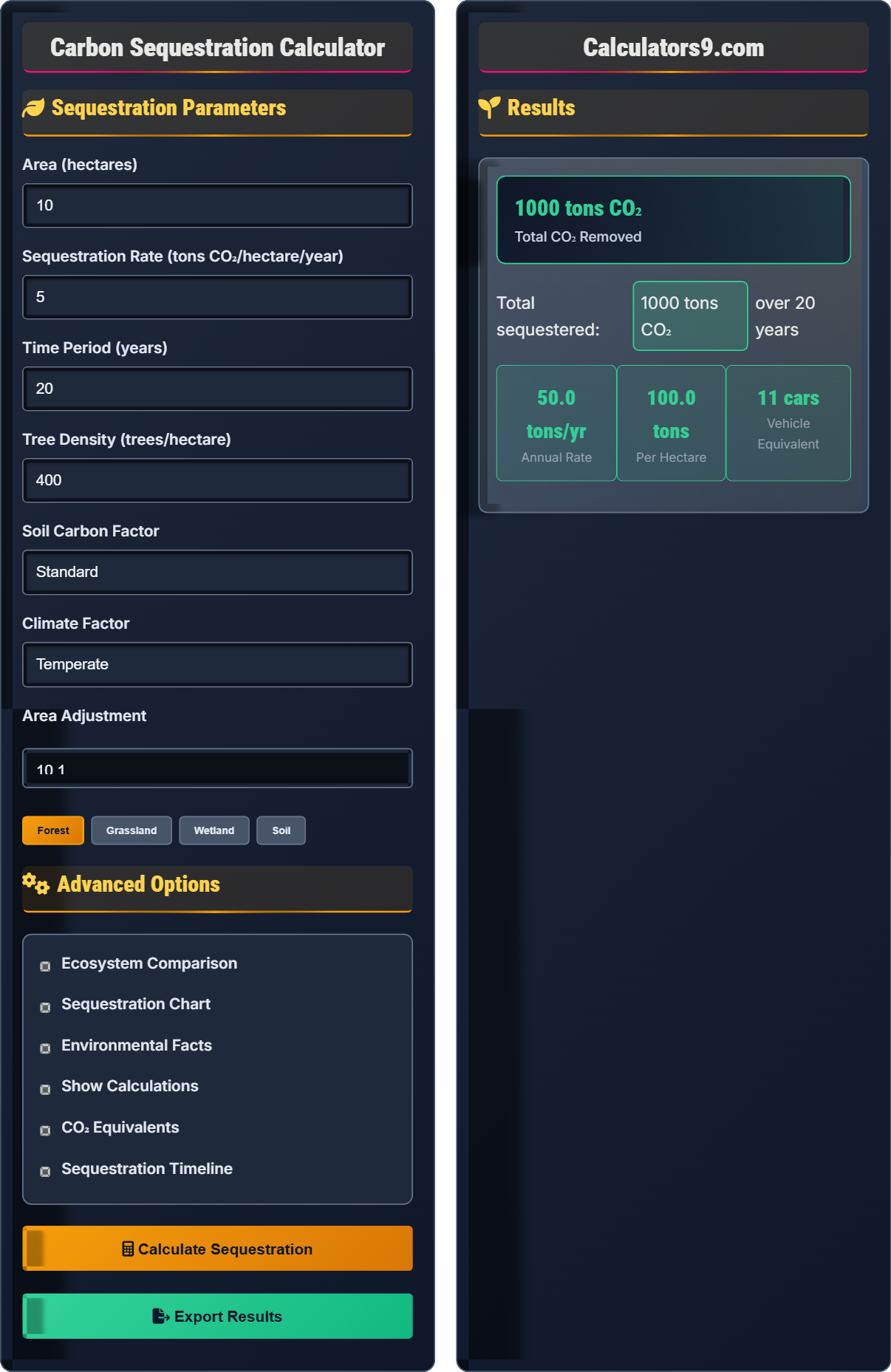
Show the calculator\( \text{CO}_2 \text{ Sequestered} = A \times R \times T \times F \)
Where:
- \( A \) = Area (hectares)
- \( R \) = Sequestration Rate (tons CO₂/hectare/year)
- \( T \) = Time (years)
- \( F \) = Forest/soil type factor
This formula calculates the amount of carbon dioxide that can be removed from the atmosphere by natural systems. Different ecosystems have varying sequestration rates based on their type, age, and environmental conditions.
Example: For a 10-hectare forest with a sequestration rate of 5 tons CO₂/hectare/year over 20 years with a factor of 1.2:
\( \text{CO}_2 \text{ Sequestered} = 10 \times 5 \times 20 \times 1.2 = 1200 \text{ tons CO}_2 \)
Therefore, the forest would sequester 1,200 tons of CO₂ over 20 years.
Sequestration Parameters
Advanced Options
Results
Carbon Sequestration Guide
Carbon sequestration is the process of capturing and storing atmospheric carbon dioxide. Natural systems like forests, grasslands, and soils act as carbon sinks, removing CO₂ from the atmosphere and storing it in biomass and organic matter. This process is crucial for mitigating climate change.
Mathematically expressed as:
Where A is area, R is sequestration rate, T is time, and F is environmental factors. This formula helps quantify the carbon storage potential of different ecosystems.
| Ecosystem | Rate (tons/ha/yr) | Storage Potential | Time to Maturity | Benefits |
|---|---|---|---|---|
| Temperate Forest | 4-8 | High | 20-50 years | Biodiversity, water regulation |
| Tropical Forest | 8-12 | Very High | 50-100 years | Species richness, climate regulation |
| Boreal Forest | 2-6 | Medium-High | 50-100 years | Permafrost protection, wildlife |
| Grassland | 2-4 | Medium | 5-10 years | Soil health, grazing |
| Wetland | 4-6 | High | 10-20 years | Flood control, water filtration |
| Agricultural Soil | 1-3 | Low-Medium | Continuous | Food production, soil health |
Environmental Science
Process of capturing and storing atmospheric CO₂.
\( \text{Rate} = A \times R \times T \times F \)
Based on area, rate, time, and environmental factors.
- Older forests store more carbon
- Tropical forests have higher rates
- Soil carbon is long-term storage
Climate Mitigation
Long-term retention of captured CO₂ in ecosystems.
\( \text{Storage} = \text{Biomass} + \text{Soil Organic Matter} \)
Combined above and below-ground carbon.
- Forest management affects sequestration
- Disturbances release stored carbon
- Soil carbon is more stable than biomass
Carbon Sequestration Quiz
Which ecosystem typically has the highest carbon sequestration rate per hectare per year?
The answer is C) Tropical rainforest. Tropical rainforests typically have the highest sequestration rates, ranging from 8-12 tons CO₂/hectare/year. This is due to high temperatures, abundant rainfall, and year-round growing conditions that support rapid plant growth and carbon uptake. While temperate forests and grasslands also sequester carbon, tropical forests generally have the highest rates due to their optimal growing conditions.
This question tests understanding of how environmental conditions affect carbon sequestration. Tropical rainforests have ideal conditions for photosynthesis (warm temperatures, high humidity, consistent rainfall), leading to high productivity and carbon storage. The question emphasizes that climate and ecosystem type are key factors in sequestration potential.
Carbon Sequestration: Process of capturing and storing atmospheric CO₂
Sequestration Rate: Amount of CO₂ stored per unit area per year
Photosynthesis: Process plants use to convert CO₂ to biomass
• Higher productivity = higher sequestration
• Tropical conditions optimize growth
• Age affects sequestration capacity
• Think of growing conditions: warmth, water, sunlight
• Tropical = optimal conditions = highest rates
• Thinking temperate forests have higher rates than tropical
• Not considering the impact of climate on productivity
A 50-hectare forest has a sequestration rate of 6 tons CO₂/hectare/year. If the forest maintains this rate for 25 years, how much CO₂ will it sequester? Show your work using the formula: CO₂ = A × R × T.
Given: A = 50 hectares, R = 6 tons CO₂/hectare/year, T = 25 years
Step 1: Apply the sequestration formula: CO₂ = A × R × T
Step 2: CO₂ = 50 × 6 × 25
Step 3: CO₂ = 300 × 25
Step 4: CO₂ = 7,500 tons CO₂
Therefore, the forest will sequester 7,500 tons of CO₂ over 25 years.
This problem demonstrates the direct relationship between area, rate, and time in carbon sequestration calculations. The formula is straightforward multiplication, but it's important to keep track of units (hectares, tons, years) and ensure they cancel appropriately to give the final answer in tons of CO₂.
Sequestration Rate: Tons of CO₂ stored per hectare per year
Carbon Storage: Total amount of CO₂ held in ecosystem• CO₂ = Area × Rate × Time
• Units must be consistent
• Rate is per unit area per year
• Always check units match the formula
• Larger area = more sequestration
• Longer time = more sequestration
• Forgetting to multiply all three factors
• Using inconsistent units
• Confusing rate per area with total rate
A forest manager is comparing two forest management strategies for a 100-hectare area. Strategy A involves maintaining old-growth forest with a sequestration rate of 8 tons CO₂/hectare/year. Strategy B involves harvesting and replanting every 30 years, with young forests sequestering at 10 tons CO₂/hectare/year. Over a 60-year period, which strategy sequesters more carbon? Calculate the total for each strategy.
Strategy A (Old-growth forest):
CO₂ = 100 × 8 × 60 = 48,000 tons CO₂
Strategy B (Harvest and replant every 30 years):
First 30 years: 100 × 10 × 30 = 30,000 tons CO₂
Next 30 years (new forest): 100 × 10 × 30 = 30,000 tons CO₂
Total for Strategy B: 30,000 + 30,000 = 60,000 tons CO₂
Therefore, Strategy B (harvest and replant) sequesters 60,000 tons compared to Strategy A's 48,000 tons over 60 years.
This problem illustrates the complex relationship between forest age and sequestration rate. Young forests typically have higher sequestration rates than mature forests, but older forests store more carbon overall. The calculation shows that continuous high-rate sequestration can exceed steady-state sequestration over time, though this is a simplified model that doesn't account for carbon released during harvesting.
Old-Growth Forest: Mature forest with high biomass storage
Young Forest: Recently established forest with high growth rate
Forest Rotation: Harvesting and replanting schedule
• Young forests have higher sequestration rates
• Old forests have higher total storage
• Management affects both rate and storage
• Consider both rate and duration
• Young forests grow faster initially
• Continuous sequestration beats steady state
• Thinking old forests sequester faster than young ones
• Forgetting to account for the entire time period
• Not considering the harvest-replant cycle
A city aims to offset 50,000 tons of CO₂ emissions annually. If they can establish 1,000 hectares of forest with an average sequestration rate of 5 tons CO₂/hectare/year, how many years will it take to offset the emissions? What happens if the forest reaches maturity after 20 years and the sequestration rate drops to 3 tons CO₂/hectare/year?
Before maturity (first 20 years):
Annual sequestration = 1,000 × 5 = 5,000 tons CO₂/year
To offset 50,000 tons annually: 50,000/5,000 = 10 years
After maturity (year 21+):
Annual sequestration = 1,000 × 3 = 3,000 tons CO₂/year
At this rate, they would offset only 3,000 tons/year vs. 50,000 tons emitted
Therefore, it takes 10 years to offset annual emissions initially, but after 20 years, the forest can only offset 6% of annual emissions.
This problem demonstrates the temporal dynamics of carbon sequestration projects. Initially, the forest provides significant offset, but as it matures, the sequestration rate decreases. This highlights the importance of long-term planning in carbon offset projects and the need for ongoing management strategies to maintain sequestration capacity.
Carbon Offset: Reduction in emissions to compensate for emissions elsewhere
Sequestration Dynamics: How sequestration rates change over time
Management Strategy: Approach to maintain sequestration capacity
• Sequestration rates change over time
• Long-term planning is essential
• Maintenance affects sustainability
• Plan for changing sequestration rates
• Consider rotation schedules
• Account for maturity effects
• Assuming constant sequestration rates forever
• Not considering the temporal aspect
• Forgetting about forest maturation effects
Which of the following factors does NOT directly affect the carbon sequestration rate of a forest?
The answer is D) Number of visitors to the forest. While tree species composition affects growth rates and biomass accumulation, soil fertility influences nutrient availability for plant growth, and atmospheric CO₂ concentration affects photosynthesis rates, the number of visitors does not directly affect the forest's ability to sequester carbon. Visitor presence might indirectly affect forest health through disturbance, but it's not a direct factor in the sequestration process itself.
This question tests understanding of which factors directly influence the biological processes of carbon sequestration. Direct factors are those that affect photosynthesis, growth, and carbon storage mechanisms. Indirect factors might affect forest health but don't directly influence the sequestration process. This distinction is important for proper forest management and carbon accounting.
Direct Factor: Affects sequestration processes immediately
Indirect Factor: Affects forest health but not sequestration directly
Photosynthesis: Primary mechanism for carbon capture
• Direct factors: growth, nutrients, CO₂
• Indirect factors: disturbance, management
• Sequestration is biological process
• Focus on biological processes
• Consider what affects plant growth
• Distinguish direct vs. indirect effects
• Including human activity as direct factor
• Confusing indirect effects with direct ones
• Not distinguishing between biological and social factors
FAQ
Q: How long does carbon remain stored in forests?
A: Carbon storage duration varies by component:
- Living biomass: 20-100 years (depends on tree species and forest type)
- Dead wood: 10-50 years (slow decomposition)
- Forest floor: 5-20 years (litter and organic matter)
- Soil organic matter: 50-500 years (longest storage)
Overall, forests can store carbon for decades to centuries. Old-growth forests store carbon for the longest periods, but they sequester at lower rates than younger forests. The key is maintaining forest health and preventing disturbances that release stored carbon back to the atmosphere.
Q: What's the difference between carbon sequestration and carbon storage?
A: These terms are related but distinct:
Carbon Sequestration: The process of capturing and storing atmospheric CO₂. This is an active process that removes CO₂ from the atmosphere and incorporates it into living biomass or soil organic matter.
Carbon Storage: The amount of carbon currently held in a system. This is a stock measure of how much carbon is stored at a given time.
Think of sequestration as the rate at which water flows into a reservoir, and storage as the amount of water currently in the reservoir. A forest sequesters carbon by absorbing CO₂, and stores it in trees, soil, and other organic matter.