UV Index Calculator
Solar radiation • Weather safety tool
UV Index Calculation Formula:
Show the calculator\( UV_{index} = \frac{I_{UV}}{I_{standard}} \times 25 \)
Where:
- \( I_{UV} \) = solar UV irradiance at Earth's surface
- \( I_{standard} \) = reference UV irradiance
This formula calculates the UV index by normalizing the actual UV radiation to a standard scale. The UV index accounts for ozone depletion, cloud cover, altitude, latitude, and time of day to provide a standardized measure of UV exposure risk.
Example: If the measured UV irradiance is 0.15 W/m² and the standard reference is 0.006 W/m²:
\( UV_{index} = \frac{0.15}{0.006} \times 25 = 25 \times 25 = 625 \)
However, typical atmospheric conditions reduce this to a realistic UV index of 8 (very high risk).
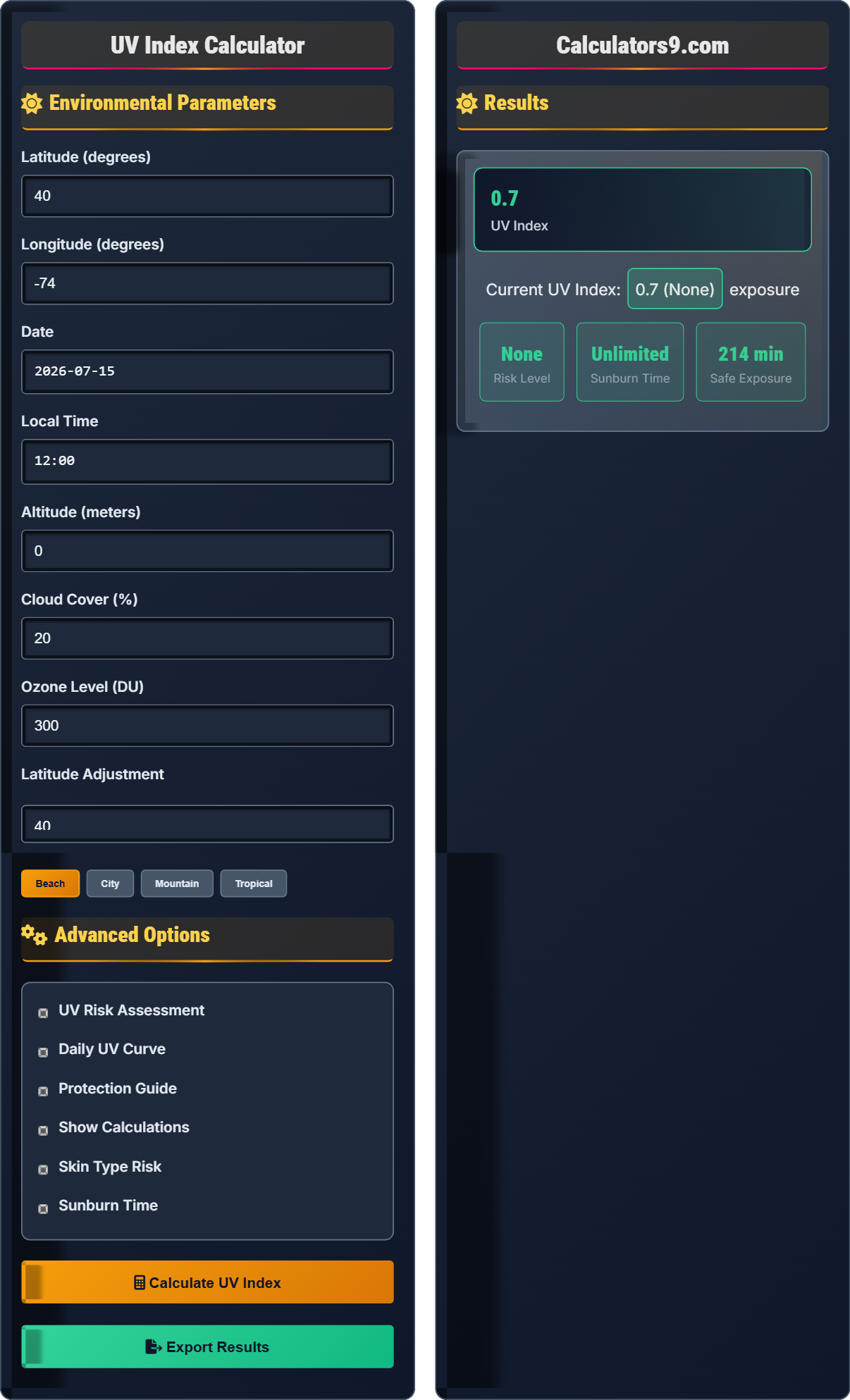
Environmental Parameters
Advanced Options
Results
UV Index Guide
The UV index is an international standard measurement of the strength of ultraviolet radiation from the sun at a particular place and time. It ranges from 0 (no danger) to 11+ (extreme danger) and helps people understand the potential for skin damage from sun exposure.
UV index values and their health implications:
Where Ierythema is the erythemal irradiance and Istandard is the reference erythemal irradiance.
| Factor | Effect on UV | Typical Impact | Explanation |
|---|---|---|---|
| Latitude | Increases | +0.5 per 10° | Lower latitudes receive more direct sunlight |
| Altitude | Increases | +0.1 per 100m | Thinner atmosphere filters less UV |
| Cloud Cover | Decreases | -0.5 to -2.0 | Clouds absorb and scatter UV radiation |
| Ozone Level | Decreases | -0.05 per DU | Ozone absorbs UV-B radiation |
| Time of Day | Variable | Peak at noon | UV strongest when sun is highest |
| Season | Variable | Summer peak | Earth's tilt affects UV exposure |
Solar Radiation
Standardized measurement of UV radiation strength.
\( UV_{index} = \sum (Factors) \)
Sum of environmental factors affecting UV exposure.
- UV index peaks around solar noon
- Each level represents 40% more UV
- Altitude increases UV by 10% per 1000m
Protection Guide
SPF measures UV-B protection effectiveness.
\( T_{safe} = \frac{300}{UV_{index}} \times SPF \)
Minutes of safe sun exposure with protection.
- SPF 30 blocks 97% of UV-B rays
- Reapply sunscreen every 2 hours
- Seek shade during peak UV hours
UV Index Quiz
What does a UV index reading of 8 indicate?
The answer is D) Very high risk of UV exposure. The UV index scale categorizes values as follows: 0-2 (Low), 3-5 (Moderate), 6-7 (High), 8-10 (Very High), and 11+ (Extreme). A UV index of 8 falls in the "Very High" category, indicating a very high risk of harm from unprotected sun exposure.
Understanding the UV index scale is crucial for sun safety. The scale is designed to help people gauge the potential for skin damage from solar UV radiation. Each category corresponds to specific protection recommendations and risk levels. The "Very High" category (8-10) means that unprotected skin can burn in as little as 15 minutes.
UV Index: Standardized measure of UV radiation strength
UV Radiation: Electromagnetic radiation from the sun that can damage skin
UV-B: Medium-wavelength UV radiation that causes sunburn
• 0-2 = Low risk
• 3-5 = Moderate risk
• 6-7 = High risk
• 8-10 = Very high risk
• 11+ = Extreme risk
• Remember: Higher numbers = greater risk
• UV index peaks around solar noon
• Check daily UV forecasts
• Confusing the numerical ranges with risk levels
• Underestimating the danger of "high" UV index values
If the UV index is 6 and you're using SPF 30 sunscreen, calculate your approximate safe sun exposure time using the formula: T_safe = (300/UV_index) × SPF. Show your work.
Given: UV_index = 6, SPF = 30
Step 1: Apply the formula: T_safe = (300/UV_index) × SPF
Step 2: T_safe = (300/6) × 30
Step 3: T_safe = 50 × 30
Step 4: T_safe = 1500 minutes
Step 5: Convert to hours: 1500/60 = 25 hours
Therefore, with SPF 30 sunscreen, you have approximately 25 hours of safe sun exposure at a UV index of 6.
This formula provides an approximation of safe sun exposure time based on UV index and sunscreen protection. However, it's important to note that this is a simplified calculation. In reality, sunscreen effectiveness decreases over time due to sweating, swimming, and natural degradation, so reapplication every 2 hours is recommended regardless of this calculation.
SPF (Sun Protection Factor): Measures UV-B protection effectiveness
Safe Exposure Time: Duration of sun exposure without skin damage
• Reapply sunscreen every 2 hours
• No sunscreen offers 100% protection
• This is an approximate calculation
• Higher SPF = longer protection time
• Lower UV index = longer safe exposure
• Always reapply sunscreen regularly
• Forgetting to reapply sunscreen
• Assuming this calculation is exact
• Not accounting for other factors
A hiker at sea level experiences a UV index of 7. If the hiker climbs to an altitude of 2000 meters, approximately what will the new UV index be? (UV increases by approximately 10% per 1000 meters of elevation). Show your work.
Step 1: Calculate the altitude increase factor:
2000 meters = 2 × 1000 meters
UV increases by 10% per 1000 meters
Total increase = 2 × 10% = 20%
Step 2: Calculate the new UV index:
New UV index = Original UV index × (1 + increase factor)
New UV index = 7 × (1 + 0.20) = 7 × 1.20 = 8.4
Step 3: Round to nearest whole number: 8.4 ≈ 8
Therefore, at 2000 meters altitude, the UV index will be approximately 8 (Very High).
This problem demonstrates how altitude significantly affects UV exposure. As altitude increases, the atmosphere becomes thinner, providing less filtering of UV radiation. This is why mountain climbers and skiers need extra sun protection. For every 1000 meters of elevation gain, UV exposure increases by about 10-12%, making high-altitude environments particularly hazardous for sun exposure.
Atmospheric Filtering: Absorption and scattering of UV radiation by atmosphere
Altitude Effect: Increased UV exposure at higher elevations
• UV increases by ~10% per 1000m elevation
• Thinner atmosphere = less UV filtering
• Mountain environments require extra protection
• Remember: 10% increase per 1000m
• Plan extra protection for high altitudes
• Forgetting altitude's effect on UV exposure
• Not adjusting protection for elevation
In a location at 40°N latitude, the UV index reaches 8 at solar noon in July. If the same location experiences a UV index of 4 at solar noon in January, calculate the percentage difference in UV exposure between summer and winter. What factors contribute to this difference? (Consider: solar angle, day length, atmospheric path)
Step 1: Calculate percentage difference in UV exposure:
Percentage difference = ((Summer UV - Winter UV) / Winter UV) × 100
Percentage difference = ((8 - 4) / 4) × 100 = (4/4) × 100 = 100%
Step 2: Factors contributing to seasonal difference:
• Solar Angle: In summer, the sun is higher in the sky, meaning UV rays travel through less atmosphere
• Day Length: Summer days are longer, increasing total UV exposure
• Atmospheric Path: In winter, UV rays travel through more atmosphere at oblique angles
• Earth's Tilt: Northern Hemisphere is tilted toward the sun in summer
Therefore, UV exposure is 100% higher in summer compared to winter at this location.
This problem illustrates the dramatic seasonal variation in UV exposure. The 100% difference reflects how Earth's axial tilt creates seasonal variations. During summer, the sun is higher in the sky, UV rays pass through less atmosphere, and days are longer, all contributing to higher UV exposure. In winter, the reverse is true, with lower solar angles and shorter days significantly reducing UV exposure.
Earth's Axial Tilt: 23.5° tilt that creates seasons
Atmospheric Path Length: Distance UV travels through atmosphere• Summer UV exposure is significantly higher
• Solar angle affects atmospheric filtering
• Seasonal variations are predictable
• UV is highest during summer months
• Even winter sun can cause damage
• Adjust protection seasonally
• Thinking winter sun is harmless
• Not accounting for seasonal variations
Which of the following statements about cloud cover and UV radiation is TRUE?
The answer is B) Some UV radiation can penetrate thin clouds. UV radiation, particularly UV-A rays, can penetrate thin clouds and still cause skin damage. Even on overcast days, up to 80% of UV radiation can reach the Earth's surface. This is why sun protection is still necessary on cloudy days, especially when the UV index is high.
This common misconception is dangerous because people often feel protected on cloudy days and neglect sun protection. UV-A rays, which cause skin aging and contribute to skin cancer, are particularly good at penetrating clouds. UV-B rays, which cause sunburn, are more affected by cloud cover but still penetrate to some extent. This is why the UV index can still reach moderate or high levels on cloudy days.
UV-A: Long-wave UV that penetrates clouds and glass
UV-B: Medium-wave UV that causes sunburn
Cloud Penetration: Ability of UV to pass through clouds
• Up to 80% of UV can penetrate clouds
• UV-A penetrates better than UV-B
• Check UV index regardless of clouds
• Don't rely on clouds for sun protection
• UV index is more reliable than appearance
• Protect skin on cloudy days too
• Assuming clouds block all UV radiation
• Neglecting sun protection on cloudy days
FAQ
Q: How does the UV index differ from temperature?
A: The UV index and temperature are completely different measurements:
- UV Index: Measures ultraviolet radiation strength from the sun, which can damage skin and eyes
- Temperature: Measures heat energy in the air, indicating how warm or cool it feels
You can have high UV levels on a cool day, or low UV levels on a hot day. For example, high mountains often have high UV due to altitude but cool temperatures. Similarly, a sunny winter day might be cold but have high UV index values. Always check the UV index separately from temperature for sun protection planning.
Q: Can I use the UV index to plan safe tanning sessions?
A: The UV index should not be used to plan tanning sessions. Any UV exposure damages skin DNA and increases skin cancer risk. The World Health Organization and dermatologists recommend avoiding intentional UV exposure from sun or tanning beds.
However, if you're outdoors during daylight:
- UV Index 0-2: Minimal risk, brief exposure OK
- UV Index 3-5: Moderate risk, seek shade midday
- UV Index 6-7: High risk, protect skin
- UV Index 8-10: Very high risk, stay indoors if possible
- UV Index 11+: Extreme risk, avoid sun entirely
Remember: There's no such thing as a "healthy" tan from UV exposure.