NoSQL Schema Validator
Document validation • Structure analysis • Schema compliance
NoSQL Schema Validation & Document Structure
Validate SchemaNoSQL databases use flexible document schemas for data storage.
Key validation aspects:
- Document Structure: Field presence and types
- Data Types: String, number, boolean, object, array
- Required Fields: Mandatory field validation
- Pattern Matching: Regular expression validation
- Nested Objects: Recursive validation
Compliance Score: 0-100 scale based on schema adherence
Proper validation ensures data integrity in NoSQL databases.
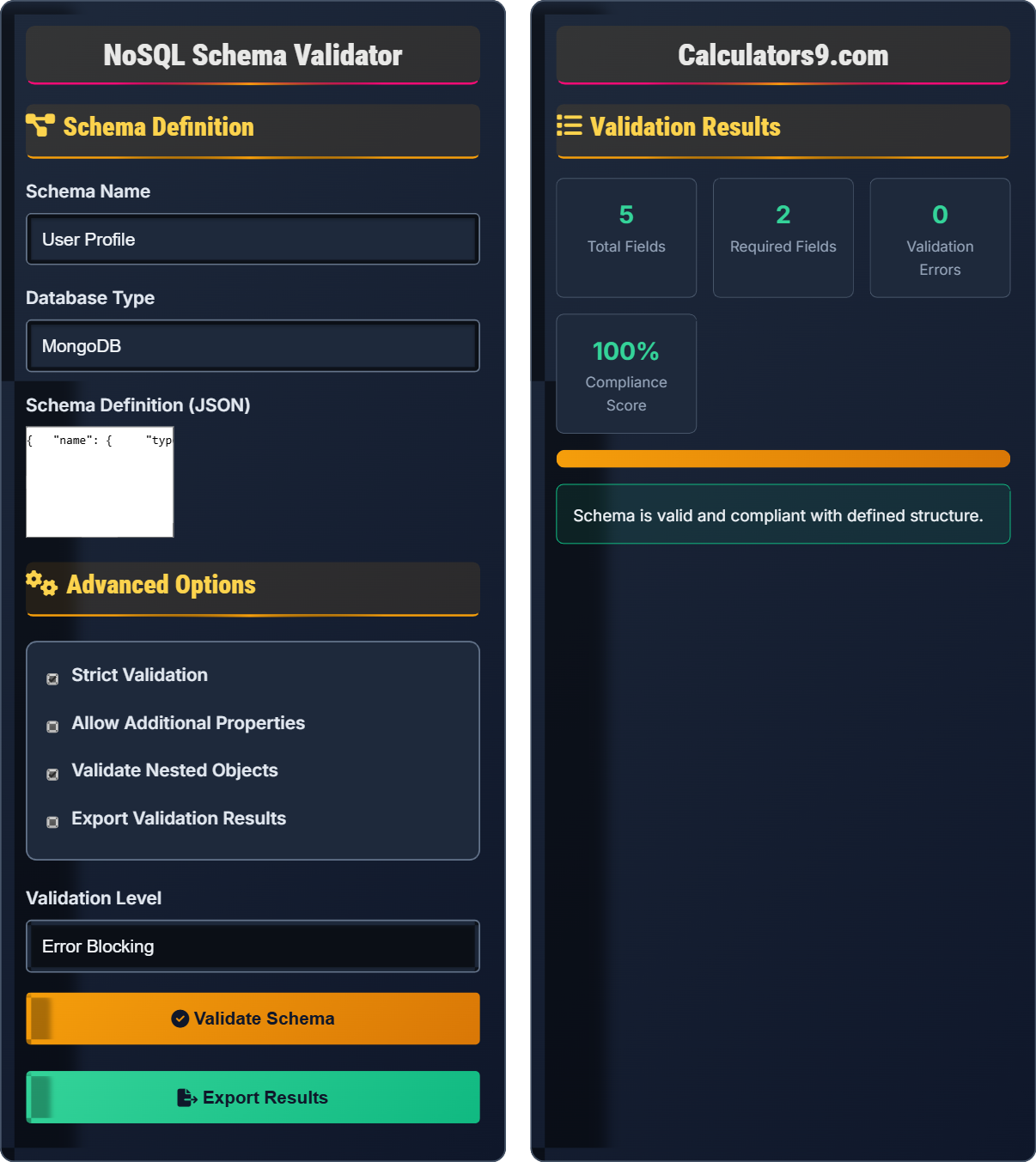
Schema Definition
Advanced Options
Validation Results
NoSQL Schema Validation & Document Structure Guide
NoSQL databases offer flexible schema validation:
Effective schema validation practices:
- Define Required Fields: Ensure critical data exists
- Type Validation: Verify data types match expectations
- Pattern Matching: Validate format with regex
- Range Constraints: Limit numeric values
- Nested Validation: Validate complex object structures
Common schema design approaches:
- Embedded Documents: Store related data together
- References: Link related documents
- Array of Objects: Collections within documents
- Polymorphic Structures: Flexible document types
- Versioning: Track schema evolution
- Index Strategy: Design indexes for common queries
- Document Size: Keep documents under 16MB
- Validation Complexity: Balance thoroughness with performance
- Read/Write Patterns: Optimize for access patterns
- Sharding Keys: Plan for horizontal scaling
NoSQL Schema Fundamentals
Flexible data structure definition for document databases.
Fields, types, constraints, and validation rules.
JSON-based structure definition.
- Flexible but structured
- Field validation required
- Type safety important
- Performance considerations
Validation Process
Systematic verification of document structure.
- Analyze schema definition
- Parse document structure
- Validate field types
- Check constraints
- Generate compliance report
- Required field presence
- Data type consistency
- Pattern matching compliance
- Nested object validation
NoSQL Schema Validation Learning Quiz
Which of the following is NOT a characteristic of NoSQL schema design?
The correct answer is C) Fixed relational schema. NoSQL databases are characterized by flexible schemas that can evolve over time, unlike traditional relational databases with fixed schemas. NoSQL allows for schema-on-read, where the structure is interpreted when data is read, and supports dynamic field addition to documents.
This question highlights the fundamental difference between NoSQL and relational databases. NoSQL databases embrace schema flexibility, allowing documents in the same collection to have different structures, which is essential for handling evolving data requirements in modern applications.
Schema-on-Read: Structure interpreted when data is accessed
Flexible Schema: Document structure can vary
Relational Schema: Fixed table structure
• NoSQL allows flexible document structures
• Schema can evolve without migrations
• Documents can have different fields
• Use schema validation for consistency
• Plan for schema evolution
• Consider indexing for performance
• Applying relational thinking to NoSQL
• Not validating document structure
• Ignoring performance implications
Given the following schema definition: {"name": {"type": "string", "required": true}, "age": {"type": "number", "min": 0, "max": 120}}, which document would fail validation?
The correct answer is B) {"name": "Alice", "age": -5}. The schema defines age as a number with a minimum value of 0. Since -5 is less than 0, this document fails the min constraint validation. The name field is valid (required string), but the age violates the minimum value constraint.
This demonstrates numeric range validation in NoSQL schemas. The min/max constraints ensure data stays within acceptable bounds. Age cannot be negative, so the validation rule prevents invalid data from entering the database.
Min Constraint: Minimum value allowed
Max Constraint: Maximum value allowed
Range Validation: Numeric value bounds
• Min/max constraints validate numeric ranges
• Negative values violate min=0 constraints
• All constraints must pass for validation
• Set appropriate min/max values
• Consider business logic in constraints
• Test edge cases in validation
• Not validating numeric ranges
• Setting inappropriate min/max values
• Forgetting negative number edge cases
A user profile schema requires an email field with pattern validation: ^[^\\s@]+@[^\\s@]+\\.[^\\s@]+$. Which of the following email addresses would FAIL validation against this regular expression?
The correct answer is C) user@@example.com. The regular expression ^[^\\s@]+@[^\\s@]+\\.[^\\s@]+$ requires exactly one @ symbol between the username and domain. The double @ symbol in "user@@example.com" violates the pattern, as the regex expects one @ followed by a domain and a dot with extension.
This demonstrates pattern validation using regular expressions. The regex breaks down as: ^[^\\s@]+ (start with non-whitespace, non-@ chars), @ (exactly one @), [^\\s@]+ (more non-whitespace, non-@ chars), \\., [^\\s@]+ (dot followed by extension). Multiple @ symbols violate this pattern.
Pattern Validation: Regex-based format validation
Regular Expression: Pattern matching syntax
Email Format: Standard email structure
• Email must have exactly one @ symbol
• Regex defines exact format requirements
• Pattern validation is strict
• Use comprehensive email regex patterns
• Test with various email formats
• Consider international domain names
• Using overly restrictive email patterns
• Not accounting for valid variations
• Forgetting to escape special characters
A document has a nested address object: {"name": "John", "address": {"street": "123 Main St", "city": "Anytown"}}. If the schema requires address.city to be a required field, which document would PASS validation?
Documents that would PASS validation include those with the address object containing a city field:
{"name": "John", "address": {"street": "123 Main St", "city": "Anytown"}}
The key requirement is that the nested address object must contain the required city field. The street field is optional in this example, so its presence doesn't affect validation of the city field.
Documents that would FAIL include:
{"name": "John", "address": {"street": "123 Main St"}} (missing city)
Validation of nested objects requires checking each level of the document structure.
This demonstrates recursive validation of nested objects. The validator must traverse the document structure to ensure all required fields exist at their expected levels. Nested validation maintains the same rules as top-level fields.
Nested Validation: Recursive field validation
Object Traversal: Walking document structure
Recursive Rules: Same validation at all levels
• Required fields must exist in nested objects
• Validation applies recursively to all levels
• Missing nested fields cause validation failure
• Define clear nested object schemas
• Use consistent naming conventions
• Validate at each level separately
• Not validating nested required fields
• Complex nesting without proper validation
• Assuming nested objects inherit parent rules
What is the primary advantage of flexible schema design in NoSQL databases compared to rigid relational schemas?
The answer is B) Easier schema evolution and agility. Flexible schemas allow for adding new fields, changing data types, or modifying document structure without requiring database migrations. This enables rapid development and adaptation to changing business requirements.
Schema flexibility is the primary advantage of NoSQL databases, enabling agile development. Unlike relational databases that require schema migrations for changes, NoSQL allows documents to evolve independently, supporting iterative development cycles.
Schema Evolution: Changing structure over time
Database Migration: Schema change process
Agile Development: Iterative approach
• Flexible schemas support rapid iteration
• No migration required for schema changes
• Documents can have different structures
• Plan for schema versioning
• Use validation to maintain consistency
• Monitor schema drift
• Assuming NoSQL doesn't need any structure
• Not validating documents for consistency
• Allowing excessive schema drift
FAQ
Q: How does NoSQL schema validation differ from relational database constraints?
A: Key differences include:
- Flexibility: NoSQL allows varying document structures
- Validation Point: NoSQL validates during write operations
- Schema Evolution: NoSQL doesn't require migrations
- Constraint Types: NoSQL focuses on document structure
Relational databases enforce rigid schemas, while NoSQL provides flexible validation that can evolve with application needs.
Q: What are the performance implications of extensive schema validation in NoSQL databases?
A: Performance considerations:
- Write Performance: Validation adds overhead to insert/update operations
- Complexity: Deeply nested validation is more expensive
- Caching: Compiled validation rules can improve performance
- Indexing: Proper indexes offset validation costs
Balance thorough validation with performance requirements. Consider validation level based on use case criticality.