Normalization Checker
Database normalization verification tool • 1NF, 2NF, 3NF, BCNF
Database Normalization Overview:
Check NormalizationDatabase normalization is the systematic approach of organizing data in a relational database to minimize redundancy and dependency. The main normal forms are:
- 1NF (First Normal Form): Eliminate repeating groups and ensure atomic values
- 2NF (Second Normal Form): Achieve 1NF and remove partial dependencies
- 3NF (Third Normal Form): Achieve 2NF and remove transitive dependencies
- BCNF (Boyce-Codd Normal Form): Strengthened version of 3NF
Normalization ensures data integrity, reduces storage requirements, and prevents update anomalies. Each normal form builds upon the previous ones, creating increasingly robust database structures.
Example: A student enrollment table violates 1NF if a student can enroll in multiple courses stored as a comma-separated list in a single field. To achieve 1NF, each course enrollment must be stored in a separate row.
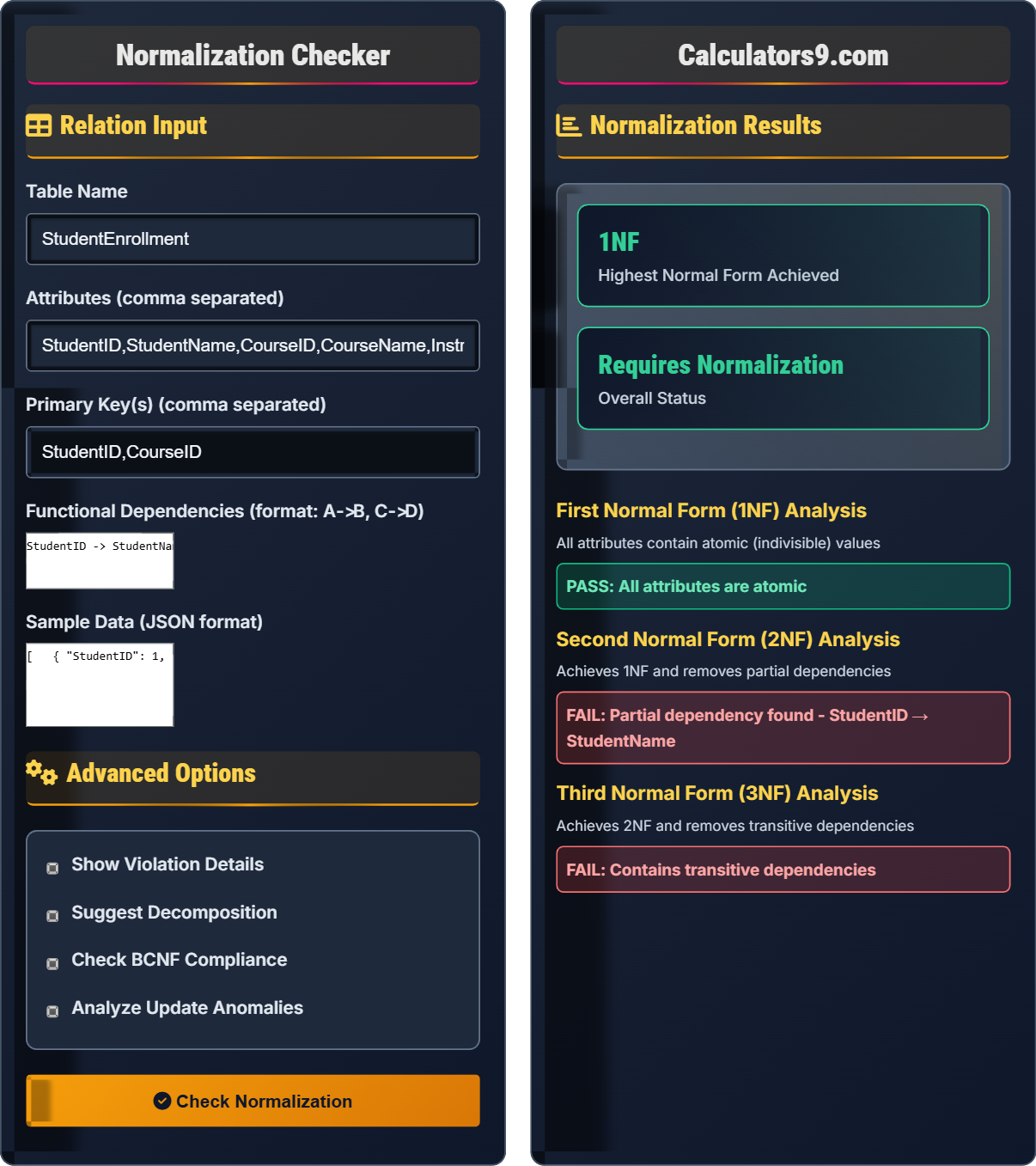
Relation Input
Advanced Options
Normalization Results
Comprehensive Database Normalization Guide
Database normalization is the process of structuring a relational database in accordance with a series of so-called normal forms to reduce data redundancy and improve data integrity. It was first proposed by Edgar F. Codd as part of his relational model.
Normalization organizes columns (attributes) and tables (relations) of a database to minimize redundancy of data (i.e., to not store the same data in more than one table) and ensure data dependencies make sense (i.e., only storing related data in a table).
A functional dependency exists when one attribute uniquely determines another attribute. If A and B are attributes of relation R, B is functionally dependent on A (denoted A → B), if each value of A in R is associated with exactly one value of B in R.
StudentID → StudentName
CourseID → CourseName
SSN → EmployeeName
Understanding functional dependencies is crucial for identifying normal form violations and designing normalized databases.
Without proper normalization, databases are prone to three types of anomalies:
- Insertion Anomaly: Cannot insert data without knowing other data
- Update Anomaly: Updating data requires multiple updates in multiple places
- Deletion Anomaly: Deleting data causes unintended loss of other data
Normalization helps eliminate these anomalies by properly structuring the database.
- Data Integrity: Ensures consistency and accuracy of data
- Reduced Redundancy: Eliminates duplicate data storage
- Storage Efficiency: Saves disk space and memory
- Easier Maintenance: Simplifies updates and modifications
- Scalability: Facilitates database growth and modification
Normalization Fundamentals
Values that cannot be further subdivided. Essential for 1NF compliance.
X → Y means "X determines Y" or "Y is functionally dependent on X"
- Each normal form builds upon previous ones
- Higher normal forms provide better data integrity
- Denormalization may be acceptable for performance
Best Practices
Attributes that can uniquely identify tuples in a relation.
- Identify problematic dependencies
- Create separate relations for each dependency
- Ensure lossless join property
- Maintain functional dependencies
- 3NF is sufficient for most applications
- BCNF eliminates all anomalies
- Performance vs. normalization trade-offs
- Query complexity considerations
Database Normalization Learning Quiz
Which of the following violates First Normal Form (1NF)?
The answer is B) A column containing comma-separated values. First Normal Form requires that all attribute values be atomic (indivisible). A column with comma-separated values violates this principle because it contains multiple values in a single field. For example, if a "Courses" column contains "Math,Science,History", this is not atomic and violates 1NF.
1NF is the foundational normal form that ensures data is stored in the most basic structured way. The atomicity requirement means each field should contain only one piece of information. This makes queries more reliable and enables proper indexing. When data is not atomic, it becomes difficult to search, sort, or perform operations on individual components.
Atomic Value: A value that cannot be further subdivided
Repeating Groups: Multiple values stored in a single field
1NF: First Normal Form - requires atomic values in all fields
• Every field must contain only one value
• No arrays or lists within a single field
• Each row-column intersection must have a single value
• Look for comma-separated values, semicolons, or any delimiter in a field
• Check for JSON objects or arrays stored as strings
• Verify that each field contains only one piece of information
• Confusing 1NF with uniqueness requirements
• Thinking 1NF applies only to numeric data
• Overlooking nested structures like JSON in text fields
Given a relation R(A, B, C, D) with functional dependencies A → B and C → D, which normal form is this relation in?
Let's analyze step by step:
Step 1: Check 1NF - We assume all attributes are atomic, so it's in 1NF.
Step 2: Check 2NF - We need to identify the primary key. Since A → B and C → D, neither A nor C alone can be the key. The minimal superkey is likely AC. Now check for partial dependencies: B depends only on A (part of key AC), and D depends only on C (part of key AC). Both B and D have partial dependencies on the key, so this violates 2NF.
Step 3: Conclusion - The relation is in 1NF but not in 2NF due to partial dependencies.
This problem demonstrates how to systematically check normal forms. The key insight is that partial dependencies occur when a non-key attribute depends on only part of the primary key. In our example, B depends on A (part of key AC), which creates a partial dependency violating 2NF. Understanding this pattern helps identify normalization issues.
Partial Dependency: A non-key attribute depending on only part of the primary key
Superkey: A set of attributes that can uniquely identify tuples
Candidate Key: A minimal superkey
• 2NF requires elimination of partial dependencies
• Determine the primary key before checking dependencies
• Non-key attributes must depend on the entire primary key
• Identify the primary key first
• Check if any non-key attributes depend on only part of the key
• Use Armstrong's axioms to derive additional dependencies
• Not properly identifying the primary key
• Confusing partial dependencies with transitive dependencies
• Assuming that having a composite key automatically violates 2NF
A company database has a relation EMPLOYEE(SSN, Name, DepartmentID, DepartmentName, ManagerName) with functional dependencies: SSN → Name, SSN → DepartmentID, DepartmentID → DepartmentName, DepartmentID → ManagerName. Does this relation violate 3NF? Explain why.
Yes, this relation violates 3NF. Here's the analysis:
Step 1: Primary key is SSN (since SSN → all other attributes)
Step 2: Check for partial dependencies - None exist since the key is single attribute SSN
Step 3: Check for transitive dependencies - Yes, there are transitive dependencies:
- DepartmentName depends transitively on SSN through DepartmentID (SSN → DepartmentID → DepartmentName)
- ManagerName depends transitively on SSN through DepartmentID (SSN → DepartmentID → ManagerName)
Since non-key attributes (DepartmentName, ManagerName) depend transitively on the primary key, this violates 3NF.
Transitive dependencies occur when A → B and B → C, then A → C transitively. In our example, SSN → DepartmentID and DepartmentID → DepartmentName, so SSN → DepartmentName transitively. This creates redundancy because DepartmentName and ManagerName will repeat for every employee in the same department, violating 3NF principles.
Transitive Dependency: When A → B and B → C, then A → C transitively
3NF: Third Normal Form - no transitive dependencies of non-key attributes
Non-key Attribute: An attribute not part of any candidate key
• 3NF requires elimination of transitive dependencies
• Non-key attributes must depend directly on the primary key
• Intermediate dependencies cause 3NF violations
• Look for chains of dependencies (A→B→C)
• Check if non-key attributes depend on other non-key attributes
• Consider extracting related attributes to separate tables
• Confusing direct dependencies with transitive ones
• Not recognizing intermediate dependencies
• Thinking that all multi-step dependencies violate 3NF
A library database has BOOK(BookID, Title, Author, Publisher, PubAddress) with functional dependencies: BookID → Title, BookID → Author, Publisher → PubAddress. The librarian notices that when a publisher changes address, they must update multiple records. How should the schema be decomposed to achieve 3NF?
This relation violates 3NF due to the transitive dependency: BookID → Publisher → PubAddress.
To achieve 3NF, decompose into two relations:
BOOK(BookID, Title, Author, Publisher)
PUBLISHER(Publisher, PubAddress)
Verification:
- In BOOK: BookID is the key, and all other attributes depend directly on it
- In PUBLISHER: Publisher is the key, and PubAddress depends directly on it
- No transitive dependencies remain
- The decomposition is lossless and preserves dependencies
Now when a publisher's address changes, only one record needs updating in the PUBLISHER table.
This example illustrates how normalization solves practical problems. The original schema caused update anomalies because changing a publisher's address required updating multiple book records. By decomposing the relation, we eliminate redundancy and ensure that each piece of information is stored in only one place, making updates more efficient and consistent.
Lossless Join: Decomposition allows original relation to be reconstructed
Dependency Preservation: All original functional dependencies are maintained
Update Anomaly: Situation requiring multiple updates for single logical change
• Decompose to eliminate transitive dependencies
• Maintain lossless join property
• Preserve functional dependencies when possible
• Group attributes that depend on the same determinant
• Create separate tables for each functional dependency
• Use foreign keys to maintain relationships between tables
• Creating too many small tables (over-normalization)
• Breaking functional dependencies during decomposition
• Not ensuring lossless join property
Which statement about BCNF (Boyce-Codd Normal Form) is TRUE compared to 3NF?
The answer is B) Every BCNF relation is also in 3NF. BCNF is a stronger normal form than 3NF. While 3NF allows certain dependencies where a non-prime attribute depends on another non-prime attribute, BCNF requires that every determinant be a superkey. This means BCNF eliminates all anomalies that 3NF allows, making every BCNF relation automatically satisfy 3NF requirements.
BCNF strengthens 3NF by addressing cases where 3NF might still have anomalies. In 3NF, we allow a functional dependency X → Y where Y is not prime (not part of any candidate key) if X is a superkey. BCNF removes this exception and requires that X must be a superkey for any non-trivial functional dependency X → Y. This makes BCNF more restrictive but also more robust against anomalies.
BCNF: Boyce-Codd Normal Form - every determinant is a superkey
Determinant: The left side of a functional dependency
Prime Attribute: Part of any candidate key
• BCNF is stricter than 3NF
• Every BCNF relation satisfies 3NF
• BCNF eliminates all functional dependency-based anomalies
• Think of BCNF as "3NF plus" - it adds stricter requirements
• Check if all determinants are superkeys for BCNF compliance
• Use BCNF when complete anomaly elimination is critical
• Believing BCNF and 3NF are equivalent
• Thinking BCNF allows more dependencies than 3NF
• Confusing superkey with candidate key requirements
FAQ
Q: Is it always necessary to normalize a database to BCNF?
A: No, it's not always necessary to normalize to BCNF. While BCNF eliminates all anomalies related to functional dependencies, achieving it sometimes requires decomposing relations in ways that lose certain constraints or make queries more complex.
Third Normal Form (3NF) is often sufficient for most practical applications, as it eliminates most update anomalies while preserving all functional dependencies and maintaining lossless join property. The choice depends on the specific requirements:
- If avoiding all update anomalies is critical, aim for BCNF
- If query performance and simplicity are priorities, 3NF may be adequate
- Consider the trade-offs between normalization benefits and implementation complexity
Remember that denormalization might be acceptable in data warehouses or reporting systems where read performance is more important than update efficiency.
Q: How do I identify functional dependencies in a given relation?
A: Identifying functional dependencies requires understanding the semantics of the data and business rules. Here's a systematic approach:
- Analyze the domain: Understand what each attribute represents and the business context
- Look for uniqueness: If knowing one attribute value determines another attribute value, you have a functional dependency
- Use Armstrong's axioms: Apply reflexivity, augmentation, and transitivity to derive additional dependencies
- Examine sample data: Look for patterns where identical values in one column correspond to identical values in another
- Consult stakeholders: Talk to domain experts to understand business rules
For example, in a STUDENT table, knowing the StudentID typically determines the StudentName, so StudentID → StudentName is a functional dependency.