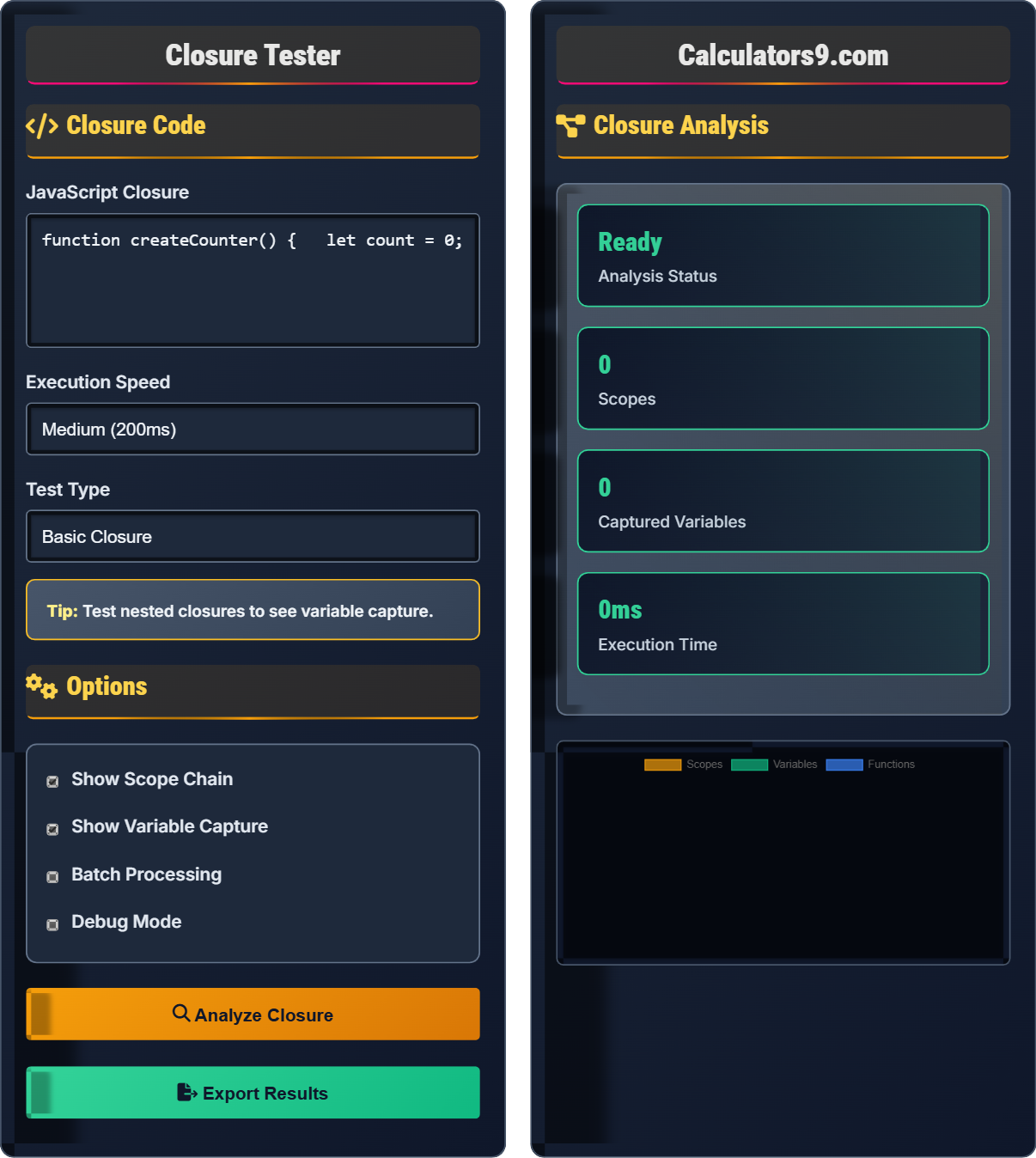
Closure Tester
JavaScript scope analyzer • 2026 standards
function outer() { var x = 1; return function inner() { return x; }; }
Closure Code
Options
Closure Analysis
| Level | Name | Type | Variables | Access |
|---|
| Name | Value | Type | Scope | Captured |
|---|
Comprehensive Closure Guide
A closure is the combination of a function bundled together (enclosed) with references to its surrounding state (lexicaL environment). In other words, a closure gives you access to an outer function's scope from an inner function. Closures are created whenever a function is created, at function creation time.
The closure creation process follows this algorithm:
Where:
- Inner Function: Function defined inside another function
- Lexical Environment: Local scope + captured variables
- Variable Capture: Maintains references to outer variables
Closures are used in various scenarios:
- Data Privacy: Creating private variables and methods
- Module Pattern: Organizing code into modules
- Event Handlers: Capturing context for callbacks
- Partial Application: Creating specialized functions
- Function Factories: Generating functions with preset parameters
- Minimize Scope: Only capture necessary variables
- Watch Memory: Avoid memory leaks from circular references
- Clear Documentation: Explain closure behavior
- Testing: Verify closure behavior in tests
- Performance: Consider closure creation costs
Closure Learning Quiz
What is the most accurate definition of a JavaScript closure?
The answer is B) A function that maintains access to its outer scope variables. A closure is formed when an inner function captures variables from its outer lexical environment, allowing the inner function to access those variables even after the outer function has returned.
The key characteristic of a closure is the retention of access to outer scope variables. While option A is often true (closures usually involve returning inner functions), it's not the defining characteristic. The essential feature is the preservation of variable access beyond the normal scope lifetime.
Closure: Function + lexical environment
Lexical Environment: Local scope + captured variables
Scope Chain: Path from inner to outer scopes
• Closures preserve variable access beyond function lifetime
• Created at function definition time
• Inner functions can access outer variables
• Remember: Function + Scope = Closure
• Look for inner functions accessing outer variables
• Closures maintain references, not values
• Confusing closures with nested functions
• Not understanding variable reference vs value
• Assuming all nested functions are closures
Explain what happens to the variable count in the following code and why it behaves this way:
function createCounter() {
  let count = 0;
  return function() {
    count++;
    return count;
  };
}
const counter = createCounter();
The variable count is captured by the closure. When createCounter() returns, the inner anonymous function maintains access to the count variable in its lexical environment. Each call to counter() increments and returns the same count variable, preserving its value between calls.
This demonstrates the persistence of closure variables. The count variable would normally be garbage collected when createCounter() returns, but the closure keeps a reference to it, allowing the inner function to maintain and modify the same variable instance across multiple calls.
Variable Capture: Retaining reference to outer scope variables
Persistence: Maintaining variable access after function returns
Lexical Binding: Linking variable to its declaration scope
• Closures capture variables, not values
• Captured variables persist beyond function lifetime
• Multiple closures can share the same variable
• Closures maintain references, not copies
• Changes affect the original variable
• Useful for data privacy
• Assuming closures create separate variable instances
• Not understanding reference vs value capture
• Forgetting that closures can modify original variables
A developer creates an array of functions in a loop, each intended to log its index number when called. However, all functions log the same number. Explain the closure issue and provide a solution.
The Problem: All inner functions capture the same variable i by reference, not by value. When the loop completes, i has its final value (the loop termination condition), so all closures reference this same value.
Solutions:
1. Use let instead of var to create block-scoped variables
2. Use an IIFE (Immediately Invoked Function Expression) to create new scope
3. Use bind() or arrow functions to capture values
Example with let:
for (let i = 0; i < 3; i++) {
  funcs[i] = () => console.log(i);
}
This classic closure issue demonstrates the difference between var and let scoping. With var, there's only one binding for i shared across all iterations. With let, each iteration gets its own binding, solving the closure problem.
Loop Closure Issue: Multiple closures sharing same variable reference
Block Scoping: Variable scoped to block (let/const)
Function Scope: Variable scoped to function (var)
• Closures capture variables by reference
• var creates function-scoped variables
• let/const create block-scoped variables
• Use let in loops to avoid closure issues
• Understand variable scoping differences
• Test closure behavior with multiple calls
• Using var in loops without understanding closure behavior
• Not testing closure behavior with multiple calls
• Assuming all closures behave identically
Design a closure-based counter that maintains private state and provides public methods to increment, decrement, and get the current value. Explain how closures provide data privacy in this scenario.
Implementation:
function createCounter(initialValue = 0) {
  let count = initialValue;

  return {
    increment: () => ++count,
    decrement: () => --count,
    getValue: () => count
  };
}

const counter = createCounter(5);
console.log(counter.getValue()); // 5
counter.increment();
console.log(counter.getValue()); // 6
Privacy Mechanism: The count variable exists only in the lexical environment of the outer function. The returned object's methods maintain closure over this variable, but external code cannot directly access count, providing data privacy.
This demonstrates the classical use of closures for data encapsulation. The private variable is inaccessible from outside the closure, but the public methods can read and modify it. This pattern provides controlled access to private data while hiding implementation details.
Data Privacy: Restricting access to internal variables
Encapsulation: Bundling data and methods togetherPublic Interface: Methods accessible from outside
• Private variables are inaccessible from outside closure
• Public methods can access private variables
• Closures provide controlled data access
• Use closures for module patterns
• Return objects with public methods
• Keep private variables in closure scope
• Returning private variables directly
• Not understanding the privacy mechanism
• Creating unnecessary closure complexity
Which scenario is most likely to cause a memory leak with closures?
The answer is B) Closure holding reference to large DOM element. When a closure maintains a reference to a DOM element that has been removed from the document but the closure still exists, it prevents the DOM element and its associated memory from being garbage collected, creating a memory leak.
This demonstrates the potential downside of closures. While closures are powerful for maintaining state, they can prevent garbage collection if they hold references to large objects that are no longer needed. This is particularly problematic with DOM elements that may have been removed from the document.
Memory Leak: Memory not freed after becoming unreachable
Garbage Collection: Automatic memory management
Reference Retention: Keeping objects alive through references
• Closures prevent garbage collection of referenced objects
• DOM references in closures can cause memory leaks
• Clean up references when no longer needed
• Nullify DOM references when done
• Use WeakMap/WeakSet for weak references
• Monitor memory usage in closures
• Not considering memory implications of closures
• Holding references to unnecessary objects
• Assuming closures don't affect memory management
Closure Basics
Function + lexical environment that captures outer variables.
Inner function → Captures outer variables → Maintains access
Preserves variable access beyond normal scope lifetime.
- Captures variables by reference
- Maintains access after outer function returns
- Created at function definition time
Best Practices
Minimize captured variables and clean up references.
- Only capture necessary variables
- Nullify DOM references when done
- Use WeakMap for weak references
- Test closure behavior thoroughly
- Memory implications
- Variable reference vs value
- Scope chain performance
- Debugging complexity
FAQ
Q: Why do closures retain variable access?
A: Closures maintain references to outer scope variables in their lexical environment. This allows inner functions to access variables from their outer functions even after the outer function has returned.
Q: var vs let in closures?
A: var creates function-scoped variables shared across iterations. let creates block-scoped variables unique to each iteration, solving common closure issues.