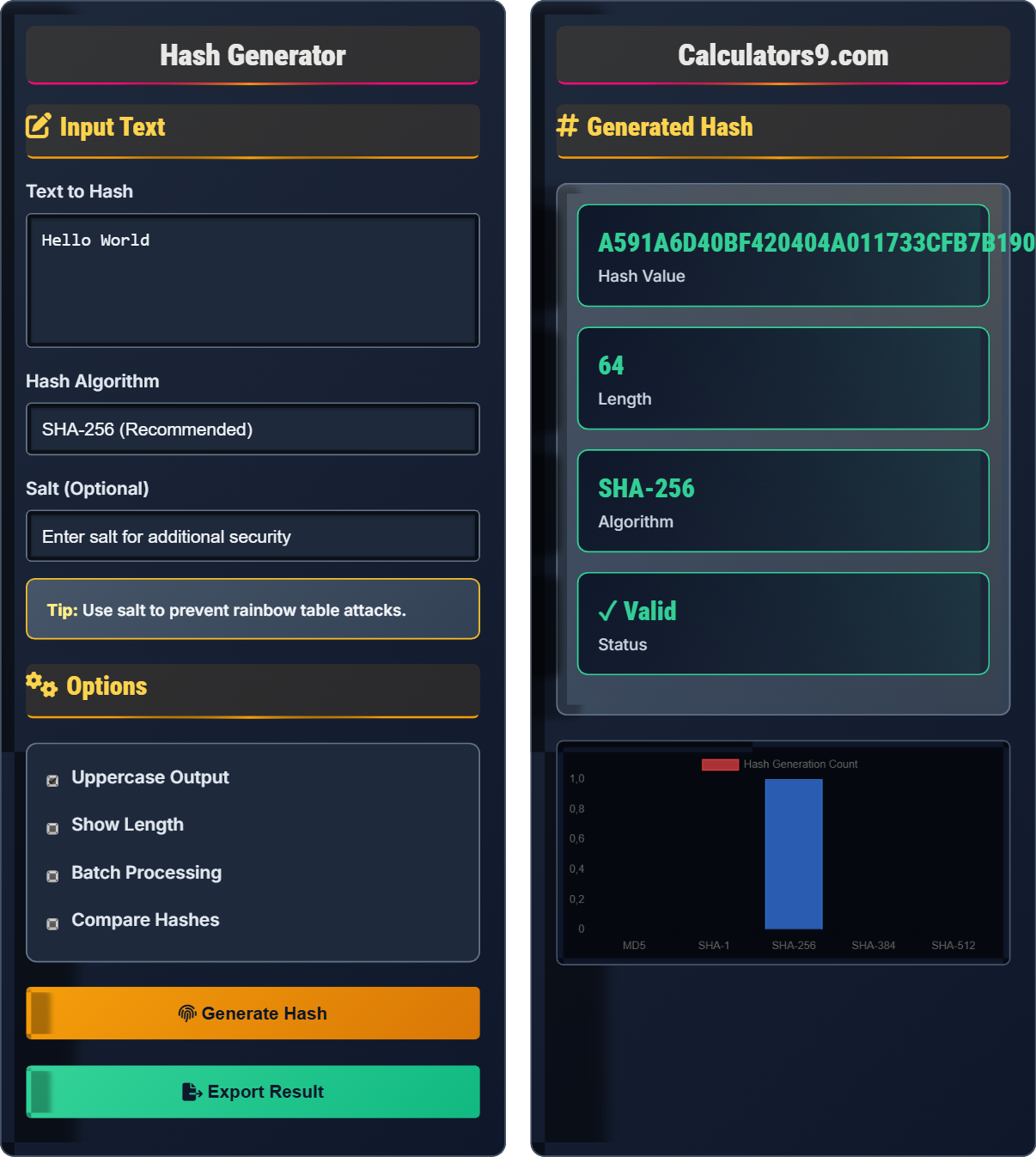
Hash Generator
Fast cryptographic hash tool • 2026 standards
Input Text
Options
Generated Hash
| Algorithm | Hash | Length | Bits | Time |
|---|
| Index | Hash | Match | Time | Action |
|---|
Comprehensive Hash Guide
A hash function is a mathematical function that converts an input (or 'message') into a fixed-size string of bytes. The output, known as a hash value or digest, appears random but is deterministic - the same input always produces the same output. Cryptographic hash functions have special properties that make them suitable for security applications.
Cryptographic hash functions must satisfy several important properties:
Where:
- Deterministic: Consistent output for given input
- Fast computation: Efficient to compute hash
- Pre-image resistance: Difficult to reverse
- Collision resistance: Hard to find same hash
Hash functions are used in various security and data integrity applications:
- Password Storage: Storing hashed passwords instead of plaintext
- Data Integrity: Verifying file authenticity
- Digital Signatures: Signing hash values instead of entire documents
- Blockchain: Creating unique fingerprints for transactions
- Cryptography: Key derivation and random number generation
- Use strong algorithms: Prefer SHA-256 or stronger over MD5/SHA-1
- Add salt: Use unique salt values to prevent rainbow table attacks
- Consider bcrypt: For password hashing, use bcrypt, scrypt, or Argon2
- Verify integrity: Always validate hash outputs
- Stay updated: Monitor for algorithm vulnerabilities
Hash Learning Quiz
Which of the following is NOT a required property of a cryptographic hash function?
The answer is D) Reversible. Cryptographic hash functions must be irreversible (pre-image resistant). The three required properties are: deterministic (same input always produces same output), pre-image resistant (difficult to determine input from output), and collision resistant (difficult to find two inputs that produce the same output).
This question tests understanding of fundamental hash function properties. The irreversibility of hash functions is crucial for security applications - if hashes were reversible, they would provide no security benefit. This property allows us to store password hashes instead of plaintext passwords, as the original password cannot be easily recovered from the hash.
Hash Function: Mathematical function that maps data of arbitrary size to fixed-size values
Deterministic: Same input always produces same output
Pre-image Resistance: Difficult to reverse the hash function
• Hash functions must be irreversible
• Same input always produces same output
• Finding collisions should be computationally difficult
• Remember: Hash functions are one-way
• Use SHA-256 for security applications
• Never store plaintext passwords
• Believing hash functions are reversible
• Using weak algorithms like MD5
• Not adding salt to password hashes
Compare the output lengths of MD5, SHA-1, SHA-256, and SHA-512. Which provides the highest security and why?
Output lengths:
• MD5: 128 bits (32 hexadecimal characters)
• SHA-1: 160 bits (40 hexadecimal characters)
• SHA-256: 256 bits (64 hexadecimal characters)
• SHA-512: 512 bits (128 hexadecimal characters)
SHA-512 provides the highest security because it has the largest output size, making collision attacks exponentially more difficult. However, SHA-256 offers a good balance of security and performance.
The output length of a hash function directly affects its security. Larger output sizes mean more possible hash values, making it harder to find collisions or perform brute-force attacks. However, longer hashes also require more computational resources. The security improvement is exponential - doubling the bit length increases security by orders of magnitude.
Output Length: Size of the hash function's output in bits
Collision: Two different inputs producing the same hash
Brute Force: Trying all possible inputs to find a match
• Longer output = higher security
• Security improves exponentially with length
• Consider performance trade-offs
• SHA-256 is widely accepted as secure
• MD5 and SHA-1 are deprecated
• Match algorithm strength to security needs
• Using outdated algorithms like MD5
• Not considering security requirements
• Confusing bit length with security level
A company stores passwords using MD5 hashes without salt. If an attacker gains access to the password database, explain the security risks and recommend improvements.
Security Risks:
1. Rainbow Table Attacks: Precomputed tables exist mapping common passwords to their MD5 hashes
2. Weak Algorithm: MD5 is vulnerable to collision attacks and considered cryptographically broken
3. No Salt: Identical passwords will have identical hashes, revealing user relationships
4. Fast Computation: MD5 is fast, enabling rapid brute-force attacks
Recommended Improvements:
• Use bcrypt, scrypt, or Argon2 for password hashing
• Implement unique salt for each password
• Upgrade to SHA-256 or stronger for other applications
• Implement rate limiting for login attempts
This example demonstrates why simple hashing is insufficient for password storage. Modern password hashing algorithms like bcrypt include built-in salting and are intentionally slow to prevent brute-force attacks. The combination of algorithm weakness, lack of salting, and fast computation creates multiple attack vectors for malicious actors.
Rainbow Table: Precomputed table for reversing hash functions
Salting: Adding random data to prevent precomputation attacks
Bcrypt: Adaptive password hashing function
• Never use MD5 for password storage
• Always use unique salt per password
• Use purpose-built password hashing functions
• Use bcrypt with cost factor ≥ 10
• Implement multi-factor authentication
• Monitor for data breaches
• Using general-purpose hashes for passwords
• Not using unique salts
• Using weak algorithms like MD5
You're developing a file sharing system where users need to verify file integrity after download. Explain how hash functions can be used for this purpose and discuss the security considerations.
Implementation:
1. Compute hash of original file before upload: SHA-256(file_content)
2. Store hash alongside file or provide separately
3. User downloads file and computes hash locally
4. Compare computed hash with original hash
Security Considerations:
• Use strong hash algorithm (SHA-256 or higher)
• Protect hash from tampering (secure distribution)
• Verify hash before using downloaded file
• Consider digital signatures for additional authenticity
• Hash verification detects corruption but not authenticity
This application demonstrates one of the primary uses of hash functions - ensuring data integrity. The deterministic nature of hash functions means that any change to the file, no matter how small, will result in a completely different hash value. However, this approach only verifies integrity, not authenticity - for that, digital signatures are needed.
Data Integrity: Ensuring data has not been altered
Verification: Confirming hash matches original
Authenticity: Confirming source of data
• Use strong hash algorithms
• Protect hash from tampering
• Verify before using data
• Provide hash via secure channel
• Automate verification process
• Use checksums for large files
• Using weak hash algorithms
• Not protecting hash distribution
• Skipping verification steps
Which of the following hash algorithms is currently considered the most secure for cryptographic applications?
The answer is C) SHA-256. While SHA-3 is newer and theoretically more secure against certain attack types, SHA-256 is currently the most widely adopted and trusted algorithm for cryptographic applications. MD5 and SHA-1 are both considered cryptographically broken and should not be used for security purposes.
This question highlights the importance of staying current with cryptographic best practices. Security recommendations evolve as new vulnerabilities are discovered. While SHA-3 offers advantages against certain theoretical attacks, SHA-256 has been extensively tested and analyzed, making it the current standard for most applications.
SHA-2 Family: Set of cryptographic hash functions (SHA-224, SHA-256, SHA-384, SHA-512)
SHA-3: Newest standard, based on Keccak algorithm
Cryptographic Broken: Vulnerabilities make algorithm unsuitable for security
• Avoid MD5 and SHA-1 for security
• Use SHA-256 as minimum standard
• Stay updated on algorithm recommendations
• Use SHA-256 for general security
• Consider SHA-3 for new projects
• Follow NIST recommendations
• Using deprecated algorithms
• Not updating security practices
• Choosing algorithms without research
Hash Basics
Fixed-size output from mathematical function.
Deterministic → One-way → Collision-resistant
Same input always produces same output.
- Irreversible
- Fixed output size
- Small changes cause large differences
Best Practices
Use SHA-256+, add salt, avoid MD5/SHA-1.
- Choose appropriate algorithm
- Add unique salt
- Validate outputs
- Keep software updated
- Performance vs security
- Future-proofing
- Regulatory compliance
- Key management
FAQ
Q: Why can't I reverse a hash to get the original text?
A: Hash functions are designed to be one-way. Information is lost during hashing. It's computationally infeasible to reverse the process.
Q: MD5 vs SHA-256?
A: MD5: 128-bit, vulnerable to collisions. SHA-256: 256-bit, secure. Use SHA-256 for security applications.