Scope Chain Analyzer
JavaScript variable resolution tool • 2026 standards
var x = 1; function f() { console.log(x); } → Variable lookup: f() → Global
JavaScript Code
Options
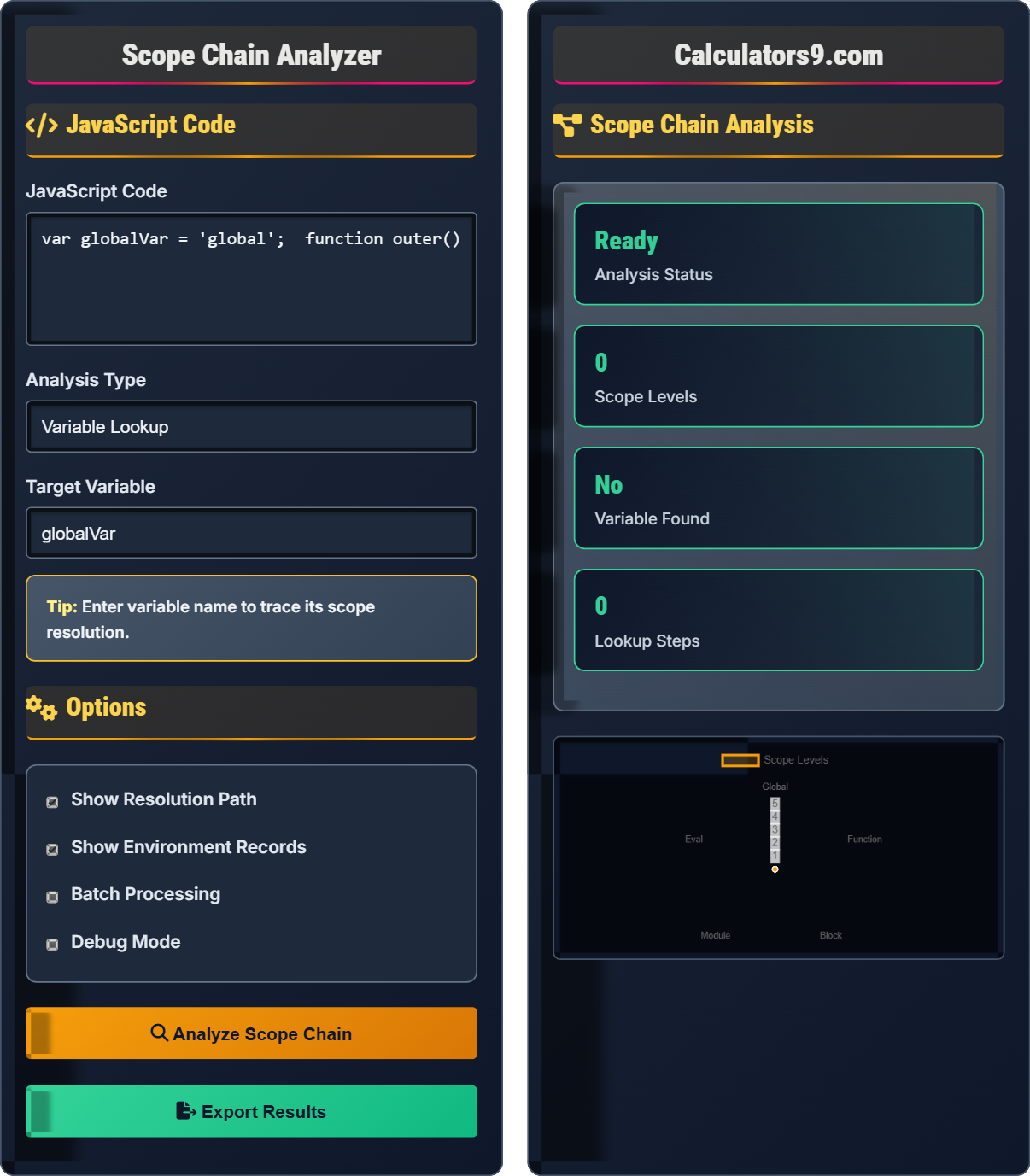
Scope Chain Analysis
| Level | Name | Type | Variables | Parent |
|---|
| Environment | Record Type | Bindings | Outer | Access |
|---|
Comprehensive Scope Chain Guide
The scope chain is the path JavaScript follows to look up variables. When a variable is accessed, JavaScript starts at the current scope and moves outward through parent scopes until it finds the variable or reaches the global scope. If the variable is not found, a ReferenceError is thrown. This mechanism allows functions to access variables from their parent scopes.
The variable resolution process follows this algorithm:
Where:
- Current Scope: Local function scope
- Parent Scope: Lexical parent of current scope
- Grandparent Scope: Higher lexical scopes
- Global Scope: Window/global object
JavaScript has several types of scopes:
- Global Scope: Variables accessible everywhere
- Function Scope: Variables within function
- Block Scope: Variables within {} (let/const)
- Module Scope: Variables within ES6 modules
- Script Scope: Variables within script tags
- Minimize Scope: Keep variables as local as possible
- Understand Hoisting: Know how declarations are processed
- Use Strict Mode: Prevent accidental global creation
- Clear Documentation: Comment scope relationships
- Testing: Verify variable access patterns
Scope Chain Learning Quiz
In what direction does JavaScript traverse the scope chain when looking for a variable?
The answer is B) From innermost to outermost scope. JavaScript starts searching for variables in the current (innermost) scope and moves outward through parent scopes until it finds the variable or reaches the global scope.
This upward traversal is crucial for understanding variable accessibility. The "inside-out" approach means inner scopes can access variables from outer scopes, but outer scopes cannot access variables from inner scopes. This creates the hierarchical nature of JavaScript scopes.
Scope Chain: Path from inner to outer scopes
Lexical Environment: Container for variable bindings
Variable Resolution: Process of finding variable value
• Search starts in current scope
• Moves to parent scope if not found
• Stops at global scope
• Remember: Inside → Outside
• Inner scopes can access outer variables
• Outer scopes cannot access inner variables
• Assuming search goes from global to local
Explain what happens when a variable is declared with the same name in both an outer and inner scope. How does JavaScript handle this situation?
When a variable is declared with the same name in both outer and inner scopes, the inner variable "shadows" the outer one. Within the inner scope, JavaScript will access the inner variable instead of the outer one. The outer variable is inaccessible within the inner scope, but becomes accessible again once execution leaves the inner scope.
Variable shadowing is a consequence of the scope chain traversal. When JavaScript looks for a variable, it stops at the first match in the scope chain, which is always the most local occurrence. This behavior prevents naming conflicts between different scopes but can lead to confusion if not understood properly.
Variable Shadowing: Inner variable hides outer variable
Scope Hierarchy: Order of scope precedence
Local Override: Inner scope taking precedence
• Inner variables shadow outer variables
• First match in scope chain is used
• Outer variable accessible outside inner scope
• Use unique variable names to avoid shadowing
• Be aware of variable name conflicts
• Understand which variable is being accessed
• Not realizing shadowing is occurring
• Expecting access to outer variable from inner scope
• Confusing which variable is being modified
A developer declares a variable with var inside a function but tries to access it before the declaration. How does JavaScript's hoisting mechanism affect the scope chain analysis in this situation?
Hoisting Effect: With var, the variable declaration is hoisted to the top of its scope, but initialization remains in place. The variable exists in the scope with value undefined during the entire scope execution, even before its actual declaration.
Scope Chain Impact: The variable is found in the current scope (due to hoisting), so JavaScript doesn't continue up the scope chain to look for it. The variable resolves to undefined if accessed before initialization.
Example: console.log(x); var x = 5; logs undefined, not an error.
This demonstrates how hoisting affects variable resolution. Even though the declaration appears later in the code, the variable is "moved" to the top of its scope during compilation. This can cause confusion because the variable exists but may not have its intended value, affecting the scope chain analysis.
Hoisting: Moving declarations to top of scope
Compilation Phase: Where declarations are processed
Temporal Dead Zone: Time before let/const initialization
• var declarations are hoisted
• Initialization stays in place
• let/const have temporal dead zone
• Declare variables at top of scope
• Use let/const to avoid hoisting issues
• Initialize variables immediately
• Assuming variables don't exist before declaration
• Not understanding hoisting behavior
• Confusing var, let, and const hoisting
Explain how closures interact with the scope chain. When a closure accesses a variable from an outer function, which part of the scope chain mechanism is responsible for making this possible?
Closure Mechanism: Closures maintain a reference to their outer lexical environment, preserving the scope chain at the time of function creation. This allows inner functions to access variables from outer functions even after the outer function has returned.
Scope Chain Preservation: The closure captures the outer environment record and its outer environment reference, effectively "storing" the scope chain. When the closure accesses a variable, it traverses its preserved scope chain just like any other variable lookup.
Key Component: The outer environment reference in the lexical environment is responsible for linking scopes together, enabling closure behavior.
Closures demonstrate the power of the scope chain mechanism. The outer environment reference in each lexical environment creates the chain that closures can follow. This is why closures can maintain access to outer variables even when the outer function has finished executing - the scope chain is preserved as part of the closure.
Closure: Function + lexical environment
Outer Environment Reference: Link to parent scope
Lexical Environment: Scope + outer reference
• Closures preserve scope chain at creation time
• Outer environment references maintain chain
• Variables accessed via normal lookup process
• Closures maintain original scope chain
• Variable values can change after closure creation
• Multiple closures share same outer scope
• Assuming closures copy variable values
• Not understanding scope chain preservation
• Expecting closures to have isolated scopes
Which of the following statements about block scope and function scope is true?
The answer is B) let and const create block scope, var creates function scope. Variables declared with let and const are scoped to the nearest enclosing block ({}), while var is scoped to the nearest function or global scope.
This distinction is crucial for understanding variable accessibility. Block-scoped variables (let/const) are only accessible within their block, while function-scoped variables (var) are accessible throughout the entire function. This affects how the scope chain is constructed and traversed.
Block Scope: Limited to {} boundaries
Function Scope: Limited to function boundaries
Scope Boundary: Where variable access ends
• let/const: Block-scoped
• var: Function-scoped
• Scope chain affected by declaration type
• Prefer let/const for more predictable scoping
• Be careful with var in loops
• Understand hoisting differences
• Confusing scope types for different declaration keywords
• Not understanding block scope boundaries
• Assuming all keywords behave the same
Scope Chain Basics
Path from inner to outer lexical environments for variable resolution.
Current → Parent → Grandparent → Global
Searches for variable in each scope until found.
- Inside → Outside traversal
- First match wins
- Closures preserve scope chain
Best Practices
Use appropriate scope types and minimize variable reach.
- Use let/const for block scope
- Minimize global variables
- Understand hoisting behavior
- Document scope relationships
- Performance implications
- Memory usage
- Debugging complexity
- Variable naming conflicts
FAQ
Q: Why does JavaScript traverse scopes from inside to outside?
A: This ensures local variables take precedence over outer ones. It follows the principle of least surprise - closest variable definition is used first.
Q: let vs var scope?
A: let/const: Block-scoped (limited to {}). var: Function-scoped (entire function). let/const prevent hoisting issues.