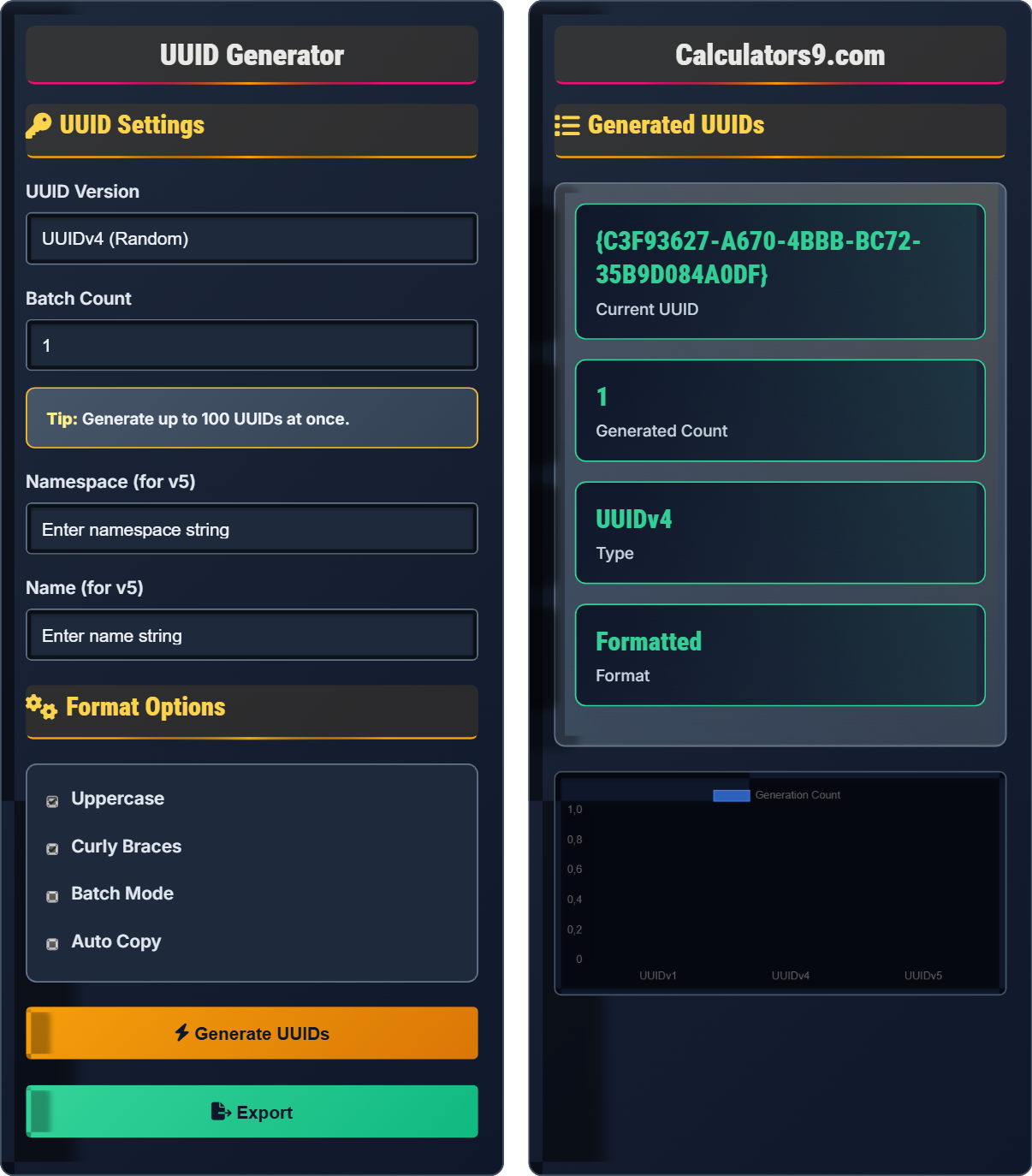
UUID Generator
Fast unique ID generator • 2026 standards
UUID Settings
Format Options
Generated UUIDs
| Index | UUID | Type | Time | Copy |
|---|
| Index | UUID | Length | Valid | Copy |
|---|
Comprehensive UUID Guide
A UUID (Universally Unique Identifier) is a 128-bit number used to uniquely identify information in computer systems. UUIDs are designed to have a very low probability of collision, meaning it's extremely unlikely that two UUIDs will be generated with the same value. They are commonly used for database keys, session identifiers, and distributed system coordination.
A UUID follows the pattern: xxxxxxxx-xxxx-Mxxx-Nxxx-xxxxxxxxxxxx
Where:
- M = Version number (1-5)
- N = Variant (typically 8, 9, A, B)
- Hexadecimal: 0-9 and A-F
- Total: 36 characters including hyphens
UUIDs are used in various scenarios where uniqueness is critical:
- Database Primary Keys: Avoiding conflicts in distributed systems
- Session Management: Unique session identifiers
- Distributed Systems: Coordinating across multiple servers
- API Keys: Secure, unique access tokens
- File Identifiers: Preventing naming collisions
- Use UUIDv4 for randomness: Best for most applications requiring uniqueness
- Consider performance: UUIDs are larger than integers (16 bytes vs 4-8 bytes)
- Database indexing: UUIDs can impact query performance
- Security considerations: UUIDv1 reveals timestamp and MAC address
- Storage efficiency: Consider binary storage for better performance
UUID Learning Quiz
What does the 'M' in the UUID format xxxxxxxx-xxxx-Mxxx-Nxxx-xxxxxxxxxxxx represent?
The answer is B) Version Number. In the UUID format, 'M' represents the version number which indicates the algorithm used to generate the UUID (values 1-5). The version number occupies bits 12-15 of the time_and_version field.
Understanding UUID structure is crucial for developers working with distributed systems. The version number is essential because it tells systems which algorithm was used to generate the UUID, allowing for proper interpretation of the other fields. This knowledge helps in debugging, validation, and ensuring compatibility across different systems.
UUID: Universally Unique Identifier - 128-bit number for unique identification
Version: Indicates the generation algorithm (1-5)
Variant: Specifies the UUID layout (bits 6-7 of clock_seq_hi_and_reserved)
• Version field is always in the 13th character position
• Version values are limited to 1-5
• Different versions serve different purposes (random, time-based, etc.)
• Remember: Position 13 = Version
• Use hex representation: 1-5 for versions
• UUIDv4 is most common (random)
• Confusing version with variant field
• Thinking version contains MAC address (that's only v1)
• Assuming all UUIDs are randomly generated
Explain the main difference between UUIDv1 and UUIDv4, and provide a use case for each.
UUIDv1: Based on timestamp and MAC address. It includes temporal and spatial information, making it sortable chronologically. Use case: Event logging where chronological order matters.
UUIDv4: Randomly generated using cryptographically secure random numbers. No inherent ordering. Use case: Database primary keys where privacy and security are important.
The main difference is predictability: v1 reveals when and where it was generated, while v4 provides better privacy and security.
This question highlights the trade-offs between different UUID versions. UUIDv1 offers chronological ordering which is valuable for audit trails and event processing, but reveals sensitive information. UUIDv4 prioritizes privacy and security, making it ideal for public-facing systems where you don't want to expose internal information.
UUIDv1: Time-based UUID containing timestamp and MAC address
UUIDv4: Randomly generated UUID with no predictable pattern
Cryptographic Randomness: Unpredictable sequence of bits
• UUIDv1 contains temporal and spatial data
• UUIDv4 provides better privacy
• Choose version based on requirements (ordering vs privacy)
• Use v1 for ordered events
• Use v4 for security-sensitive applications
• Consider v5 for deterministic generation
• Using v1 when privacy is important
• Using v4 when chronological ordering is needed
• Not understanding the implications of exposed MAC addresses
If you generate 1 million UUIDv4s per second, what is the approximate probability of generating a duplicate within 1 year? (Assume perfect randomness)
Step 1: Calculate total UUIDs generated in 1 year = 1,000,000/sec × 60 sec/min × 60 min/hr × 24 hr/day × 365 days = 31,536,000,000,000 (about 31.5 trillion)
Step 2: UUIDv4 space = 2^122 (about 5.3 × 10^36) possible values
Step 3: Using birthday paradox approximation, probability ≈ n²/(2×N) where n = 31.5 trillion, N = 2^122
Step 4: Probability ≈ (31.5×10¹²)² / (2×2^122) ≈ 9.9×10²⁶ / 2×5.3×10³⁶ ≈ 9.3×10⁻¹¹
This is approximately 0.0000000093%, essentially zero chance of collision.
This demonstrates the astronomical scale of UUID uniqueness. Even generating millions of UUIDs per second for years, the probability of collision remains negligible. The 128-bit space provides such enormous entropy that practical collisions are virtually impossible, which is why UUIDs are trusted in distributed systems worldwide.
Birthday Paradox: Mathematical principle describing collision probability
Entropy: Measure of randomness and unpredictability
Collision: Two identical UUIDs generated independently
• UUIDv4 collision probability is astronomically low
• Birthday paradox governs collision probability
• 128-bit space ensures practical uniqueness
• Remember: 2^122 possible UUIDv4 values
• Practical collisions are impossible
• Focus on implementation, not collision concerns
• Underestimating the size of 128-bit space
• Overthinking collision probabilities
• Confusing theoretical vs practical collision risks
You're designing a distributed e-commerce system with multiple database shards. Should you use auto-incrementing IDs or UUIDs for product IDs? Justify your choice considering scalability, security, and performance.
Recommendation: Use UUIDs
Scalability Benefits: UUIDs allow merging databases without ID conflicts, crucial for sharding and horizontal scaling. Auto-incrementing IDs require coordination across shards.
Security Benefits: UUIDs don't reveal business metrics (order count, user count) and prevent enumeration attacks. Auto-incrementing IDs expose sequential patterns.
Performance Trade-offs: UUIDs are larger (16 bytes vs 4-8 bytes) and less efficient for indexing, but modern databases handle this well. The scalability benefits outweigh performance costs in distributed systems.
Implementation: Use UUIDv7 (new standard) or UUIDv4 for optimal balance of uniqueness and performance.
This question demonstrates the practical decision-making process for UUID usage. In distributed systems, the ability to generate unique identifiers independently across nodes is paramount. While UUIDs have minor performance overhead, the architectural benefits of avoiding coordination between distributed components far outweigh the costs, especially in cloud-native applications.
Distributed System: Computing system with components on multiple machines
Sharding: Partitioning data across multiple databases
Enumeration Attack: Attempting to discover resources by incrementing IDs
• Use UUIDs in distributed systems
• Consider performance implications
• Balance security and scalability needs
• Use database-specific UUID optimizations
• Consider ULIDs for ordered UUIDs
• Plan for migration if switching from integers
• Ignoring scalability requirements
• Not considering security implications
• Overlooking database performance impacts
Which of the following is NOT a valid UUID format?
The answer is D) 550e8400-e29b-41d4-a716-44665544000g. This is invalid because it contains 'g', which is not a valid hexadecimal digit (valid digits are 0-9 and A-F). The correct format must contain only hexadecimal characters and follow the 8-4-4-4-12 pattern with hyphens.
This question tests understanding of both UUID format structure and hexadecimal notation. Valid UUIDs must strictly follow the pattern and use only valid hexadecimal characters. The presence of invalid characters like 'g' makes the entire UUID invalid. This is crucial for validation in production systems to prevent data integrity issues.
Hexadecimal: Base-16 numbering system (0-9, A-F)
UUID Format: 8-4-4-4-12 hexadecimal digit pattern
Validation: Process of verifying UUID compliance with standards
• Only hexadecimal digits (0-9, A-F) are valid
• Must follow 8-4-4-4-12 hyphen pattern
• Case-insensitive but typically lowercase
• Use regex validation: /^[0-9a-f]{8}-[0-9a-f]{4}-[0-9a-f]{4}-[0-9a-f]{4}-[0-9a-f]{12}$/i
• Check for 36 characters (including hyphens)
• Verify version bit in 13th position
• Accepting non-hexadecimal characters
• Not validating hyphen positions
• Missing version validation
UUID Basics
128-bit identifier for unique resource identification.
xxxxxxxx-xxxx-Mxxx-Nxxx-xxxxxxxxxxxx
Where M=version, N=variant, total 36 chars.
- Version in 13th position
- Only hex digits (0-9, A-F)
- 8-4-4-4-12 pattern
Best Practices
Choose v4 for privacy, v1 for ordering, v5 for determinism.
- Use binary storage
- Consider ULIDs
- Optimize indexes
- Batch operations
- Database performance
- Security implications
- Ordering requirements
- Storage efficiency
FAQ
Q: Why use UUIDs instead of auto-incrementing IDs?
A: UUIDs avoid conflicts in distributed systems. Auto-incrementing requires coordination between nodes. UUIDs can be generated independently anywhere.
Q: UUIDv1 vs UUIDv4?
A: UUIDv1: chronological ordering, exposes timestamp/MAC. UUIDv4: random, private, no inherent order. Use v4 for security, v1 for ordering.