Keyword Density Analyzer
Performance calculator • 2026 edition
Keyword Density Formula:
Show the analyzerKeyword density is calculated using the formula:
\( \text{Density} = \left(\frac{\text{Keyword Occurrences}}{\text{Total Words}}\right) \times 100 \)
Where:
- Keyword Occurrences: Number of times the target keyword appears
- Total Words: Total number of words in the content
- Optimal Range: 1-3% for most SEO applications
- Over-Optimization: Above 5% may trigger spam filters
This formula helps ensure content maintains proper keyword balance for SEO effectiveness.
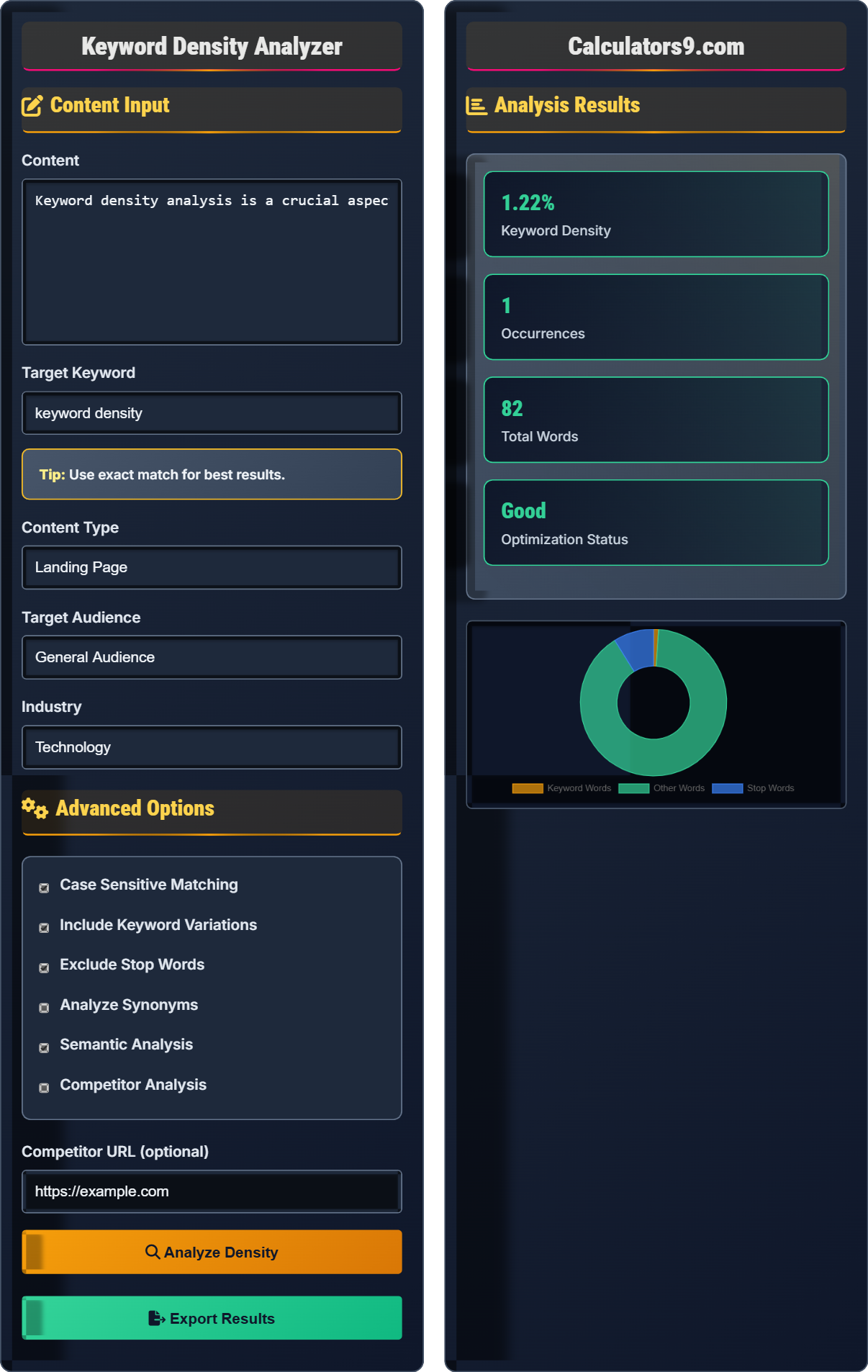
Content Input
Advanced Options
Analysis Results
| Position | Sentence | Context |
|---|---|---|
| 1 | Keyword density analysis is a crucial aspect... | Opening paragraph |
| 2 | By examining how frequently a target keyword appears... | Second paragraph |
| 3 | The optimal keyword density is typically between... | Third paragraph |
| 4 | Over-optimization can lead to penalties... | Fourth paragraph |
| 5 | Modern SEO focuses on semantic relationships... | Conclusion |
Comprehensive Keyword Density Guide
Keyword density is the percentage of times a target keyword appears in relation to the total word count of a web page. It's a metric used in search engine optimization to measure how frequently a specific term appears in content. While historically important for SEO, modern search engines use more sophisticated algorithms that consider context, semantics, and user experience alongside keyword frequency.
The keyword density formula is:
Where "Keyword Occurrences" is the number of times the target keyword appears in the content, and "Total Words" is the total word count of the content (excluding HTML tags and metadata).
Based on current SEO best practices, the recommended keyword density ranges are:
Modern keyword optimization strategies include:
- Focus on semantic relationships: Include related terms and synonyms
- Natural placement: Integrate keywords naturally in content
- Contextual relevance: Ensure keywords match content intent
- Content quality: Prioritize user value over keyword frequency
- Variety in usage: Use different forms of keywords
Keyword Density Learning Quiz
What is the recommended keyword density range for optimal SEO performance?
The answer is B) 1-3%. This range is considered optimal for most SEO applications. Modern search engines prioritize content quality and user experience over exact keyword frequency, making this moderate range effective for relevance without appearing spammy. Higher densities may trigger over-optimization penalties.
The 1-3% range represents a balance between keyword visibility and natural content flow. It's high enough to signal relevance to search engines while remaining low enough to maintain readability for users. This range accommodates semantic variations and related terms that modern search algorithms consider alongside exact keyword matches.
Keyword Density: Percentage of keyword occurrences in content
Optimization: Adjusting content for better search performance
Over-optimization: Excessive keyword usage that appears unnatural
• Maintain 1-3% for primary keywords
• Focus on content quality over density
• Include semantic variations
• Use related terms and synonyms
• Place keywords naturally in content
• Focus on user experience first
• Stuffing keywords unnaturally
• Ignoring semantic relationships
• Prioritizing density over content quality
Calculate the keyword density for a 500-word article that contains the keyword "web development" 8 times. Show your work.
Step 1: Identify values
Keyword occurrences = 8
Total words = 500
Step 2: Apply formula
Density = (8 ÷ 500) × 100
Density = 0.016 × 100
Density = 1.6%
Therefore, the keyword density is 1.6%, which falls within the optimal range of 1-3%.
This calculation demonstrates the basic arithmetic behind keyword density. The result of 1.6% is well within the recommended range, indicating good optimization balance. This example shows that even a moderate number of occurrences (8) in a standard article length (500 words) can achieve optimal density.
Optimal Range: Recommended density for best performance
Arithmetic: Mathematical calculation process
Balance: Appropriate proportion of elements
• Divide occurrences by total words
• Multiply by 100 to get percentage
• Compare to optimal range
• Count all instances of the keyword
• Exclude HTML tags from word count
• Consider case sensitivity
• Including HTML tags in word count
• Not accounting for case sensitivity
• Forgetting to multiply by 100
A website has a 2.5% keyword density for its primary keyword. If they increase density to 6% by adding more keyword instances, what are the potential positive and negative impacts on search performance?
Potential positive impacts:
• Increased relevance signals for target keyword
• Potentially higher rankings for exact-match queries
• More prominent keyword presence in content
Potential negative impacts:
• Risk of over-optimization penalties
• Reduced readability and user experience
• Potential keyword stuffing detection
• Decreased content quality perception
Modern SEO algorithms prioritize user experience over keyword density, so increasing from 2.5% to 6% may result in more negative than positive impacts. The optimal approach is to maintain natural content flow while achieving moderate keyword density.
This example demonstrates the diminishing returns of keyword density optimization. While moderate density helps with relevance, excessive density can harm performance through penalties and reduced user engagement. The 6% density exceeds the recommended range and risks triggering spam filters that modern search engines use to identify manipulative content.
Diminishing Returns: Decreasing benefit from increasing input
Spam Filters: Algorithms detecting manipulative contentUser Engagement: Interaction and satisfaction metrics
• Avoid exceeding 5% density
• Prioritize user experience
• Maintain natural content flow
• Use related terms instead of exact keywords
• Focus on content value over density
• Monitor user engagement metrics
• Prioritizing density over content quality
• Not considering semantic variations
• Ignoring user experience impact
What is the primary benefit of including semantic variations in keyword density analysis?
The answer is B) Improve content relevance and context. Semantic variations help search engines understand the broader topic and context of content. Modern algorithms like Google's BERT and RankBrain consider related terms, synonyms, and contextual relationships to better understand content meaning and intent.
Semantic analysis represents the evolution from exact keyword matching to understanding content meaning. Search engines now recognize that related terms like "web development," "web developer," "website creation," and "coding" all relate to the same topic. Including these variations creates stronger topical authority and improves content understanding.
Semantic Analysis: Understanding meaning and relationships
Topical Authority: Recognition as expert in a topic
Contextual Relationships: Connections between related terms
• Include related terms and synonyms
• Focus on topic clusters
• Maintain natural language patterns
• Use tools like Google's Related Searches
• Include LSI (Latent Semantic Indexing) keywords
• Create topic clusters around main keywords
• Only focusing on exact keyword matches
• Not considering semantic relationships
• Ignoring related topics and concepts
A blog post has 800 words with a keyword density of 0.8%. The SEO goal is to achieve 2.0% density. How many additional keyword instances are needed to reach this goal?
Step 1: Calculate current occurrences
0.8% = (Occurrences ÷ 800) × 100
0.008 = Occurrences ÷ 800
Occurrences = 0.008 × 800 = 6.4 ≈ 6 instances
Step 2: Calculate target occurrences
2.0% = (Target ÷ 800) × 100
0.02 = Target ÷ 800
Target = 0.02 × 800 = 16 instances
Step 3: Calculate additional instances needed
Additional = 16 - 6 = 10 more instances
Therefore, 10 additional keyword instances are needed to achieve 2.0% density.
This calculation demonstrates how to reverse-engineer keyword density to determine required additions. The formula rearranges to solve for occurrences when density and word count are known. This approach is useful for strategic content optimization where specific density targets need to be met.
Reverse Engineering: Working backwards from desired outcome
Strategic Optimization: Planned approach to content improvement
Target Achievement: Meeting predetermined density goals
• Rearrange formula to solve for different variables
• Round occurrences to whole numbers
• Ensure natural integration of additional keywords
• Distribute additional keywords throughout content
• Use variations to maintain natural flow
• Focus on quality placement, not just quantity
• Forgetting to round to whole numbers
• Clustering all additional keywords in one area
• Not considering content quality impact
Keyword Fundamentals
Keyword occurrences ÷ total words × 100 = percentage.
Count → Calculate → Compare → Optimize
- Optimal: 1-3%
- Acceptable: 0.5-5%
- Over-optimized: >5%
FAQ
Q: Is keyword density still important for SEO in 2026?
A: Yes, but in a more nuanced way than in the past. Modern search engines use sophisticated algorithms like BERT and RankBrain that understand context, semantics, and user intent. However, keyword density still serves as a relevance signal. The focus should be on maintaining natural density within the 1-3% range while prioritizing content quality, user experience, and semantic relationships.
Today's approach combines traditional density metrics with:
- Semantic keyword variations
- Topic clustering
- Entity recognition
- User engagement signals
The key is balance - density matters, but it's one of many factors that search engines consider when evaluating content relevance and quality.
Q: How do I optimize content for both users and search engines?
A: The key is creating content that naturally satisfies both audiences:
- Start with user needs: Address real questions and problems
- Use natural language: Include keywords where they fit naturally
- Provide value: Ensure content is helpful and comprehensive
- Structure content: Use headers, lists, and proper formatting
- Optimize for context: Include related terms and concepts
Modern SEO rewards content that genuinely helps users, so the best approach is to write primarily for your audience while incorporating relevant keywords naturally. This approach satisfies both user experience and search algorithm requirements.