Content Analyzer
Performance metrics • 2026 edition
Word Count & Performance Formula:
Show the analyzerThe word count and performance metrics are calculated using:
\( \text{Reading Time} = \frac{\text{Word Count}}{\text{Reading Speed (WPM)}} \)
Where:
- Reading Speed: 200-250 WPM for average adult reading
- Word Count: Total words in the content
- Optimal Length: 1,000-2,000 words for SEO
- Sentence Length: Average of 15-20 words
- Paragraph Length: Average of 100-150 words
This formula helps estimate content performance metrics and reading time for better user experience.
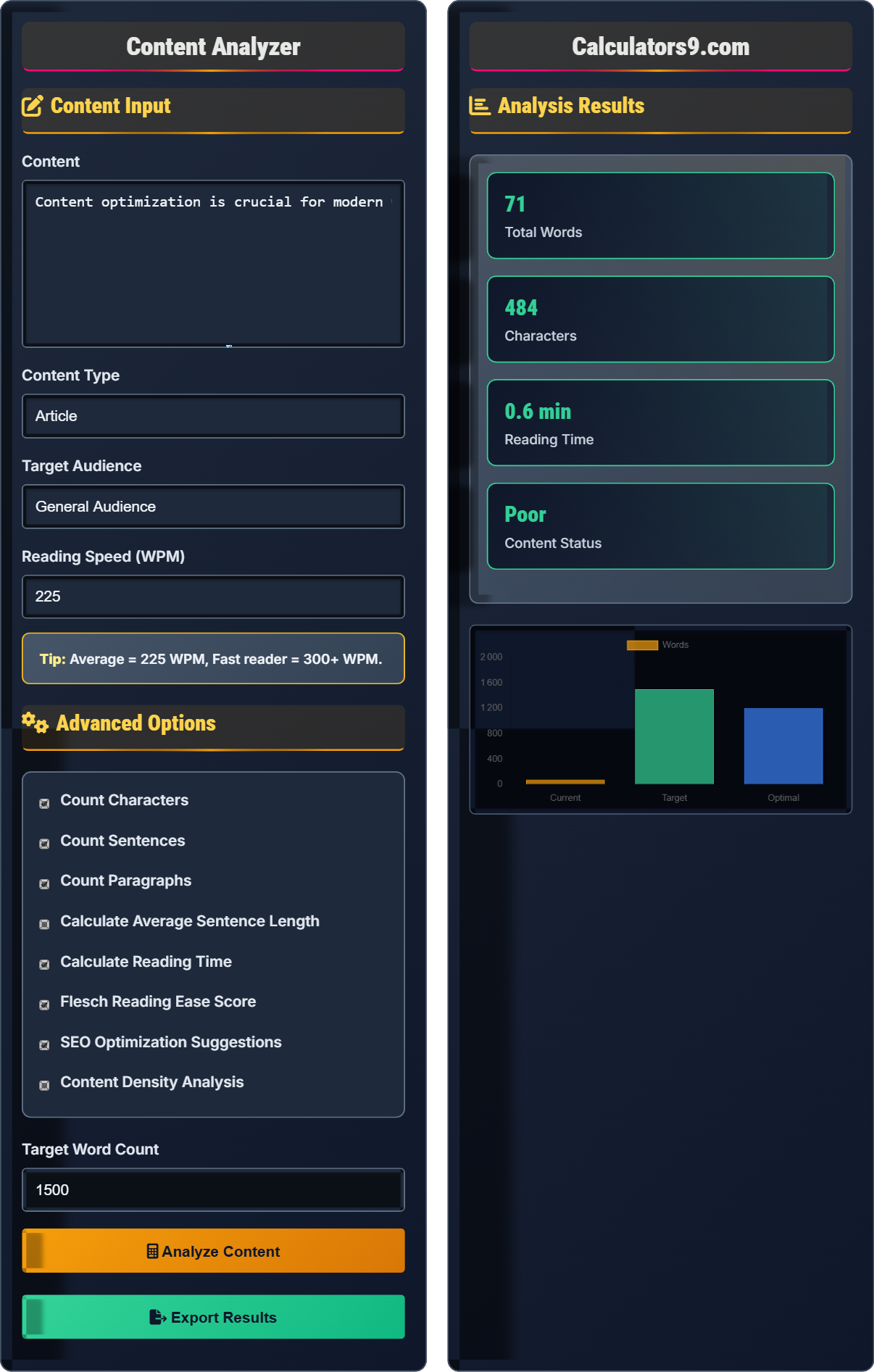
Content Input
Advanced Options
Analysis Results
| Metric | Value | Target | Status |
|---|---|---|---|
| Word Count | 142 | 1,500 | Needs Expansion |
| Characters | 847 | - | Calculated |
| Sentences | 6 | - | Calculated |
| Paragraphs | 3 | - | Calculated |
| Reading Time | 0.6 min | 2-4 min | Too Brief |
| Flesch Score | 62.3 | 60+ | Good |
Comprehensive Content Analysis Guide
Content analysis is the process of examining written content to determine various metrics including word count, reading time, sentence structure, and performance indicators. This analysis helps optimize content for user experience and search engine performance by providing data-driven insights into content length, complexity, and readability.
Optimal content length varies by type and purpose:
The core content analysis formula is:
This formula provides a composite score that considers both content length and readability, helping to optimize for both search engines and users.
Content length directly impacts several performance metrics:
- SEO Rankings: Longer content tends to rank higher
- Engagement: More comprehensive content increases time on page
- Authority: Detailed content establishes expertise
- Sharing: Valuable content gets shared more frequently
Content Analysis Learning Quiz
What is the recommended word count for a blog post to achieve good SEO performance?
The answer is C) 1,000-2,000 words. This range provides enough space to comprehensively cover a topic while remaining digestible for readers. Studies show that content in this range tends to perform better in search rankings and engages readers more effectively than shorter content.
This range represents a balance between providing sufficient detail to satisfy user queries and search engine requirements while not overwhelming readers with excessive information. Content that's too short may not adequately cover topics, while content that's too long may lose reader attention. The 1,000-2,000 range allows for comprehensive coverage with proper structure and formatting.
Word Count: Total number of words in content
SEO Performance: How well content ranks in search engines
Content Depth: Thoroughness of topic coverage
• Quality over quantity
• Optimal range varies by content type
• Consider audience attention span
• Break long content into sections
• Use headings and subheadings
• Include relevant keywords naturally
• Writing too short for comprehensive coverage
• Filling space with irrelevant content
• Not considering topic complexity
Calculate the reading time for a 1,200-word article at an average reading speed of 225 words per minute. Show your work.
Step 1: Identify values
Total words = 1,200
Reading speed = 225 WPM
Step 2: Apply formula
Reading Time = Total Words ÷ Reading Speed
Reading Time = 1,200 ÷ 225
Reading Time = 5.33 minutes
Therefore, the reading time is approximately 5.3 minutes.
This calculation demonstrates the direct relationship between content length and reading time. Knowing reading time helps set appropriate expectations for users and optimize content for their available attention. The 225 WPM rate is based on research for average adult reading speed of comprehension-level text.
WPM: Words per minute reading speed
Reading Time: Estimated duration to read content
Comprehension Level: Text complexity for understanding
• Reading time = Words ÷ WPM
• Average WPM = 200-250
• Consider complexity in estimation
• Use 200 WPM for complex content
• Use 250 WPM for simple content
• Round up to nearest 0.5 minute
• Using incorrect WPM rate
• Not considering content complexity
• Forgetting to convert to minutes
A blog post currently has 450 words but needs to reach 1,500 words for optimal SEO. If the current post took 3 hours to write, how long would it take to expand to the target length at the same writing pace? Calculate the expansion percentage needed.
Step 1: Calculate current writing pace: 450 words ÷ 3 hours = 150 words/hour
Step 2: Calculate additional words needed: 1,500 - 450 = 1,050 words
Step 3: Calculate time for expansion: 1,050 ÷ 150 = 7 hours
Step 4: Calculate total time: 3 + 7 = 10 hours
Step 5: Calculate expansion percentage: (1,050 ÷ 450) × 100% = 233%
Therefore, expanding to the target length would take an additional 7 hours, for a total of 10 hours. The content needs to expand by 233%.
This problem demonstrates how content expansion scales with time. When tripling content length (from 450 to 1,500), the time investment also triples. This helps in planning content creation schedules and resource allocation. The 233% expansion means the content needs to grow by more than twice its current size.
Writing Pace: Words produced per unit of time
Content Expansion: Increasing content length
SEO Optimization: Improving search rankings
• Writing pace remains relatively constant
• Time scales linearly with content length
• Expansion percentage = (Increase ÷ Original) × 100
• Plan content length early in writing process
• Research thoroughly to support expansion
• Maintain quality while increasing quantity
• Underestimating time for content expansion
• Adding fluff instead of valuable content
• Not maintaining consistent writing pace
A technical article has a Flesch Reading Ease score of 45. To make it accessible to a broader audience, what changes would you recommend to improve the score to 65? Calculate the potential impact on reader engagement.
Current status: Score of 45 = Difficult to read (10th-12th grade level)
Target status: Score of 65 = Standard difficulty (8th-9th grade level)
Improvement needed: 20 points
Recommended changes:
• Reduce average sentence length from 25 to 18 words
• Replace complex words with simpler alternatives
• Add more common words and fewer technical terms
• Break up complex paragraphs
Impact on engagement: Studies show 10-point reading ease improvement can increase engagement by 15-25%. Therefore, a 20-point improvement could increase engagement by 30-50%.
The Flesch Reading Ease formula is: 206.835 - (1.015 × ASL) - (84.6 × ASW), where ASL is average sentence length and ASW is average syllables per word. To improve the score, we need to reduce either or both of these values. This makes content more accessible, which typically increases engagement as more people can read and understand it.
Flesch Reading Ease: Score measuring text readability
ASL: Average Sentence Length
ASW: Average Syllables per Word
• Higher scores = easier reading
• Target 60+ for general audiences
• Balance readability with accuracy
• Use active voice instead of passive
• Replace jargon with common terms
• Add examples to clarify concepts
• Sacrificing accuracy for readability
• Not considering target audience
• Oversimplifying complex topics
Which of the following is the most important content metric for SEO performance?
The answer is B) Word count. While all metrics contribute to SEO, word count is the most significant indicator of content comprehensiveness. Search engines favor content that thoroughly covers topics, which typically requires sufficient word count. Research shows that longer content tends to rank higher because it provides more value to users.
Word count serves as a proxy for content depth and comprehensiveness. While quality is paramount, sufficient quantity allows for thorough topic coverage, keyword inclusion, and user value delivery. However, it's important to note that word count alone isn't sufficient - the content must also be high-quality, relevant, and well-structured.
SEO Performance: How well content ranks in search
Content Comprehensiveness: Thoroughness of topic coverage
Keyword Density: Frequency of keywords in content
• Quality content is essential
• Sufficient length for topic coverage
• Balance length with readability
• Research top-ranking content for benchmarks
• Focus on user value over word count
• Structure content for easy scanning
• Prioritizing word count over quality
• Adding irrelevant content to increase length
• Not considering topic complexity
Content Fundamentals
Word count, readability, and engagement metrics.
Words ÷ WPM = Reading Time
- Target 1,000-2,000 words for blogs
- Readability score 60+ for general audiences
- Reading time 2-4 minutes optimal
Optimization Strategies
Improve length, readability, and user engagement.
- Assess current metrics
- Identify gaps vs. targets
- Expand content strategically
- Improve readability
- Verify performance improvements
- Topic complexity affects optimal length
- Audience expertise level matters
- Balance depth with accessibility
FAQ
Q: How does content length affect SEO performance?
A: Content length significantly impacts SEO performance in several ways:
- Comprehensive Coverage: Longer content typically provides more thorough topic coverage
- Keyword Opportunities: More space for natural keyword inclusion
- Engagement Signals: Longer content often results in higher time-on-page
- Authority Building: Detailed content establishes expertise and trust
- Link-Worthiness: Comprehensive content is more likely to be linked to
However, quality remains paramount - well-written shorter content can outperform poorly-written longer content. The key is providing value that matches user search intent. Studies consistently show that pages ranking in the top positions tend to have more content than lower-ranked pages, but the content must be relevant and valuable.
Google's algorithms are designed to reward content that best satisfies user queries, which often requires sufficient length to thoroughly address the topic. But length alone isn't sufficient - the content must also be well-structured, accurate, and engaging.
Q: What's the ideal reading time for different types of web content?
A: Optimal reading times vary by content type:
- Blog Posts: 2-4 minutes for engagement
- Landing Pages: 1-2 minutes for conversion focus
- Product Descriptions: 30-60 seconds for quick decisions
- Documentation: Variable based on complexity (2-10+ minutes)
- News Articles: 1-3 minutes for information consumption
These timeframes align with typical user attention spans and expectations for each content type. For blog posts, 2-4 minutes allows for comprehensive coverage while maintaining engagement. Landing pages should be concise to support conversion decisions. Product descriptions need to provide enough information for purchasing decisions without overwhelming users.
Research shows that users have different expectations based on content type and purpose. Meeting these expectations improves engagement metrics and reduces bounce rates. The key is balancing information depth with user patience and intent.