Carat Weight Estimator
Diamond sizing calculator • 2026 standards
Carat Weight Formula:
Show the calculator\( \text{Carat Weight} = \text{Length} \times \text{Width} \times \text{Depth} \times \text{Shape Factor} \)
Where:
- Length, Width, Depth in millimeters
- Shape Factor varies by cut (round: 0.0061, oval: 0.0062, etc.)
- Standard diamond density factor: 0.0061 for round brilliants
This formula estimates carat weight based on physical dimensions, accounting for the specific shape of the gemstone.
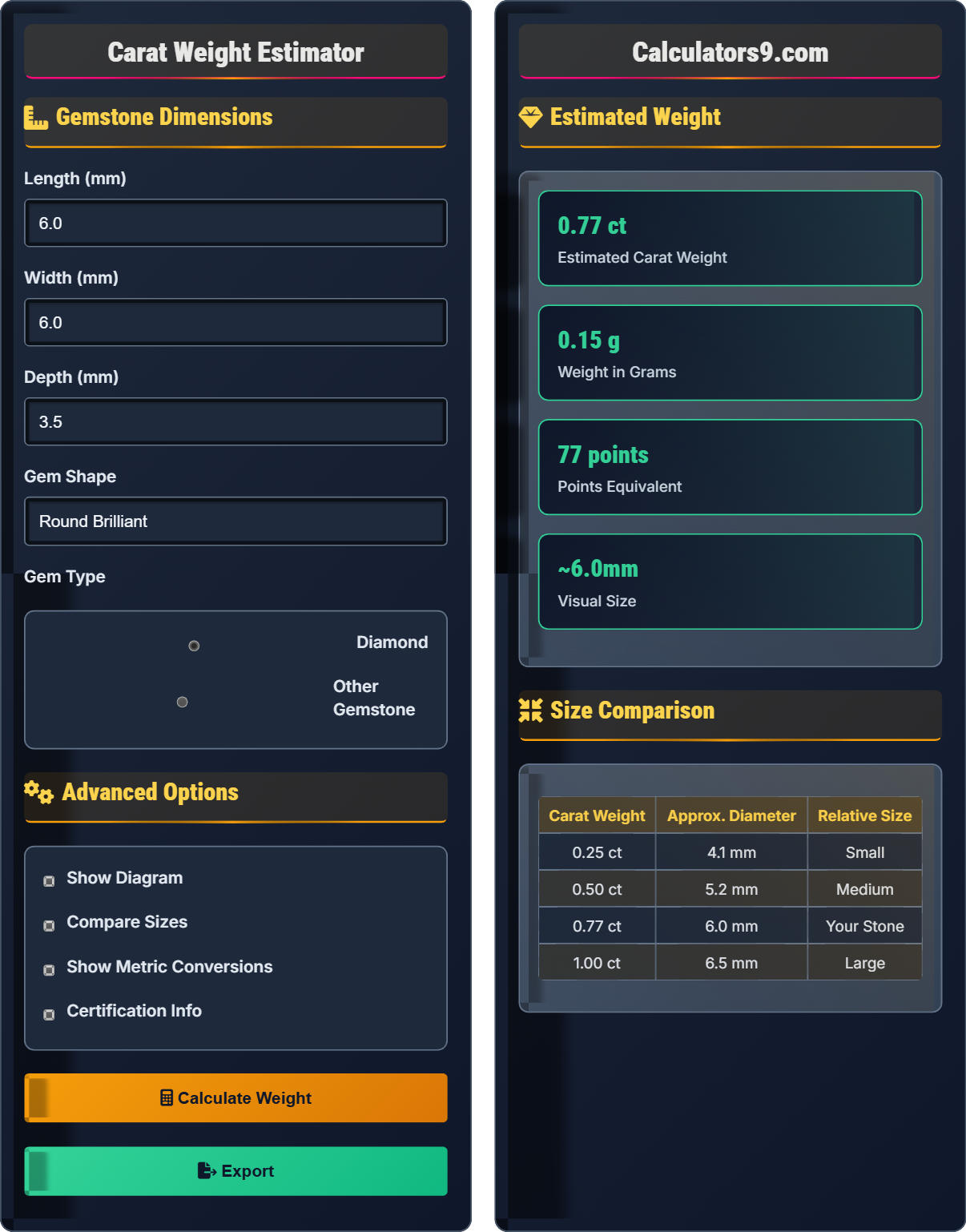
Example: For a round diamond measuring 6mm x 6mm x 3.5mm:
Carat Weight = 6 × 6 × 3.5 × 0.0061 = 0.77 carats
Thus, the estimated weight is approximately 0.77 carats.
Gemstone Dimensions
Advanced Options
Estimated Weight
Size Comparison
| Carat Weight | Approx. Diameter | Relative Size |
|---|---|---|
| 0.25 ct | 4.1 mm | Small |
| 0.50 ct | 5.2 mm | Medium |
| 0.77 ct | 6.0 mm | Your Stone |
| 1.00 ct | 6.5 mm | Large |
Carat Weight Fundamentals
Carat weight is the unit of measurement for the mass of diamonds and other gemstones. One carat equals exactly 200 milligrams (0.2 grams). The term originates from the carob seeds used historically for weighing precious stones.
Carat Weight = Length × Width × Depth × Shape Factor
Shape factors vary: Round (0.0061), Oval (0.0062), Princess (0.0083), Cushion (0.0060), Emerald (0.0080), Marquise (0.0058), Pear (0.0060), Heart (0.0059), Radiant (0.0085).
- One carat = 200 milligrams = 0.2 grams
- One carat = 100 points
- Weight distribution affects visual size
- Different gemstones have different densities
Diamond Sizing Guide
Two diamonds of equal carat weight can appear different in size depending on their cut proportions. A shallow cut diamond will appear larger face-up than a deep cut diamond of the same weight.
- 0.25 ct (4.1mm) - Accent stones
- 0.50 ct (5.2mm) - Starter diamonds
- 0.75 ct (5.8mm) - Popular engagement size
- 1.00 ct (6.5mm) - Classic size
- 1.50 ct (7.4mm) - Statement size
- Setting affects perceived size
- Cut quality impacts brilliance
- Proportions affect light performance
- Clarity grades impact value
Carat Weight Learning Quiz
How many milligrams are in one carat?
The answer is B) 200 mg. By definition, one carat equals exactly 200 milligrams. This standardized measurement system ensures consistency across the global jewelry industry.
Understanding carat measurements is fundamental to jewelry evaluation. The carat system was standardized in 1907 by the International Committee of Weights and Measures. Before this, various regions used different standards based on carob seeds, which had natural variations in weight.
Carat (ct): Unit of weight for gems, equal to 200mg
Point: Subunit of carat, 100 points = 1 carat
Milligram (mg): Metric unit of mass, 1000mg = 1 gram
• 1 carat = 200 milligrams = 0.2 grams
• 1 carat = 100 points
• Carat weight does not determine visual size alone
• Remember: 200mg per carat
• Use "200" to recall the conversion
• Points are used for sub-carat weights
• Confusing carat weight with size measurements
• Thinking 1 carat = 100mg (it's 200mg)
• Mixing up carat (weight) with karat (gold purity)
A round diamond measures 7mm in diameter and 4mm in depth. Estimate its carat weight using the standard formula. Show your work.
Using the formula: Carat Weight = Length × Width × Depth × Shape Factor
Given:
- Length = 7mm
- Width = 7mm (round stone)
- Depth = 4mm
- Shape Factor for Round = 0.0061
Calculation: 7 × 7 × 4 × 0.0061 = 196 × 0.0061 = 1.20 carats
The estimated weight is approximately 1.20 carats.
This calculation demonstrates how three-dimensional measurements combine to estimate weight. The shape factor accounts for the specific cutting pattern's volume efficiency. For round diamonds, the factor 0.0061 is derived from the average density of diamond and typical cutting proportions.
Shape Factor: Coefficient accounting for volume differences between cuts
Volume Calculation: Three-dimensional space occupied by the stone
Density: Mass per unit volume of the material
• Always measure length, width, and depth
• Use appropriate shape factor for cut type
• Results are estimations, not certified weights
• For round diamonds: assume length = width
• Double-check measurements for accuracy
• Forgetting to use correct shape factor
• Measuring incorrectly or using inaccurate tools
• Applying round formula to fancy shapes
Sarah is choosing between two diamonds: Diamond A weighs 0.75 carats and measures 5.8mm, while Diamond B weighs 0.75 carats but measures 6.0mm. Which diamond appears larger, and why might they have different sizes despite equal weight?
Diamond B (6.0mm) appears larger than Diamond A (5.8mm) despite having the same weight. This occurs because Diamond B has been cut with shallower proportions, spreading the weight across a wider surface area. Diamond A likely has deeper proportions, concentrating the weight in thickness rather than diameter.
This illustrates the critical difference between weight and visual size in diamonds. Cut proportions significantly impact appearance. A diamond with excellent cut proportions maximizes brilliance while maintaining good face-up size. Poor proportions can hide weight in the depth, making the stone appear smaller than its carat weight suggests.
Cut Proportions: Relationships between diamond dimensions
Depth Percentage: Depth relative to average diameterTable Percentage: Table width relative to average diameter
• Equal carat weight ≠ Equal visual size
• Cut proportions affect apparent size
• Depth percentage impacts brilliance
• Compare diameter measurements when weights are similar
• Look for ideal cut proportions
• Balance carat weight with cut quality
• Assuming higher carat weight always means larger appearance
• Ignoring cut quality in favor of size
• Not considering depth when evaluating size
Jennifer is comparing a 1-carat diamond (density 3.52 g/cm³) with a 1-carat emerald (density 2.76 g/cm³). Both have identical measurements. Which gemstone will appear larger, and why? Explain using density principles.
The emerald will appear larger than the diamond despite both weighing 1 carat. This occurs because emeralds have a lower density (2.76 g/cm³) than diamonds (3.52 g/cm³). For the same weight, the emerald occupies more volume, resulting in larger physical dimensions.
Density (mass/volume) varies significantly between gemstone materials. When comparing gems of equal carat weight, those with lower density will be physically larger. This is why a 1-carat ruby appears smaller than a 1-carat opal, even though both weigh exactly the same.
Density: Mass per unit volume (g/cm³)
Volume: Physical space occupied by the gem
Specific Gravity: Ratio of gem's density to water's density
• Different gems have different densities
• Equal carat weight ≠ Equal volume
• Density affects apparent size for given weight
• Research gemstone density when comparing sizes
• Lower density gems appear larger for same weight
• Use density to verify authenticity
• Assuming all 1-carat gems look the same size
• Not accounting for density differences
• Confusing weight with physical dimensions
Which of the following shapes typically has the highest shape factor, making it appear smaller for its carat weight?
The answer is B) Princess Cut. Princess cuts typically have the highest shape factor (around 0.0083), meaning they appear smaller face-up for their carat weight compared to other popular cuts. This is because princess cuts tend to have greater depth and less spread, concentrating the weight in the stone's body rather than its surface area.
Shape factors reflect how efficiently each cut spreads the diamond's weight across its visible surface. Round brilliants (0.0061) maximize face-up size, while princess cuts (0.0083) prioritize structural integrity and brilliance, often resulting in deeper proportions that hide some weight in the depth. This is why a 1-carat princess cut appears smaller than a 1-carat round brilliant.
Shape Factor: Volume coefficient for weight estimation
Face-Up Size: Visible surface area of mounted stone
Cutting Efficiency: How well weight is distributed
• Princess cuts have highest shape factor
• Round brilliants appear largest for given weight
• Shape factors account for cutting style differences
• Round brilliants maximize apparent size
• Princess cuts may need higher carat weight for desired look
• Consider shape factor when comparing stones
• Assuming all cuts of equal weight appear the same size
• Not considering shape factors when shopping
• Expecting princess cuts to match round appearance
FAQ
Q: How accurate is carat weight estimation from measurements?
A: Carat weight estimation from measurements is typically within ±5-10% of the actual weight for well-cut stones. The formula Carat Weight = Length × Width × Depth × Shape Factor provides a close approximation.
For example, if our calculator estimates 1.00 carat for a round diamond measuring 6.5mm × 6.5mm × 4.0mm (using 0.0061 shape factor):
6.5 × 6.5 × 4.0 × 0.0061 = 1.03 carats
Actual weight might range from 0.98 to 1.08 carats depending on exact proportions and cutting style. For certified purchases, always rely on precise scale measurements rather than estimations.
Q: Why do some diamonds of the same carat weight look different in size?
A: Diamonds of identical carat weight can appear different sizes due to their cut proportions. Two critical factors affect visual size:
- Depth Percentage: A diamond with 60% depth will appear smaller than one with 58% depth
- Table Percentage: Larger table diameters increase face-up size
For example, a 1-carat diamond with 65% depth will look smaller than a 1-carat diamond with 58% depth, even though both weigh exactly the same. The deeper diamond hides more weight in its profile, while the shallower one spreads weight across a wider surface area.