Engagement Rate Calculator
Social media analytics • 2026 content creator
Audience Metrics
Advanced Options
Engagement Analysis
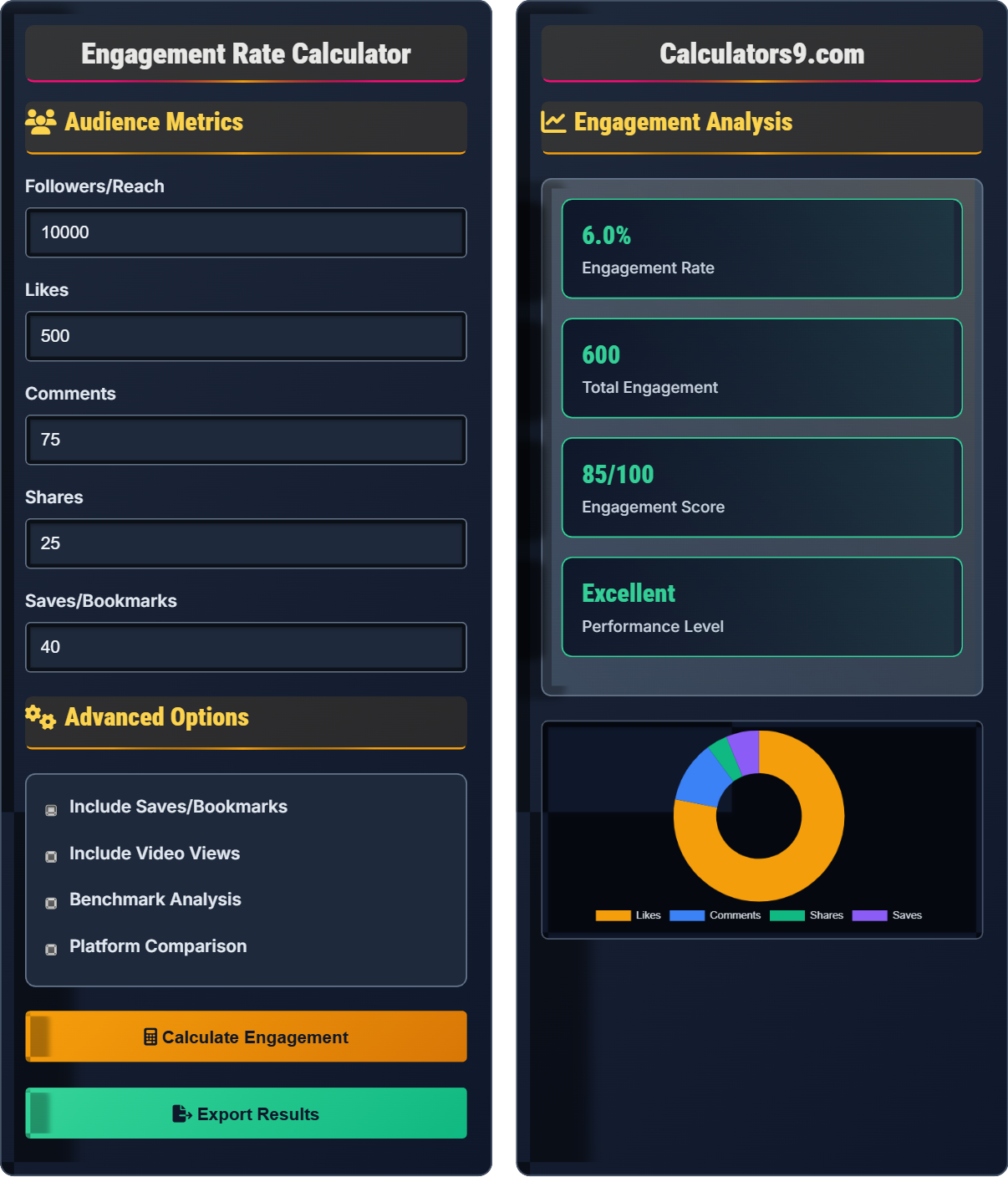
| Engagement Type | Count | Percentage |
|---|---|---|
| Likes | 500 | 78.1% |
| Comments | 75 | 11.7% |
| Shares | 25 | 3.9% |
| Saves | 40 | 6.3% |
| Analytics | Value | Benchmark |
|---|---|---|
| Engagement Rate | 6.4% | 3-6% |
| Comment Rate | 0.75% | 0.5-2% |
| Share Rate | 0.25% | 0.1-0.5% |
| Save Rate | 0.4% | 0.2-1% |
Comprehensive Engagement Optimization Guide
Engagement Rate measures how actively your audience interacts with your content. The basic formula is: (Total Engagements / Total Followers) × 100. Total engagements typically include likes, comments, shares, and saves. Engagement rate is a key metric for content creators and marketers as it indicates audience interest and content effectiveness.
The standard formula for engagement rate is:
Where Total Engagements = Likes + Comments + Shares + Saves. Some platforms include additional metrics like clicks, saves, or video completion rates in their engagement calculations.
Typical engagement rates by platform:
- Instagram: 1-3% (good), 3-6% (excellent)
- Facebook: 0.5-2% (good), 2-4% (excellent)
- Twitter/X: 0.5-1% (good), 1-3% (excellent)
- YouTube: 2-4% (good), 4-8% (excellent)
- TikTok: 3-6% (good), 6-10% (excellent)
- LinkedIn: 1-2% (good), 2-5% (excellent)
- Consistent Posting: Maintain regular content schedule
- Quality Content: Create valuable, entertaining, or educational content
- Community Interaction: Respond to comments and engage with followers
- Hashtag Strategy: Use relevant and trending hashtags
- Call-to-Action: Encourage specific engagement behaviors
Engagement Rate Learning Quiz
If a post receives 500 likes, 75 comments, 25 shares, and 40 saves from an audience of 10,000 followers, what is the engagement rate?
Using the formula: Engagement Rate = (Total Engagements / Total Followers) × 100
Given:
- Likes = 500
- Comments = 75
- Shares = 25
- Saves = 40
- Total Followers = 10,000
Total Engagements = 500 + 75 + 25 + 40 = 640
Engagement Rate = (640 / 10,000) × 100 = 6.4%
This problem demonstrates the fundamental engagement rate calculation. The formula sums all engagement types (likes, comments, shares, saves) and divides by the total follower count, then multiplies by 100 to get a percentage. The 6.4% rate is considered excellent performance, well above typical benchmarks. This calculation helps content creators understand how effectively their content resonates with their audience.
Engagement Rate: Percentage of audience that interacts with content
Engagement Types: Various ways audience can interact with content
Followers: Total audience size for the account
• Engagement Rate = (Total Engagements / Followers) × 100
• Sum all engagement types before dividing
• Higher rates indicate more effective content
• Remember: (likes + comments + shares + saves) ÷ followers × 100
• Comments and shares are typically more valuable than likes
• Compare to platform-specific benchmarks
• Forgetting to include all engagement types
• Not converting to percentage by multiplying by 100
• Using impressions instead of followers in denominator
A content creator has 50,000 followers and achieves an engagement rate of 4.2% across their posts. Calculate the average total engagement per post and evaluate if this is good performance.
Using the formula: Total Engagements = (Engagement Rate × Followers) / 100
Given:
- Engagement Rate = 4.2%
- Followers = 50,000
Calculation: (4.2 × 50,000) / 100 = 210,000 / 100 = 2,100
The creator averages 2,100 engagements per post. This is excellent performance, particularly for Instagram where 3-6% is considered excellent.
This example shows how to reverse the engagement rate calculation to find total engagements. A 4.2% rate on 50,000 followers means 2,100 people are interacting with each post. This level of engagement indicates high-quality content that resonates strongly with the audience. The performance is excellent compared to typical benchmarks.
Performance Benchmark: Standard for comparing engagement rates
Average Engagement: Typical engagement per piece of content
Content Resonance: How well content connects with audience
• Reverse formula: Engagements = (Rate × Followers) / 100
• 4-6% is excellent on most platforms
• Quality over quantity in engagement
• Use benchmarks specific to your platform
• Focus on engagement quality, not just quantity
• Track engagement rate trends over time
• Comparing to wrong platform benchmarks
• Focusing only on rate without considering absolute numbers
• Not accounting for follower growth over time
A creator starts with 1,000 followers and an engagement rate of 8%. As they grow to 50,000 followers, their engagement rate drops to 4%. Calculate the change in absolute engagement numbers and explain why this happens.
Initial engagement: (8 × 1,000) / 100 = 80 engagements
Final engagement: (4 × 50,000) / 100 = 2,000 engagements
Absolute increase: 2,000 - 80 = 1,920 more engagements
Even though the rate dropped from 8% to 4%, the absolute engagement increased by 1,920. This happens because as accounts grow, the audience becomes more diverse and includes less engaged followers, causing the percentage rate to drop even as total engagement increases.
This example demonstrates the relationship between follower count and engagement rate. As accounts grow, engagement rates typically decline due to audience dilution. New followers may not be as engaged as early followers. However, the absolute number of engagements often increases significantly. This shows why it's important to consider both engagement rate and absolute engagement numbers when evaluating performance.
Audience Dilution: Decrease in engagement rate as audience grows
Absolute Engagement: Total number of engagements regardless of rate
Engagement Decay: Natural decline in engagement rate over time
• Engagement rates typically decline with growth
• Absolute engagement often increases with growth
• Consider both rate and absolute numbers
• Track both engagement rate and absolute numbers
• Segment audience to maintain engagement
• Focus on quality content to combat decay
• Only focusing on engagement rate without absolute numbers
• Expecting engagement rate to stay constant during growth
• Not segmenting audience for targeted content
A brand has 100K followers on Instagram (4% engagement) and 500K followers on Facebook (1.5% engagement). Calculate which platform generates more absolute engagement and determine which is more efficient for content creation.
Instagram engagement: (4 × 100,000) / 100 = 4,000 engagements
Facebook engagement: (1.5 × 500,000) / 100 = 7,500 engagements
Facebook generates 7,500 vs 4,000 engagements, so it has higher absolute engagement. However, Instagram has a 4% rate vs 1.5%, making it 2.67x more efficient per follower. For content creation efficiency, Instagram is superior despite the smaller absolute number.
This example shows the importance of distinguishing between absolute engagement and engagement efficiency. While Facebook generates more total interactions, Instagram is significantly more efficient per follower. This demonstrates why engagement rate is crucial for content creators who want to maximize impact per unit of effort. The choice between platforms depends on whether you prioritize absolute reach or efficiency.
Engagement Efficiency: Engagement per follower
Absolute Reach: Total number of interactions
Platform Effectiveness: How well platform delivers results
• Distinguish between absolute and rate metrics
• Consider both reach and efficiency
• Different platforms serve different goals
• Calculate engagement per follower for efficiency
• Use absolute numbers for reach goals
• Consider time investment per platform
• Only looking at absolute numbers without efficiency
• Not considering time investment per platform
• Comparing different platforms without context
Which of the following strategies would most effectively increase engagement rate?
The answer is B) Create high-quality content that encourages interaction. This strategy directly increases the numerator (engagements) by creating content that naturally prompts likes, comments, shares, and saves. High-quality, valuable content resonates with the audience and motivates them to engage. Buying followers (A) artificially inflates the denominator and often decreases engagement rate. Random posting (C) and infrequent posting (D) typically hurt engagement by reducing audience anticipation and consistency.
This question highlights the importance of focusing on genuine engagement rather than artificial metrics. The engagement rate formula shows that increasing the numerator (engagements) while maintaining or growing the denominator (followers) is the most effective approach. High-quality content creates organic engagement, which is more valuable than purchased or incentivized engagement. Authentic engagement leads to stronger audience relationships and better long-term results.
Organic Engagement: Natural interactions without incentives
Authentic Engagement: Genuine audience interest
Engagement Quality: Value of interactions beyond quantity
• Focus on genuine audience connections
• Quality content drives authentic engagement
• Avoid artificial engagement tactics
• Create content that solves problems or entertains
• Ask questions to encourage comments
• Use calls-to-action appropriately
• Focusing on vanity metrics over meaningful engagement
• Not understanding the difference between reach and engagement
• Using engagement pods or artificial methods
Engagement Fundamentals
Percentage of audience that interacts with your content. Formula: (Engagements / Followers) × 100.
Engagements = Likes + Comments + Shares + Saves. Benchmark: 3-6% for most platforms.
- Quality content drives authentic engagement
- Engagement rate typically decreases with growth
- Consider both rate and absolute numbers
Strategies
Create valuable, relevant content that encourages interaction.
- Post consistently with quality content
- Respond to comments and engage with audience
- Use relevant hashtags and tags
- Include clear calls-to-action
- Platform-specific best practices
- Audience preferences and behavior
- Timing and frequency of posts
- Content format and presentation
FAQ
Q: What's a good engagement rate for 2026?
A: 3-6% is good, 6-10% is excellent. Instagram: 1-3% baseline. TikTok: 3-6% baseline. YouTube: 2-4% baseline. Quality over quantity always.
Q: Should I focus on engagement rate or absolute numbers?
A: Both matter. Rate shows efficiency, absolute numbers show reach. For growth phase: focus on absolute. For mature accounts: focus on rate. Always consider both for balanced perspective.