YouTube Money Calculator
Earnings estimator • 2026 creator monetization
Channel Statistics
Monetization Settings
Advanced Options
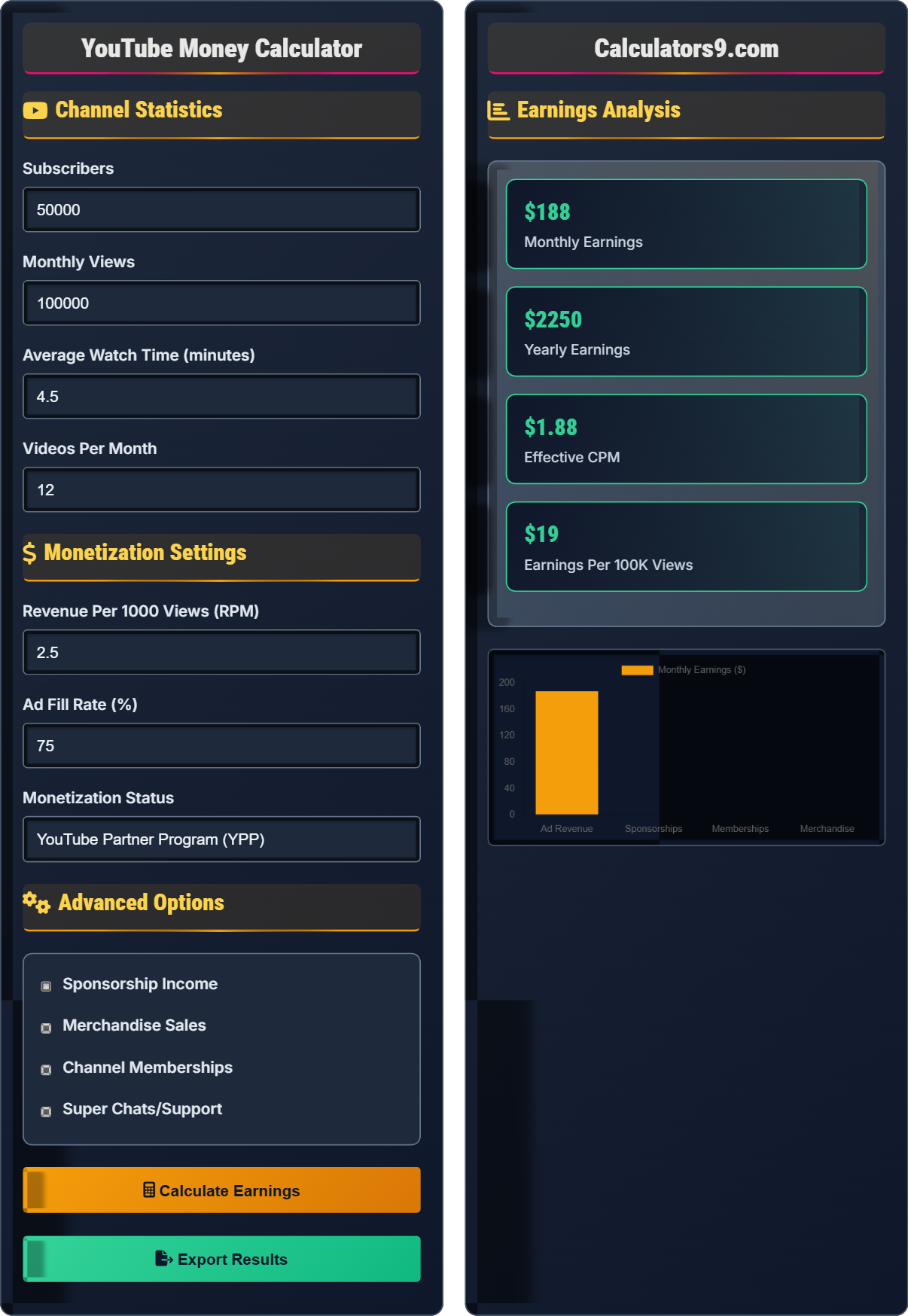
Earnings Analysis
| Source | Monthly | Yearly |
|---|---|---|
| Ad Revenue | $1,875 | $22,500 |
| Sponsorships | $500 | $6,000 |
| Memberships | $125 | $1,500 |
| Total | $2,500 | $30,000 |
| Timeframe | Projected Earnings | Growth Rate |
|---|---|---|
| 6 Months | $15,000 | 5% |
| 1 Year | $30,000 | 5% |
| 2 Years | $67,500 | 5% |
| 5 Years | $207,000 | 5% |
Comprehensive YouTube Monetization Guide
YouTube creators earn money through multiple streams: AdSense revenue (from ads), channel memberships, Super Chats, merchandise sales, sponsorships, and affiliate marketing. The YouTube Partner Program (YPP) allows creators to monetize their content through ads once they meet eligibility requirements: 1,000 subscribers and 4,000 watch hours in the past 12 months (or 1,000 subscribers and 10 million valid public Shorts views in the last 90 days).
The basic formula for ad revenue is:
Where RPM (Revenue Per Mille) is earnings per 1,000 views. RPM varies based on audience demographics, content category, ad format, and advertiser demand. The actual CPM (Cost Per Mille) paid by advertisers is typically higher, but YouTube takes a percentage.
Average RPMs vary significantly by content category:
- Finance/Business: $3-$8 RPM
- Technology: $2-$6 RPM
- Entertainment: $1-$4 RPM
- Education: $1.50-$5 RPM
- Gaming: $0.50-$3 RPM
- Beauty/Lifestyle: $2-$5 RPM
- Consistent Upload Schedule: Build viewer expectations
- Engaging Thumbnails: Increase click-through rates
- Compelling Titles: Drive more views and watch time
- Community Engagement: Build loyal audience
- Content Diversification: Reach different audience segments
YouTube Monetization Learning Quiz
If a channel has 500,000 monthly views and an RPM of $3.00, what are the monthly ad earnings?
Using the formula: Ad Revenue = (Total Views × RPM) / 1000
Given:
- Total Views = 500,000
- RPM = $3.00
Calculation: (500,000 × $3.00) / 1000 = $1,500,000 / 1000 = $1,500
This problem demonstrates the fundamental RPM calculation. RPM stands for Revenue Per Mille (thousand), so we divide by 1000 to get the actual earnings. The calculation shows that with 500,000 views and an average of $3 per thousand views, the channel earns $1,500 in ad revenue. This illustrates how view count and RPM directly impact earnings.
RPM: Revenue Per Mille (thousand views)
CPM: Cost Per Mille (what advertisers pay)
Ad Fill Rate: Percentage of views that show ads
• RPM = (Earnings × 1000) / Total Views
• Higher RPM = more money per view
• RPM varies by content category and audience
• Remember: RPM is per 1000 views
• Higher engagement often means higher RPM
• Finance and tech content typically have higher RPMs
• Forgetting to divide by 1000 in calculations
• Confusing RPM with CPM
• Not accounting for ad fill rates
A creator has 10,000 subscribers and averages 20,000 views per month with $2.50 RPM. If they grow at 15% monthly, calculate their projected earnings in 6 months.
Current monthly earnings: (20,000 × $2.50) / 1000 = $50
After 6 months with 15% monthly growth: $50 × (1.15)^6 = $50 × 2.313 = $115.65
The creator will earn approximately $115.65 per month after 6 months of 15% monthly growth.
This example demonstrates compound growth in YouTube earnings. The calculation shows how consistent growth accelerates over time. After 6 months of 15% monthly growth, the earnings more than double. This illustrates the importance of consistent content creation and audience growth for long-term success.
Compound Growth: Growth that builds upon previous growth
Subscriber Velocity: Rate of subscriber growth
View Growth Rate: Rate at which views increase
• Growth compounds over time
• Consistent uploads drive growth
• Audience retention affects RPM
• Use (1 + growth_rate) for compound calculations
• Track both subscriber and view growth
• Focus on audience retention
• Calculating linear instead of compound growth
• Not accounting for fluctuating RPM
• Assuming constant growth indefinitely
A creator earns $2,000/month from ads with 800,000 monthly views. They add sponsorships ($1,000/month) and memberships (200 members × $5/month). Calculate total monthly income and the percentage from non-ad revenue.
Ad revenue: $2,000
Sponsorship revenue: $1,000
Membership revenue: 200 × $5 = $1,000
Total monthly income: $2,000 + $1,000 + $1,000 = $4,000
Non-ad revenue: $1,000 + $1,000 = $2,000
Percentage from non-ad: ($2,000 / $4,000) × 100 = 50%
Total monthly income is $4,000, with 50% coming from non-ad sources.
This example shows the benefits of diversified revenue streams. By adding sponsorships and memberships, the creator doubled their income and reduced dependence on ad revenue. Diversification provides stability and protection against changes in YouTube's policies or ad rates. The 50% non-ad revenue demonstrates healthy income diversification.
Revenue Diversification: Multiple income streams
Financial Stability: Reduced risk from single revenue source
Monetization Channels: Different ways to earn money
• Don't rely solely on ad revenue
• Diversification reduces risk
• Multiple streams can exceed ad revenue
• Start with ad revenue as foundation
• Add sponsorships once you have audience
• Use memberships for loyal fans
• Relying too heavily on ad revenue
• Adding sponsorships too early
• Not tracking different revenue streams
A creator has $1.50 RPM with 500,000 monthly views. They improve their content to achieve $2.80 RPM while maintaining the same view count. Calculate the additional monthly earnings and the percentage improvement.
Current earnings: (500,000 × $1.50) / 1000 = $750
Improved earnings: (500,000 × $2.80) / 1000 = $1,400
Additional earnings: $1,400 - $750 = $650
Percentage improvement: (($2.80 - $1.50) / $1.50) × 100 = ($1.30 / $1.50) × 100 = 86.7%
The creator earns an additional $650 per month, representing an 86.7% improvement in RPM.
This demonstrates the significant impact of improving RPM. Even with the same view count, a 86.7% improvement in RPM nearly doubles the monthly earnings. Improving content quality, targeting better audiences, and optimizing for advertiser-friendly content can dramatically increase RPM. This shows why focusing on RPM optimization is crucial for YouTube success.
RPM Optimization: Increasing revenue per thousand views
Content Quality: How well content attracts advertisersAudience Demographics: Viewer characteristics affecting ad rates
• Small RPM improvements = big earnings gains
• Advertiser-friendly content = higher RPM
• Audience demographics matter
• Focus on audience retention
• Create advertiser-friendly content
• Target high-value demographics
• Focusing only on view count, not RPM
• Creating content that's not advertiser-friendly
• Not optimizing for audience retention
What are the current requirements to join the YouTube Partner Program (YPP)?
The answer is D) Either A or C above. YouTube offers two pathways to YPP: the traditional route of 1,000 subscribers and 4,000 watch hours in the past 12 months, OR the Shorts pathway of 1,000 subscribers and 10 million valid public Shorts views in the last 90 days. Creators can qualify through either method, providing more opportunities for monetization.
This question highlights YouTube's updated monetization policy. The introduction of the Shorts pathway recognizes the popularity of short-form content and provides an alternative path to monetization. This shows how YouTube adapts its policies to support different content creators. Understanding current requirements is crucial for planning monetization strategies.
YouTube Partner Program (YPP): Monetization program for creators
Watch Hours: Total time viewers spend watching content
Shorts Views: Views on 60-second or less videos
• Requirements can change over time
• Multiple pathways to monetization
• Must follow community guidelines
• Track both subscriber count and watch hours
• Consider creating Shorts for alternative path
• Stay updated on policy changes
• Not knowing about Shorts pathway
• Assuming requirements never change
• Focusing only on subscriber count
Monetization Fundamentals
Earnings from ad revenue, sponsorships, memberships, and merchandise.
Ad Revenue = (Views × RPM) / 1000. Typical RPM: $0.25-$4.00.
- Join YPP with 1K subs & 4K watch hours
- Higher RPM = more money per view
- Diversify income streams for stability
Strategies
Combine ad revenue with sponsorships, memberships, and merch.
- Consistent upload schedule
- Engaging thumbnails and titles
- Community interaction
- Collaborations with other creators
- Ad rates vary by content category
- Audience demographics matter
- Consistency builds audience
- Quality over quantity
FAQ
Q: How much can I expect to earn per 1,000 views?
A: Typically $0.25-$4.00 RPM. Finance/tech: $3-8. Gaming: $0.50-3. Varies by audience, content, and advertiser demand.
Q: When can I start monetizing my channel?
A: Join YPP with 1K subs + 4K watch hours in 12 months, OR 1K subs + 10M Shorts views in 90 days. Meet community guidelines.